12–18 October 2026
What moved in longevity science this week, what it changes for what you take, move, eat and measure, and what is being sold far ahead of its evidence. Global signal, India lens.
This week in 30 seconds
| Not yet | A US service now sets GLP-1 plans by a blood aging score, retested every three months. If a clinic ties your GLP-1 plan to a quarterly aging score, ask what it would do differently at a lower number, and what shows that helps. Nothing in the evidence says the prescribing decision needs the score.Measure |
| No | A belly-fat extract missed its target, and the collagen case still isn't made. Save your money on both, and keep the test you now have: with the next claim, check whether the number quoted is the one the trial set out to measure.Eat |
| Not yet | Steroid users' hearts were still underperforming after they stopped. Nothing here shows that checking a former user's heart function changes anything, so tell a doctor you have used these drugs rather than waiting for symptoms.Take |
| Not yet | A new blood-cell ratio was linked to immune aging and health trajectories, in 2,609 people. This is a pattern worth knowing about, not yet a test you can ask for or a number you can act on.Measure |
| No | Wildfire and traffic pollution components were linked to millions of new dementia diagnoses in Medicare data. This is about air you breathe involuntarily. The response belongs to regulators, not to anything you can individually buy or do.Measure |
| Not yet | Training frequency mattered less than weekly volume for muscle growth, across 16 pooled trials. If you already train, hitting your weekly volume looks more important than how you split it across the week -- but this was not tested in older adults specifically.Move |
Changes what you do: 0 yes · 4 not yet · 2 no
What this issue rests on · 15 sources
| ON THE LADDER |
| Lab and animals · 2 |
| People, watched · 3 |
| People, tested on a stand-in · 5 |
| BESIDE IT |
| Measurement and methods · 1 |
| Reviews · 3 |
| Not a study · 1 |
◆◆◆◇◇ Every study sits on a five-step ladder, from lab to a person’s actual outcome. How to read it
Take Review
Steroid users' hearts were still underperforming after they stopped
Does this change what you should do?
Not yetNothing here shows that checking a former user's heart function changes anything, so tell a doctor you have used these drugs rather than waiting for symptoms.
| Who | People using anabolic-androgenic steroids outside medical care, compared with non-users |
|---|---|
| How many | Not stated |
| How long | Not reported |
| Design | Systematic review and meta-analysis of comparative cohort studies: users watched, not randomised |
| Measured | All-cause mortality, OUTCOME; heart pumping measures, STAND-IN |
Anabolic steroids get discussed in gyms in terms of what they do while you are on them. What happens after you stop is the part users hear least about.
A pooled analysis of cohort studies comparing non-medical users with non-users found excess deaths from all causes, and weaker heart pumping in people who had already quit. Nobody was randomised, so training habits, other drugs taken alongside, and who starts using at all are tangled into the numbers.
That tangle could inflate a mortality figure. It could equally produce the weaker heart pumping seen in former users: nobody measured their hearts before they started. 6
HARMSReported: the affected readings are global longitudinal strain and ejection fraction, two measures of how well the heart squeezes, and the review formally assessed its own risk of bias.
WHAT WOULD MOVE THISProspective follow-up after people stop, with imaging and events, showing heart function returning to normal.
6 Medical Sciences · systematic review and meta-analysis of comparative cohort studies
Move Review
Training frequency mattered less than weekly volume for muscle growth, across 16 pooled trials
Does this change what you should do?
Not yetIf you already train, hitting your weekly volume looks more important than how you split it across the week -- but this was not tested in older adults specifically.
| Who | 380 participants across 16 trials |
|---|---|
| How many | 380 |
| How long | Varies by trial, pooled across 16 studies |
| Design | Systematic review and meta-analysis of volume-equated resistance-training trials |
| Measured | Muscle size (hypertrophy), STAND-IN |
| 16trials pooled | 380participants | 1 to 3sessions per muscle per week |
◆ Biomarkers are not outcomesMuscle size stands in for the strength and function outcomes a reader likely actually cares about.
A systematic review pooled 16 trials, 380 participants total, that held weekly training volume constant while varying how many times a week each muscle was trained, from once to three times. Once volume was equated, splitting it across more sessions had little independent effect on how much muscle grew, with GRADE-rated certainty behind the comparison.
Participants were not specifically older adults, so this should not be read as guidance for preserving muscle against age-related loss specifically -- it says something about hypertrophy training in general, not about sarcopenia prevention. The outcome measured was muscle size, not strength or physical function. 9
HARMSResistance-training harms are not reported in this meta-analysis; it compares outcomes between training schedules, not training against no training.
WHAT WOULD MOVE THISThe same comparison repeated in older adults specifically, measuring strength or function rather than muscle size.
9 systematic review and meta-analysis of volume-equated resistance-training trials, muscle size (surrogate) outcome · n = 380
Eat Review
A belly-fat extract missed its target, and the collagen case still isn't made
Does this change what you should do?
NoSave your money on both, and keep the test you now have: with the next claim, check whether the number quoted is the one the trial set out to measure.
| Who | People taking tamarind seed husk extract; separately, trials of oral collagen |
|---|---|
| How many | 112 in the tamarind trial; not stated for the collagen review |
| How long | 12 weeks |
| Design | Randomised, double-blind, placebo-controlled trial, plus a narrative review of RCTs, systematic reviews and meta-analyses |
| Measured | Visceral fat area, STAND-IN; skin, body-composition and joint claims, STAND-IN |
| p=0.077primary endpoint at week 12 |
◆ Funding is not validationThe collagen review names industry funding as one reason the positive results in that literature are hard to trust.
If you have been eyeing collagen powder for skin and joints, or a herbal capsule for belly fat, two reports this week are worth a minute.
A review of the randomised trials and meta-analyses on oral collagen found the evidence insufficient for its skin, body-composition and joint claims. It named industry funding among the reasons positive results there are hard to read. A trial of tamarind seed husk extract in 112 people missed its main target, visceral fat at twelve weeks, after earlier timepoints had looked significant.
When a product leads with a secondary result, the thing it set out to test usually did not come in. Visceral fat is a stand-in anyway: even a hit would not have told you about illness or lifespan. 4,5
HARMSNot measured: neither the collagen review nor the tamarind trial carries adverse-event data.
WHAT WOULD MOVE THISA pre-registered trial hitting the primary endpoint it declared, published whether or not it worked.
4 International Journal of Disease Reversal and Prevention · narrative review of RCTs, systematic reviews, and meta-analyses · 5 Journal of Food Bioactives · randomised, double-blind, placebo-controlled trial (UMIN000057223) · n = 112
Measure Not a study
A US service now sets GLP-1 plans by a blood aging score, retested every three months
Does this change what you should do?
Not yetIf a clinic ties your GLP-1 plan to a quarterly aging score, ask what it would do differently at a lower number, and what shows that helps. Nothing in the evidence says the prescribing decision needs the score.
| Who | Adults in genetic datasets; separately, buyers of a US telehealth aging score |
|---|---|
| How many | Not stated |
| How long | Not applicable to a genetic analysis |
| Design | Two-sample Mendelian randomisation with pleiotropy dissection and replication: inherited genetic differences used as a natural experiment. Separately, retrospective validation of an imaging-derived biological age estimator against observational mortality outcomes |
| Measured | Fibrotic lung disease risk against six ageing measures, OUTCOME |
| 6ageing measures tested |
◆ Biomarkers are not outcomesThe aging score stands in for health itself, and no study here shows that moving it changes how long or how well anyone lives.
If a clinic wants to run your treatment off a biological age score, settle one thing first: what would the number change? One US telehealth service now sets GLP-1 plans against a blood-based aging score, and retests every three months.
These scores are not empty. A biological age estimate read off CT scans was tested against mortality records and did carry information about who died. But this week's causal test found that scores built from chemical marks on DNA and from blood proteins did not raise the risk of fibrotic lung disease, while short telomeres did.
Predicting death across a group is a different claim from being a dial worth turning in one person. 1–3
HARMSNot measured: no study here reports outcomes, good or bad, for anyone whose care was steered by an aging score.
WHAT WOULD MOVE THISA trial randomising people to care guided by an aging score against usual care, reporting illness, independence or death.
1 Longevity.Technology · Not a study · 2 two-sample Mendelian randomisation with pleiotropy dissection and replication · 3 Scientific Reports · retrospective validation of an imaging-derived biological age estimator against observational mortality outcomes
Measure◆◆◆◇◇ People, watched
A new blood-cell ratio was linked to immune aging and health trajectories, in 2,609 people
Does this change what you should do?
Not yetThis is a pattern worth knowing about, not yet a test you can ask for or a number you can act on.
| Who | 2,609 people aged 18 to 98, across 8 international cohorts |
|---|---|
| How many | 2,609 |
| How long | Cross-sectional: one point in time per person |
| Design | Observational cohort: single-cell sequencing of over 12 million white blood cells; watched, not tested |
| Measured | Ratio of two T-cell subtypes (GZMK+ to GZMB+), STAND-IN |
| 2,609people profiled | over 12 millionwhite blood cells analysed |
◆ Biomarkers are not outcomesThe ratio being associated with health trajectories does not mean shifting it would change them.
A single-cell analysis of blood from 2,609 people, ages 18 to 98, across eight international cohorts, measured the balance between two subtypes of a common immune cell. One subtype (marked GZMK+) rose with age in people who stayed healthier; the other (GZMB+) rose more in people with worse health trajectories. The ratio between them tracked better with health outcomes than age alone.
This record is Eric Topol's newsletter describing the peer-reviewed paper, not the paper itself. Nobody was assigned to anything here. The cohorts were watched, and the cell ratio was measured alongside whatever health outcomes people already had or went on to have. 7
HARMSA blood draw carries its own ordinary risk. No harms specific to this analysis are reported, because nothing was administered.
WHAT WOULD MOVE THISA clinical test built on this ratio, validated against a real outcome like illness or survival in a separate cohort, not just correlated with health status in the same one.
7 observational cohort, single-cell RNA-seq across 8 international cohorts · n = 2,609
Measure◆◆◆◇◇ People, watched
Wildfire and traffic pollution components were linked to millions of new dementia diagnoses in Medicare data
Does this change what you should do?
NoThis is about air you breathe involuntarily. The response belongs to regulators, not to anything you can individually buy or do.
| Who | Medicare fee-for-service beneficiaries, 2005 to 2019 |
|---|---|
| How many | nearly 40 million |
| How long | 14 years |
| Design | Observational cohort: national claims data linked to modelled air-pollution exposure; watched, not tested |
| Measured | New Alzheimer's and dementia diagnoses, OUTCOME |
| nearly 40 millionbeneficiaries tracked | 3.5 millionnew Alzheimer's cases | 8.4 millionnew dementia cases |
Researchers linked claims records from nearly 40 million Medicare beneficiaries to detailed estimates of the PM2.5 pollution components they breathed, from wildfire smoke and other combustion sources, over 14 years. The analysis found 3.5 million new Alzheimer's diagnoses and 8.4 million new dementia diagnoses in that population. It then asked which specific pollution components carried the strongest association.
This is observational: nobody's exposure was assigned or controlled, so the finding is an association across a huge population, not proof that any one component causes dementia. A companion analysis found a similar pattern for mortality. The transferable part is which chemical components matter, not wildfire specifically. India's own exposure comes mostly from different combustion sources, including crop burning, so the component-level finding may travel even where the wildfire source does not. 8
HARMSThe study measures an existing, involuntary exposure's association with disease; it is not evaluating a product or therapy with its own side effects.
WHAT WOULD MOVE THISA natural experiment, such as a region-level pollution-reduction policy, tested directly against dementia incidence.
8 medRxiv · observational cohort, national Medicare claims linked to environmental exposure data · n = 39,678,630
What didn't move
NAD+ supplements. A ten-person crossover compared liposomal with conventional oral dosing; in worms, an NMN-producing probiotic matched purified NMN on most measures. Absorption and worms, no human function, disease or survival. 10,11
Longeveron's Alzheimer's cell therapy. A post-hoc reanalysis of brain-inflammation markers from the completed 49-participant trial, posted as a preprint during an investor tour. A hypothesis for the next trial, not evidence of benefit. 12
Statins and muscle. In liver-cell cultures, lovastatin and atorvastatin cut IGF-1 release, proposed as the route to statin-linked muscle loss. Cells, not people, and no reason to stop a prescribed statin. 13
Exercise proteomics. Two papers mapped thousands of coordinated protein changes in blood, saliva and urine after a single bout of exercise. Detailed biology, and still nothing that reproduces exercise. 14,15
The thread this week
All three items turn on the same gap: a number that predicts something, and a number worth acting on.
Sources
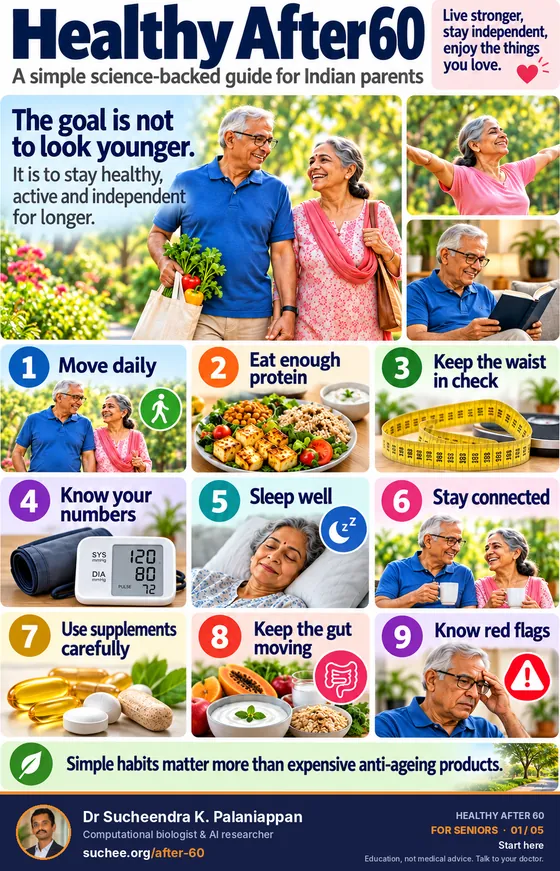
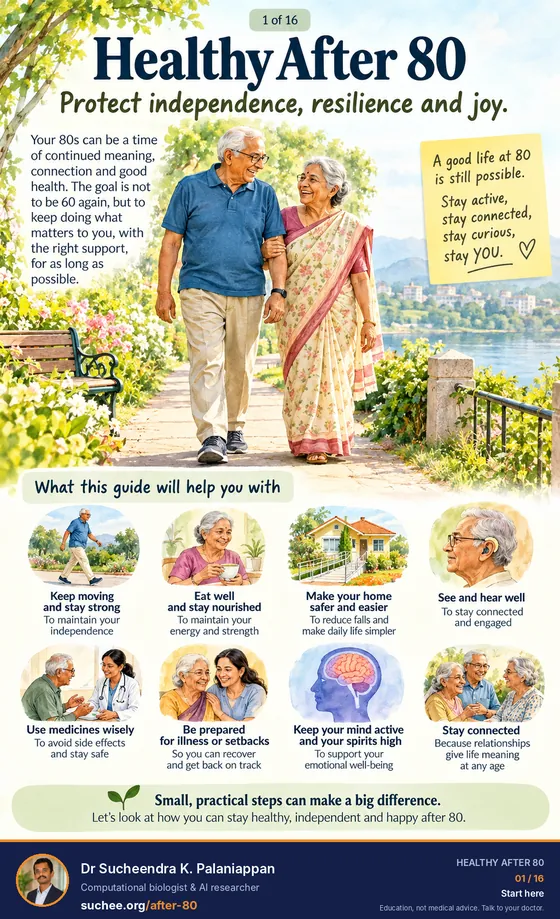
Most longevity news is early. These plain guides cover what is already proven, stage by stage, with Indian sources first.




Scientist working at the intersection of computation, biology and medicine. Longevity, Interpreted. exists to understand the evidence, not sell an intervention.
All issues · Subscribe · Health by age · suchee.org · LinkedIn · Scholar