Health by age · 80 and over
Healthy after 80 protect independence and act early
After 80 the question shifts from what your tests show to what you can still do: walk, dress, eat, manage the day and see the people who matter.
The guides cover what protects that: using your legs, preventing falls, spotting frailty, weight loss and sudden confusion early, pruning medicines, eating and drinking safely, seeing and hearing well, a home that helps, and a circle of care set up before it is needed.
Sixteen one-page guides, written for elders and the families who look after them, each with a source for every number.
Sources are listed below: Indian ones where they exist (the India Ageing Report, the national blindness survey, 112, Elderline and the Supreme Court on living wills), WHO and international guidelines for the rest, labelled as such.
 Sucheendra Kumar PalaniappanComputational biologist
Read them in order
Tap a guide to open it full screen, then swipe through all sixteen. Each one has a text version and its sources.
-
 01 / 16
Start here
Eight things that protect independence after 80, on one page.
Read as text
- The goal is not to be 60 again, but to keep doing what matters to you, with the right support, for as long as possible.
- The number of Indians over 80 is expected to nearly quadruple by 2050, so this stage of life is becoming common. India's oldest old
- Keep moving and keep your legs strong. How much to move after 65
- Eat enough, with protein at every meal, and drink enough unless your doctor has told you to limit fluids. Protein · How much to drink
- Make the home safer, and have your eyes and ears checked. A safer home · Sight in India
- Go through your medicines with your doctor at least once a year. Medicines to review after 65
- Act early on change: a fall, weight loss, slowing down or sudden confusion. What frailty means · Delirium
- Stay close to the people and things you enjoy. Staying connected
-
 02 / 16
What matters most now
At 80, what you can do matters as much as what your tests show.
Read as text
- Healthy ageing after 80 is about protecting what you can do: walking, dressing and bathing, eating, and managing money, medicines and the home. What WHO checks after 60
- Numbers still matter. Ask your doctor which blood pressure and sugar targets make sense for you now, and do not stop a medicine on your own.
- Walk around on your own, with a stick or walker if it helps.
- Keep up what keeps life full: people, interests and the things you enjoy. Staying connected
- Asking for help early is part of staying independent, not the end of it.
-
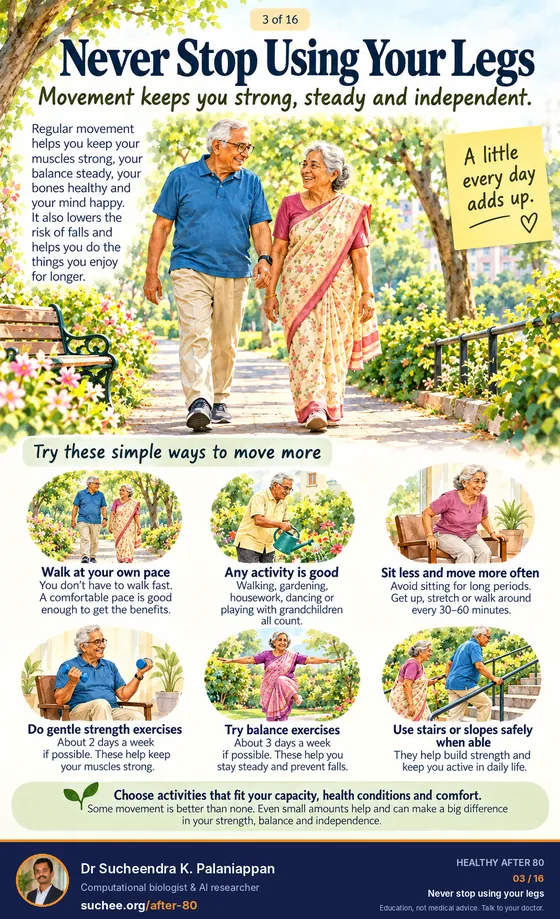 03 / 16
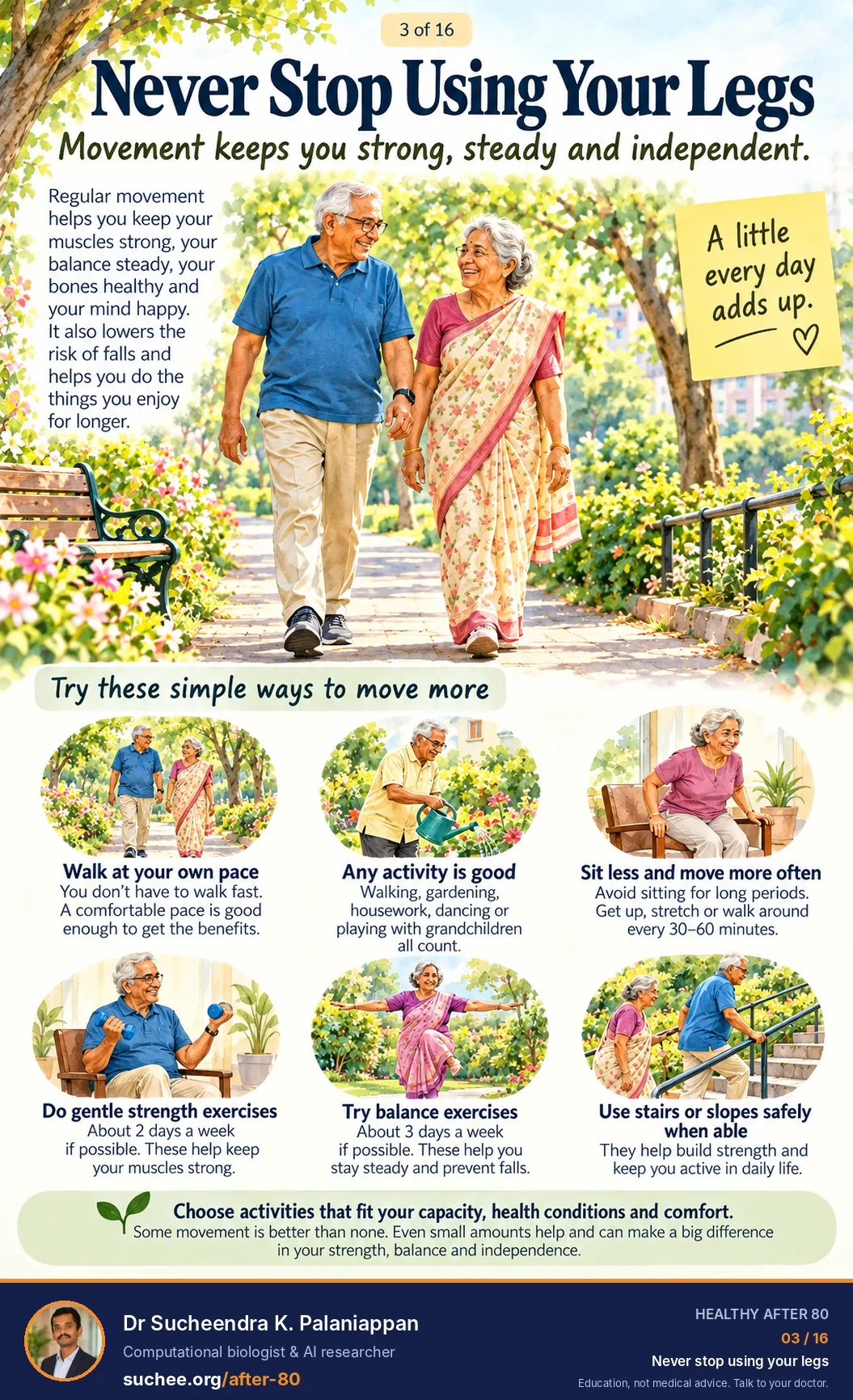
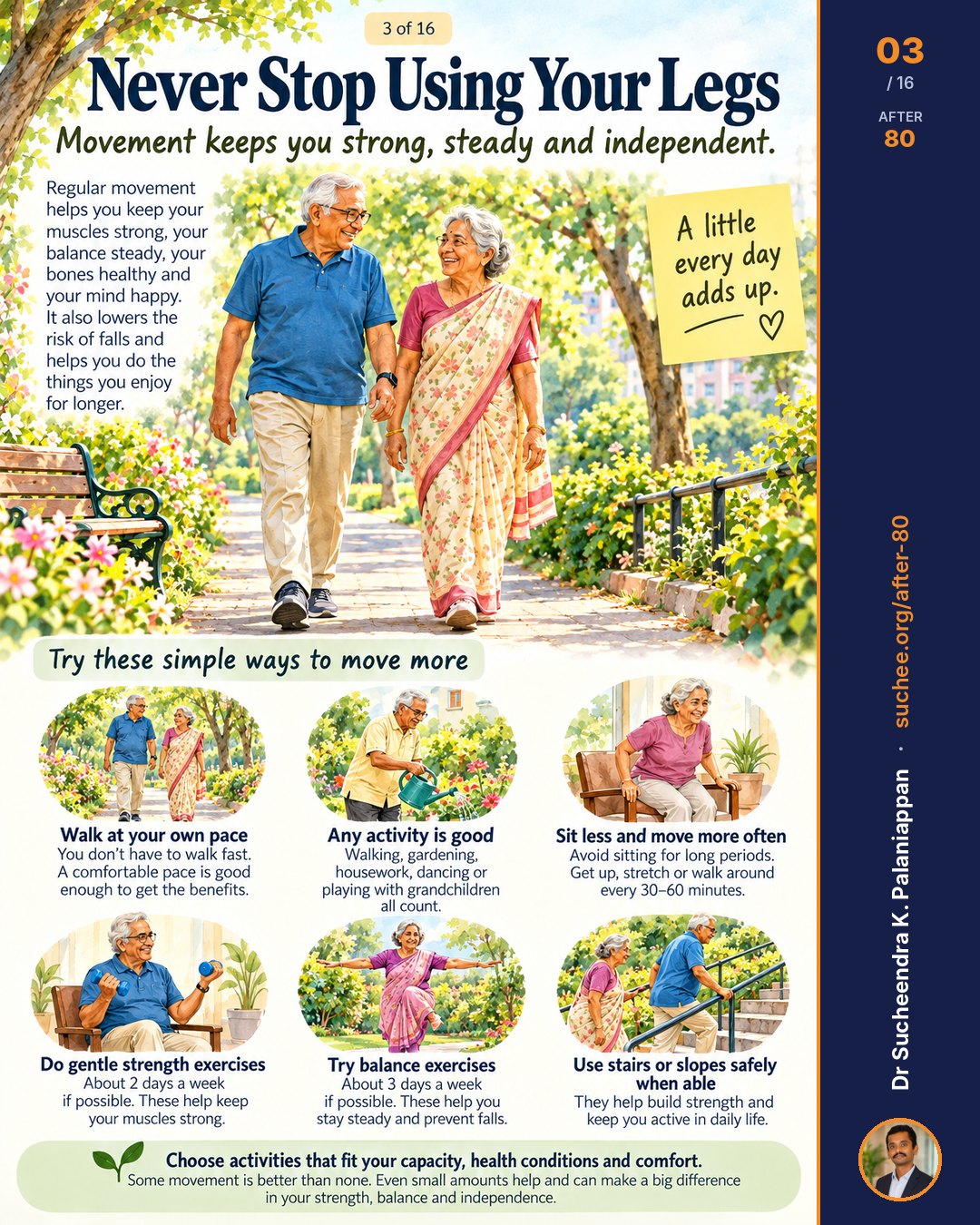
Never stop using your legs
Movement keeps you strong, steady and independent.
Read as text
- Walk at your own pace. Walking, gardening, housework and playing with grandchildren all count, and some activity is better than none. How much to move after 65
- Strength exercises on 2 or more days a week, such as standing up from a chair or light weights. How much to move after 65
- Balance exercises on 3 or more days a week, always holding a chair or counter, with someone nearby when you start. How much to move after 65
- Exercise that trains balance lowers the rate of falls by about a quarter. Exercise and falls
- Break up long sitting. Stand up slowly, then walk around.
- On stairs and slopes, hold the handrail.
- If you have fallen, had surgery, or have heart, joint or dizziness problems, ask your doctor or physiotherapist which exercises suit you. Stop and rest if you feel chest pain, breathlessness or dizziness.
-
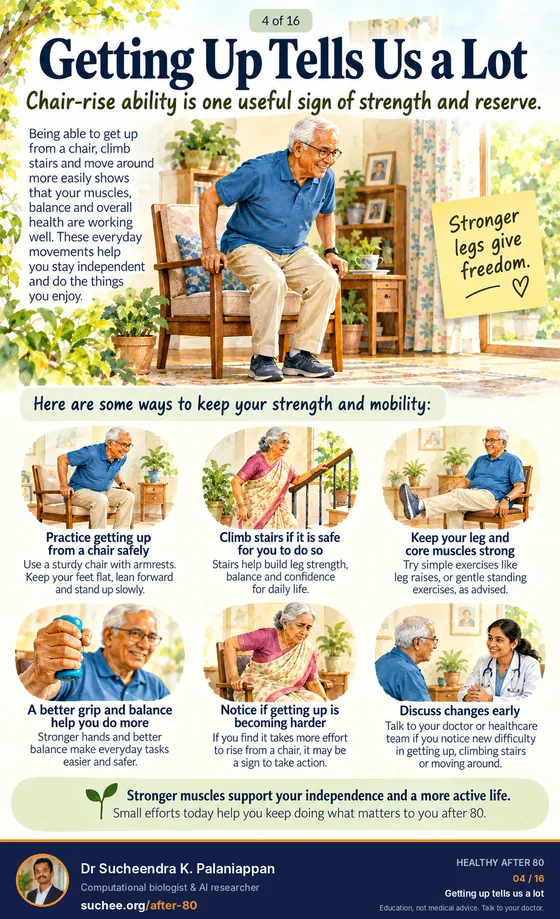 04 / 16
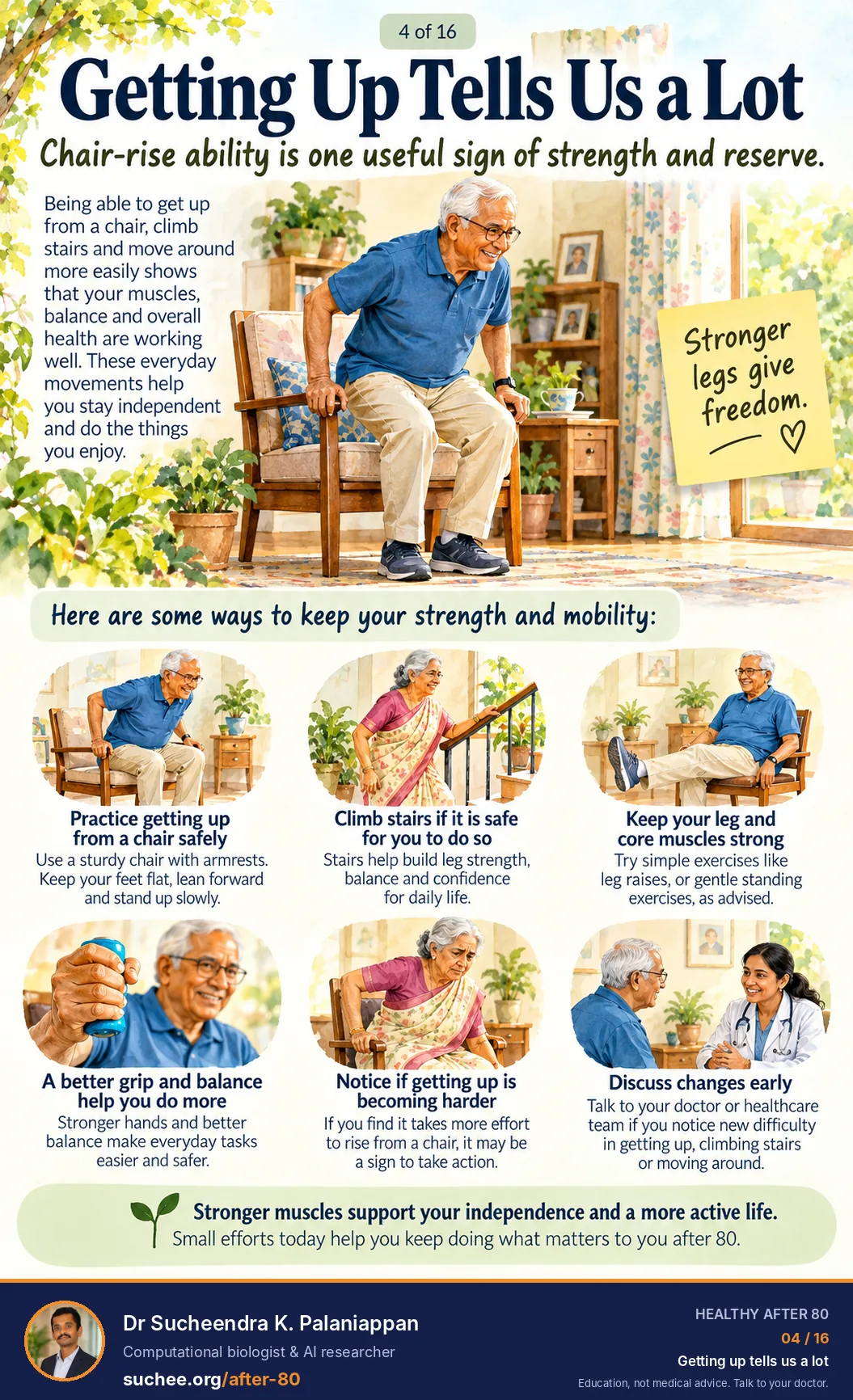
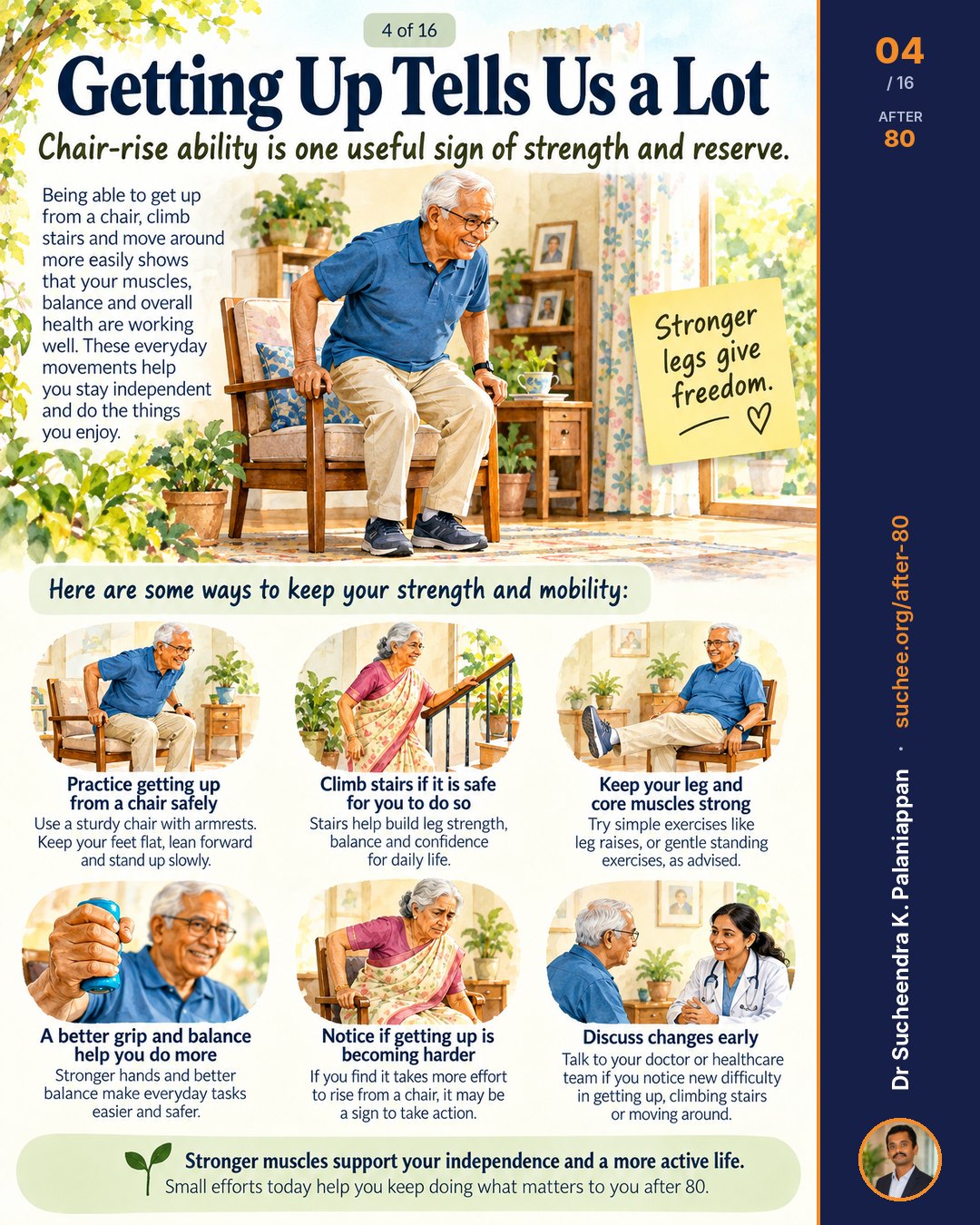
Getting up tells us a lot
How easily you rise from a chair is one useful sign of strength.
Read as text
- Getting up from a chair is one simple sign of leg strength and balance. WHO's screening asks a person to stand up five times without using their arms; taking longer than 14 seconds is a reason for a fuller check. The chair-rise check
- Practise getting up safely: a sturdy chair with armrests, feet flat, lean forward, stand up slowly.
- Climb stairs if it is safe for you, holding the handrail.
- Keep leg and core muscles strong with standing exercises, holding a chair or counter. How much to move after 65
- Notice if getting up needs your hands, several tries or more effort than before, and tell your doctor. A sudden change needs a prompt visit.
-
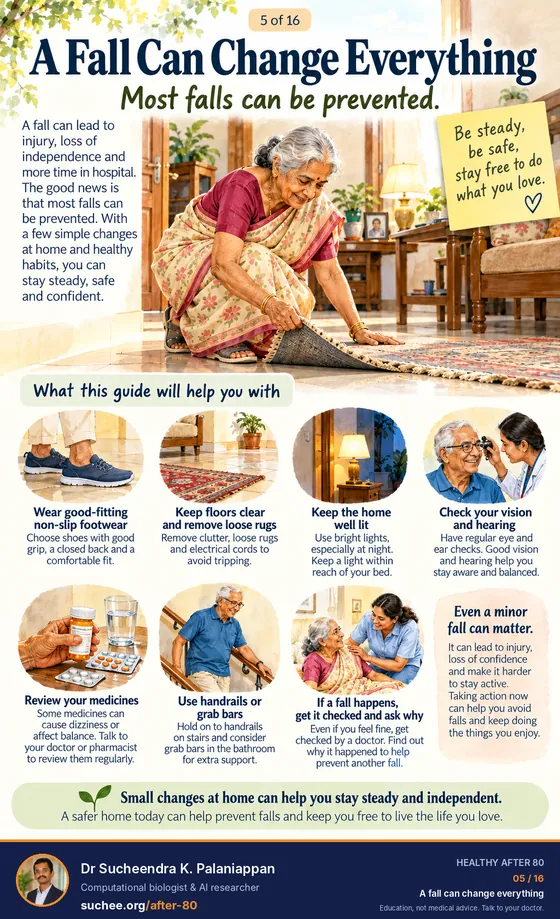 05 / 16
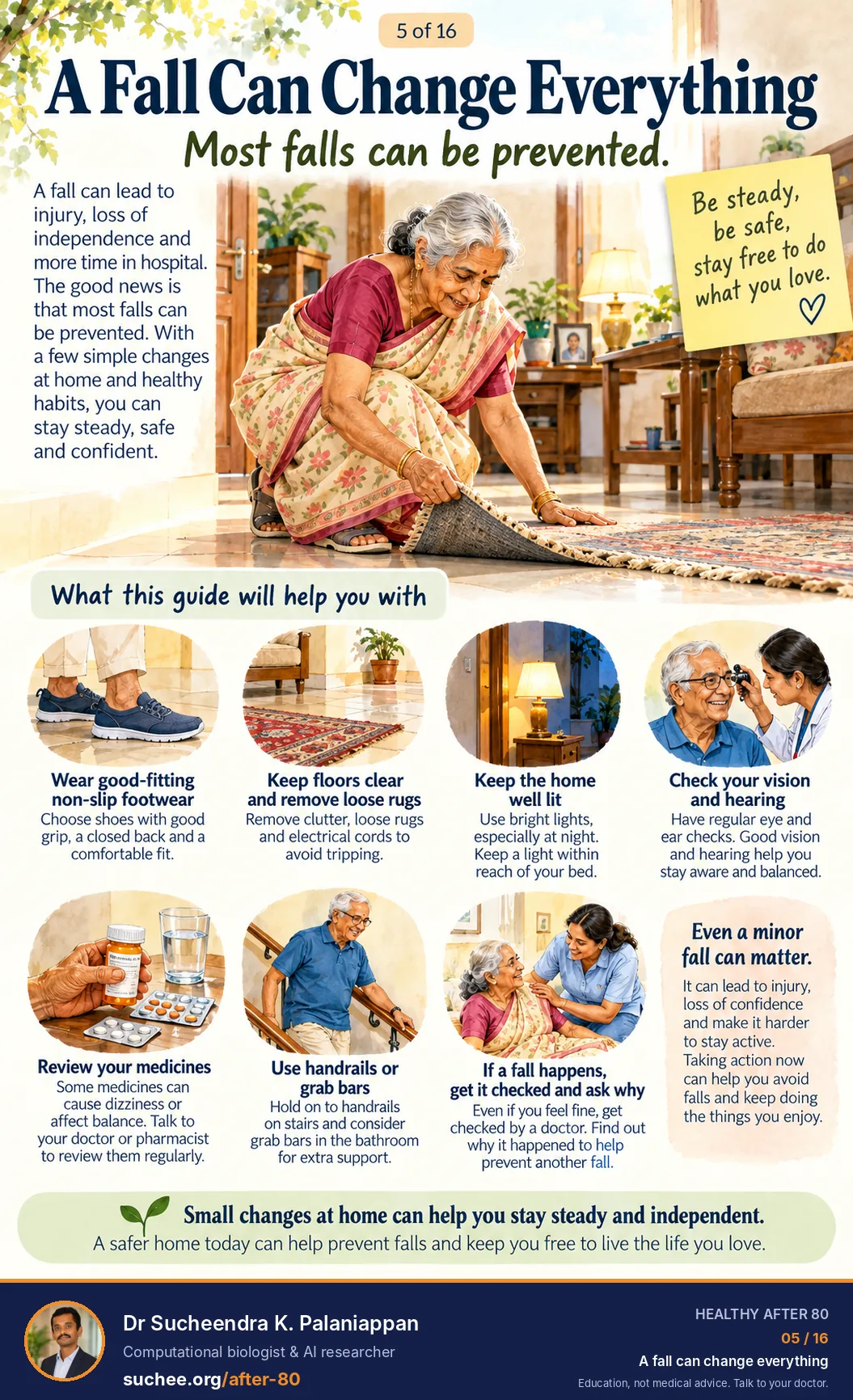
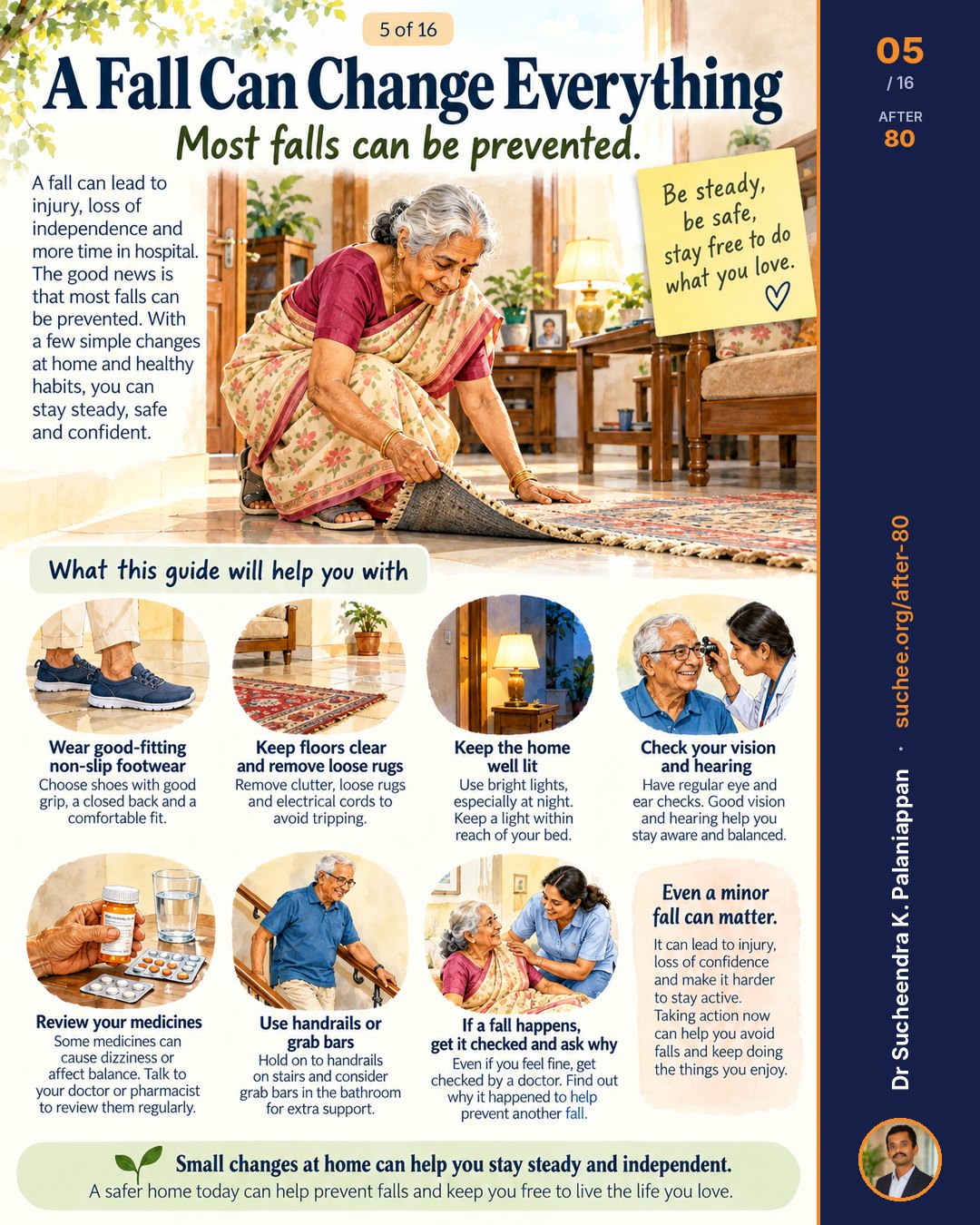
A fall can change everything
Many falls can be prevented.
Read as text
- Worldwide, adults over 60 have the most deaths from falls, and even a minor fall can shake confidence. Falls worldwide
- Many falls can be prevented. Exercise that trains balance lowers the rate of falls by about a quarter. Exercise and falls
- Wear well-fitting shoes or slippers with a good grip and a closed back.
- Clear floors of clutter, loose rugs and wires. Ask someone else to lift rugs and move furniture.
- Light the way at night, with a switch or lamp you can reach from bed.
- Have your eyes checked, and ask whether any medicine is making you dizzy. Sight in India · Medicines to review after 65
- Use handrails on stairs and grab bars in the bathroom. A safer home
- After any fall, see a doctor even if you feel fine, and ask why it happened. A knock to the head, especially on blood thinners, needs care the same day. After a fall
-
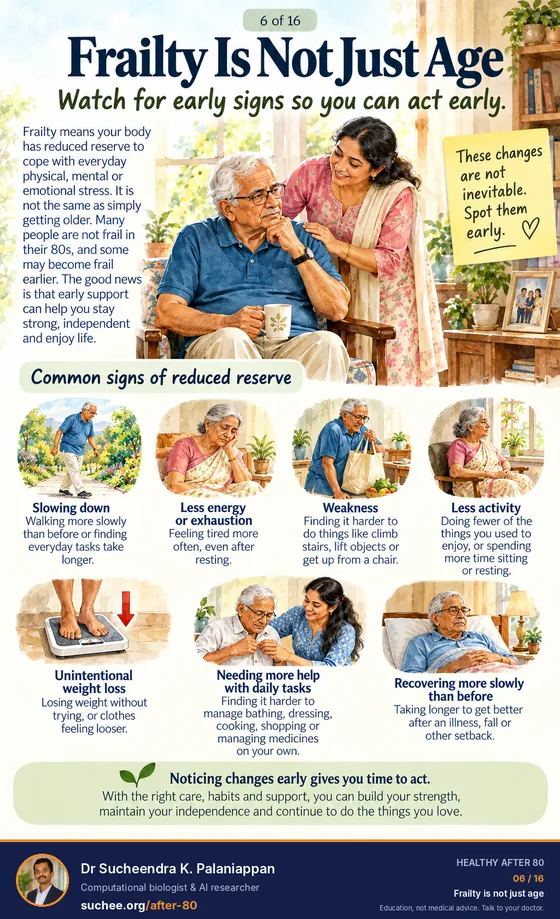 06 / 16
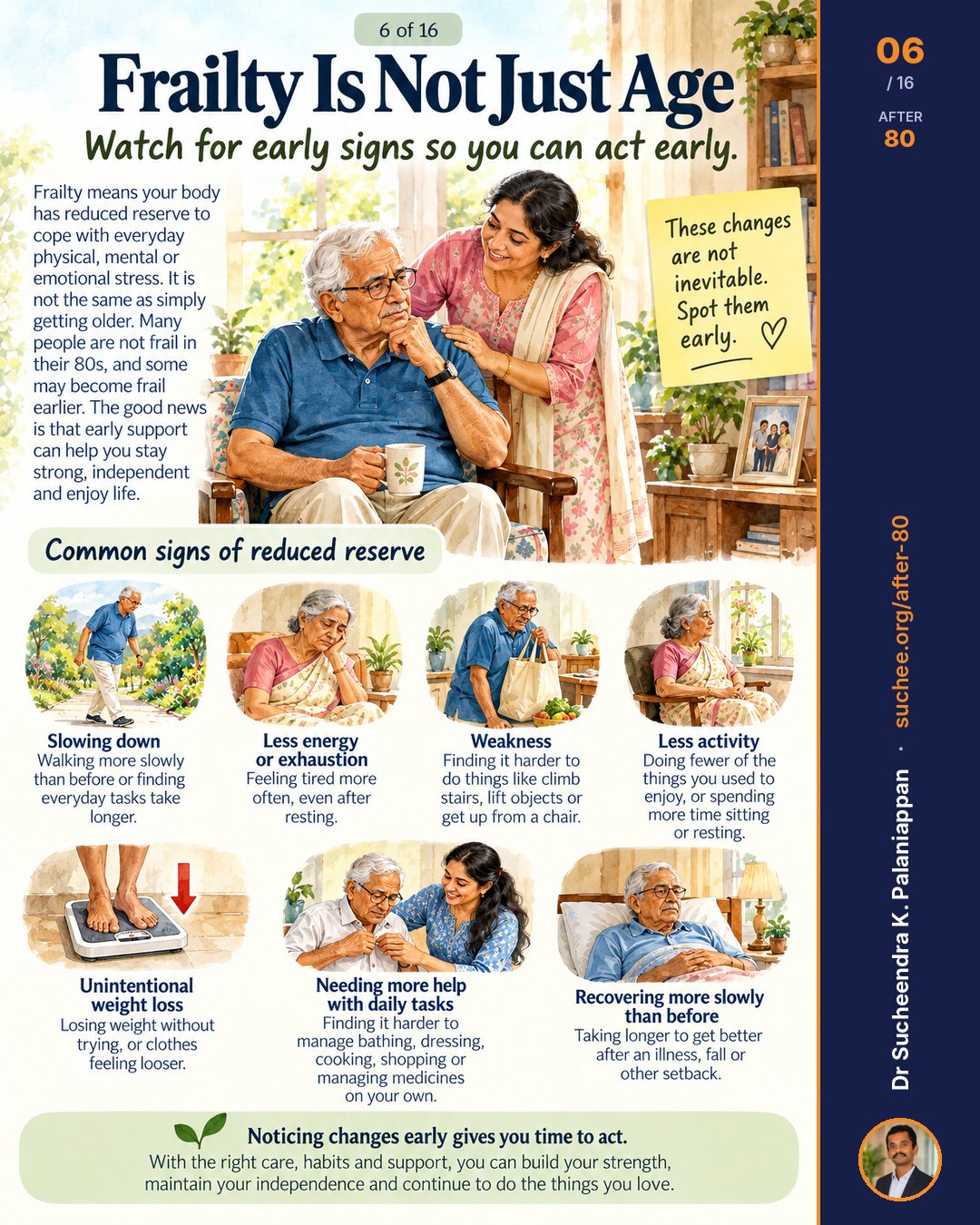
Frailty is not just age
Watch for early signs so you can act.
Read as text
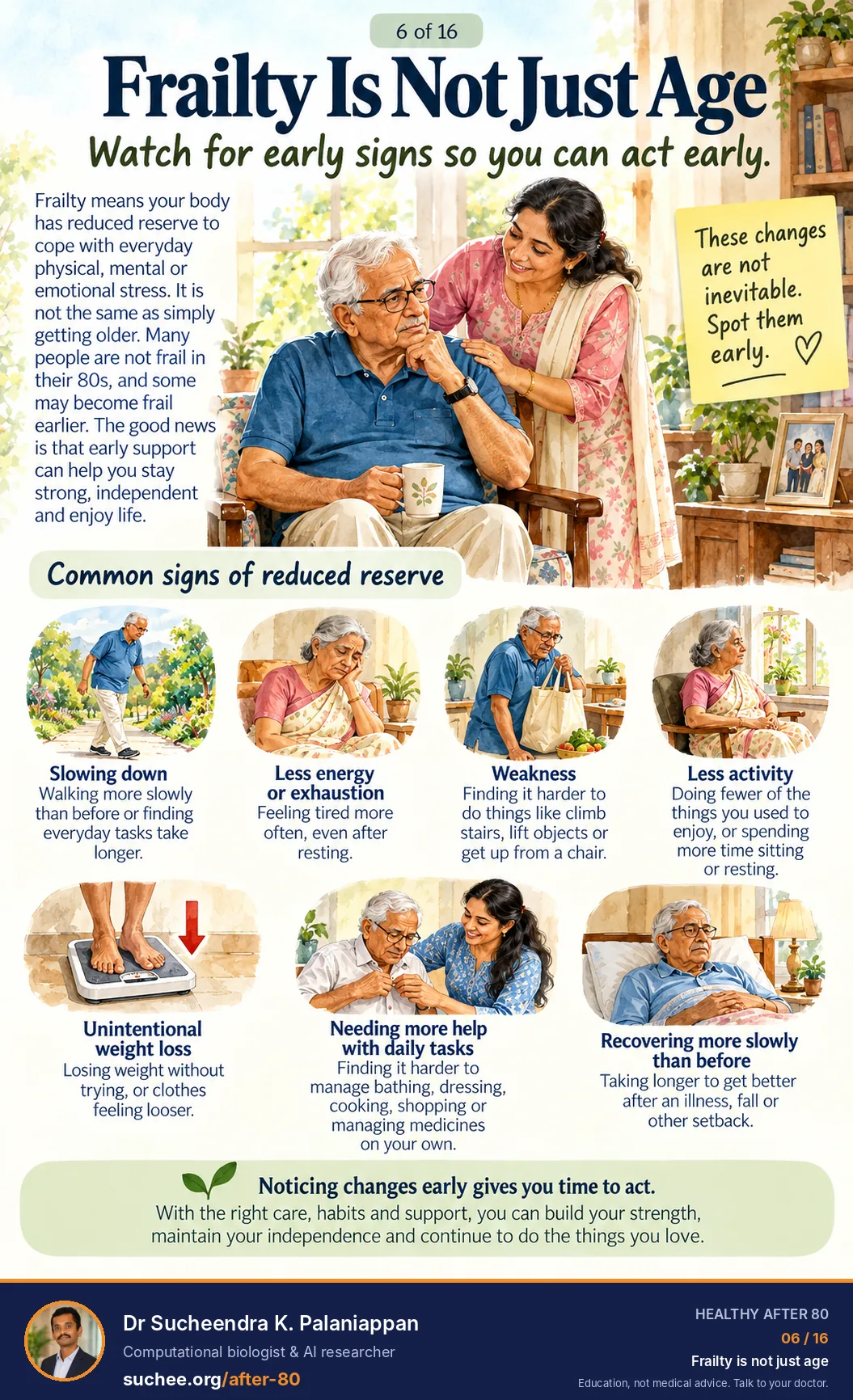
- Frailty means the body has less reserve to cope with an illness, a fall or a stressful event. It is not the same as getting older: many people in their 80s are not frail. What frailty means
- Signs to watch: walking more slowly, feeling exhausted, weakness, doing less, losing weight without trying, needing more help with daily tasks, and recovering more slowly from illness. What frailty means
- One sign on its own can be ordinary ageing. Two or more, or a clear change over a few months, is a reason to see your doctor. What frailty means
- Tiredness and doing less can also come from depression, anaemia or thyroid problems, which can be treated.
- Early support helps: regular exercise, enough food and protein, and a review of medicines and health problems. How much to move after 65 · Protein
-
 07 / 16
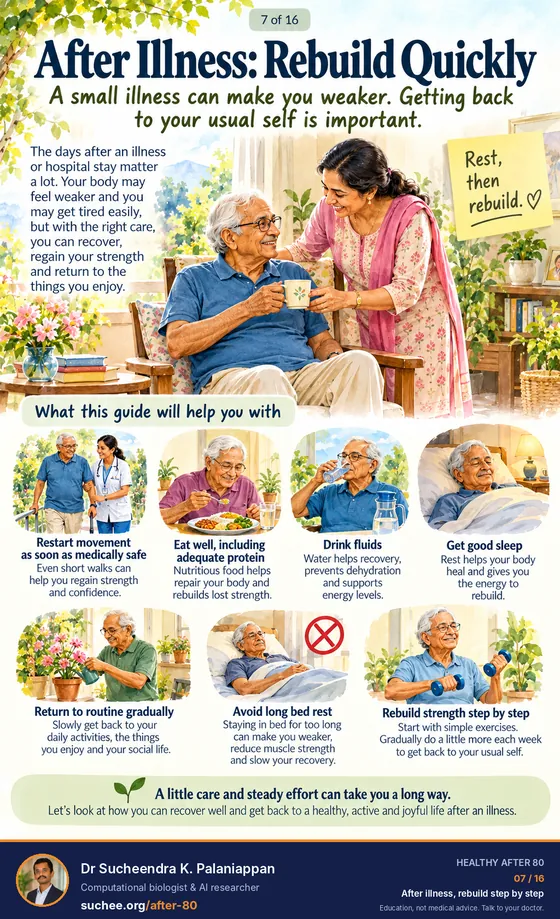
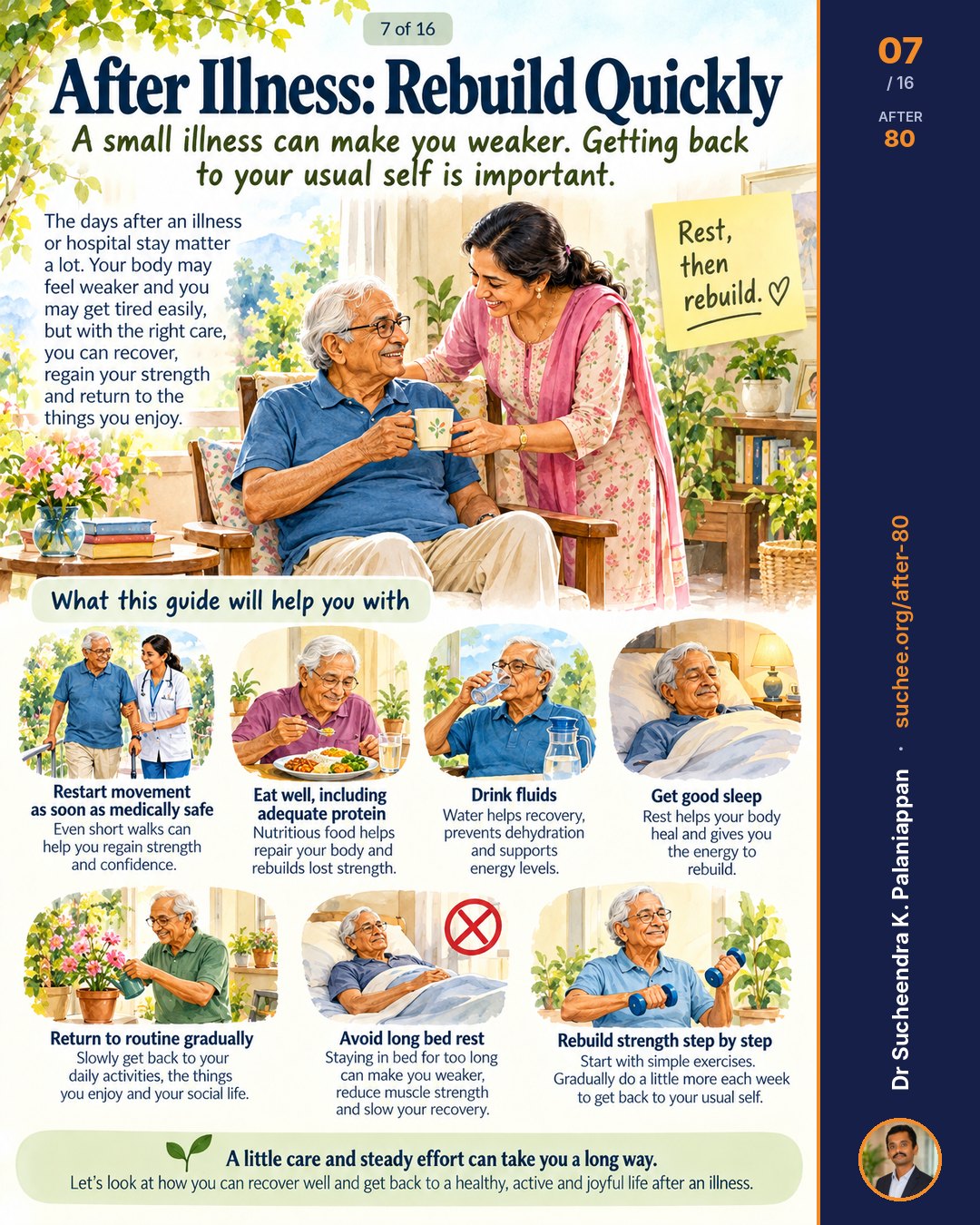
After illness, rebuild step by step
A short illness or hospital stay can leave you weaker. Rebuild gradually.
Read as text
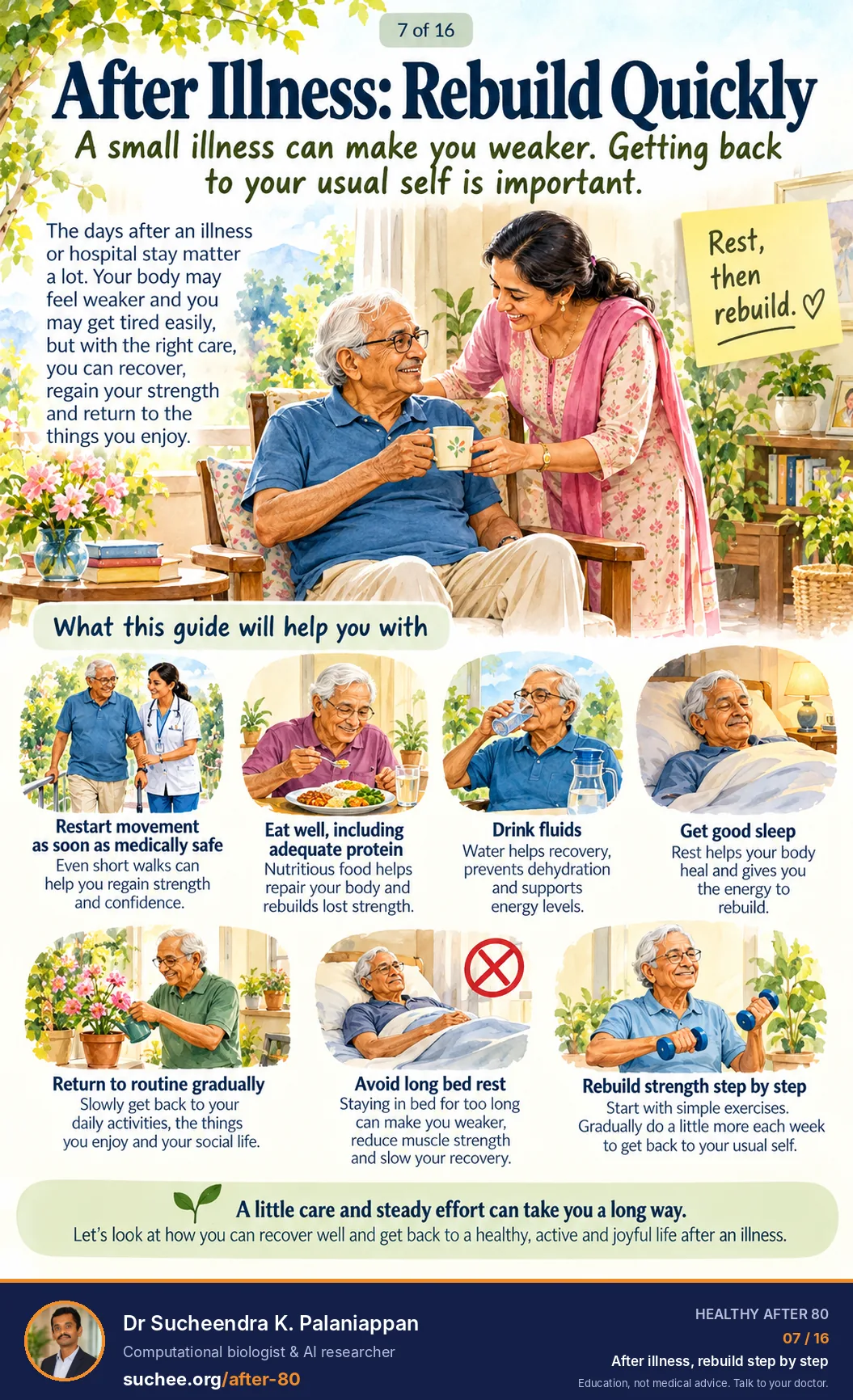
- Bed rest costs muscle quickly: in one study, 10 days in bed cost healthy older adults about 1 kg of leg muscle. Bed rest and muscle
- Start moving again as soon as your doctor says it is safe. Even short walks help.
- Eat well, with protein at each meal: at least 1 g per kg of body weight a day, unless your doctor has told you to limit it for kidney disease. Protein
- Drink enough, unless your doctor has told you to limit fluids. How much to drink
- Rest and sleep well, but avoid long stretches in bed. Bed rest and muscle
- Rebuild strength step by step, holding a chair for support, with exercises from a doctor or physiotherapist.
- After a hospital stay, go through any new medicines with your doctor and keep the follow-up visits.
-
 08 / 16
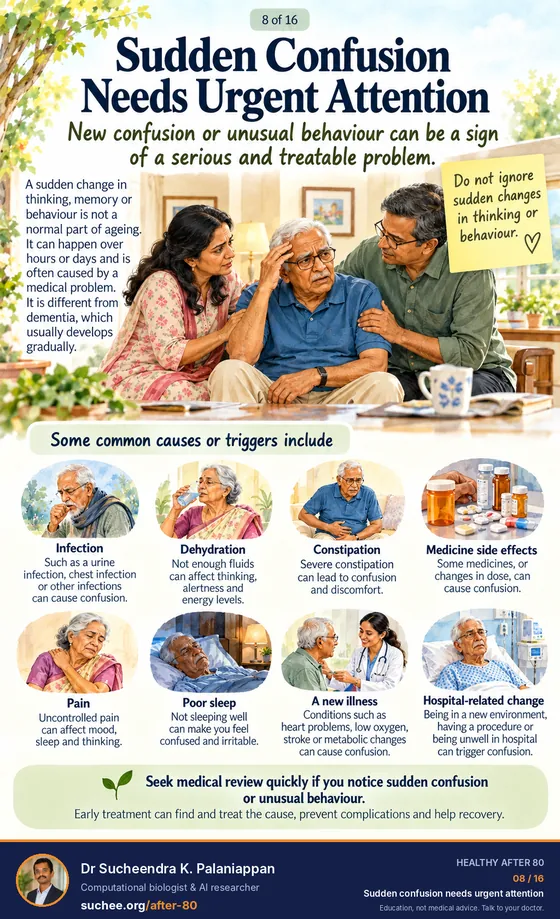
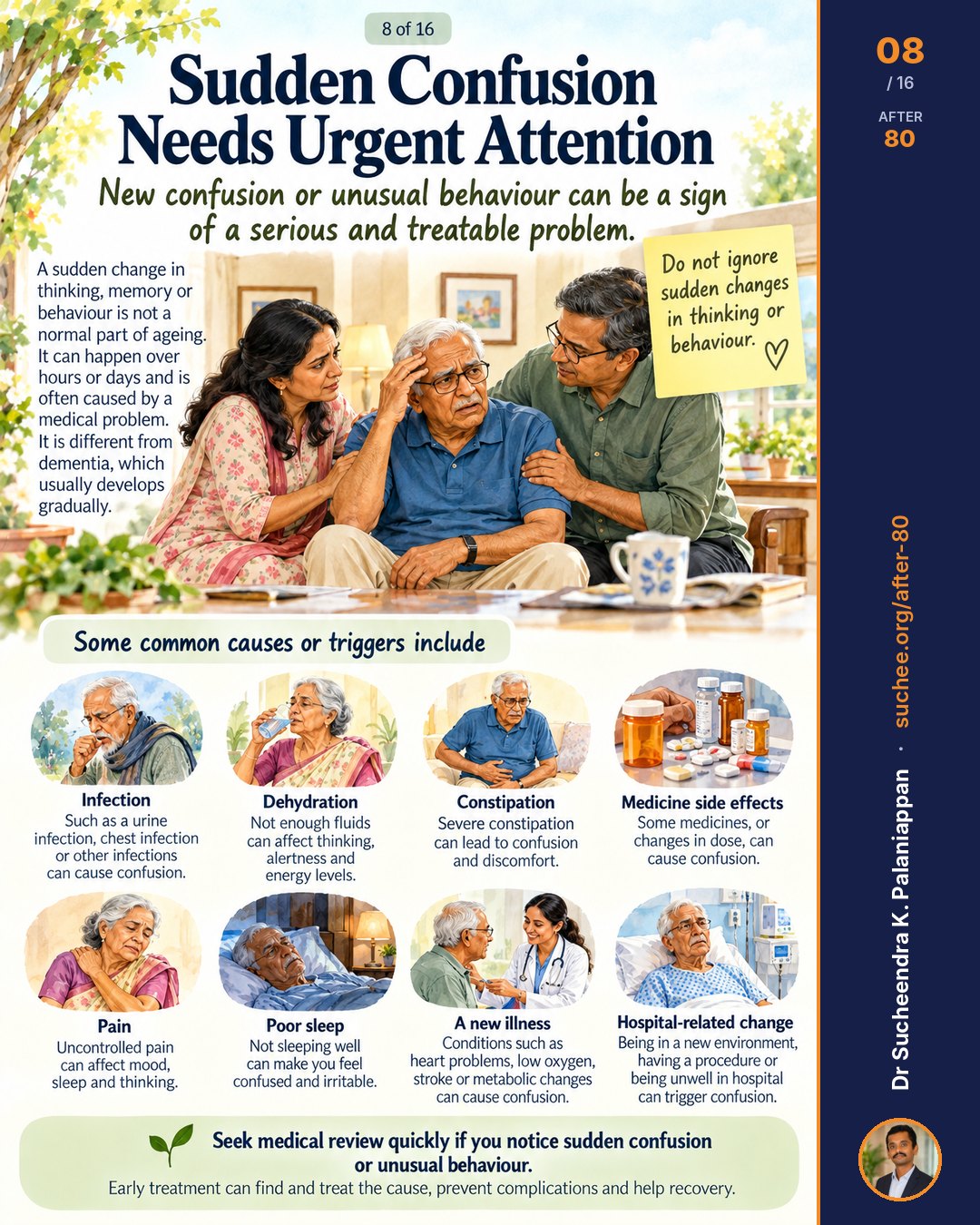
Sudden confusion needs urgent attention
New confusion over hours or days is often a treatable medical problem.
Read as text
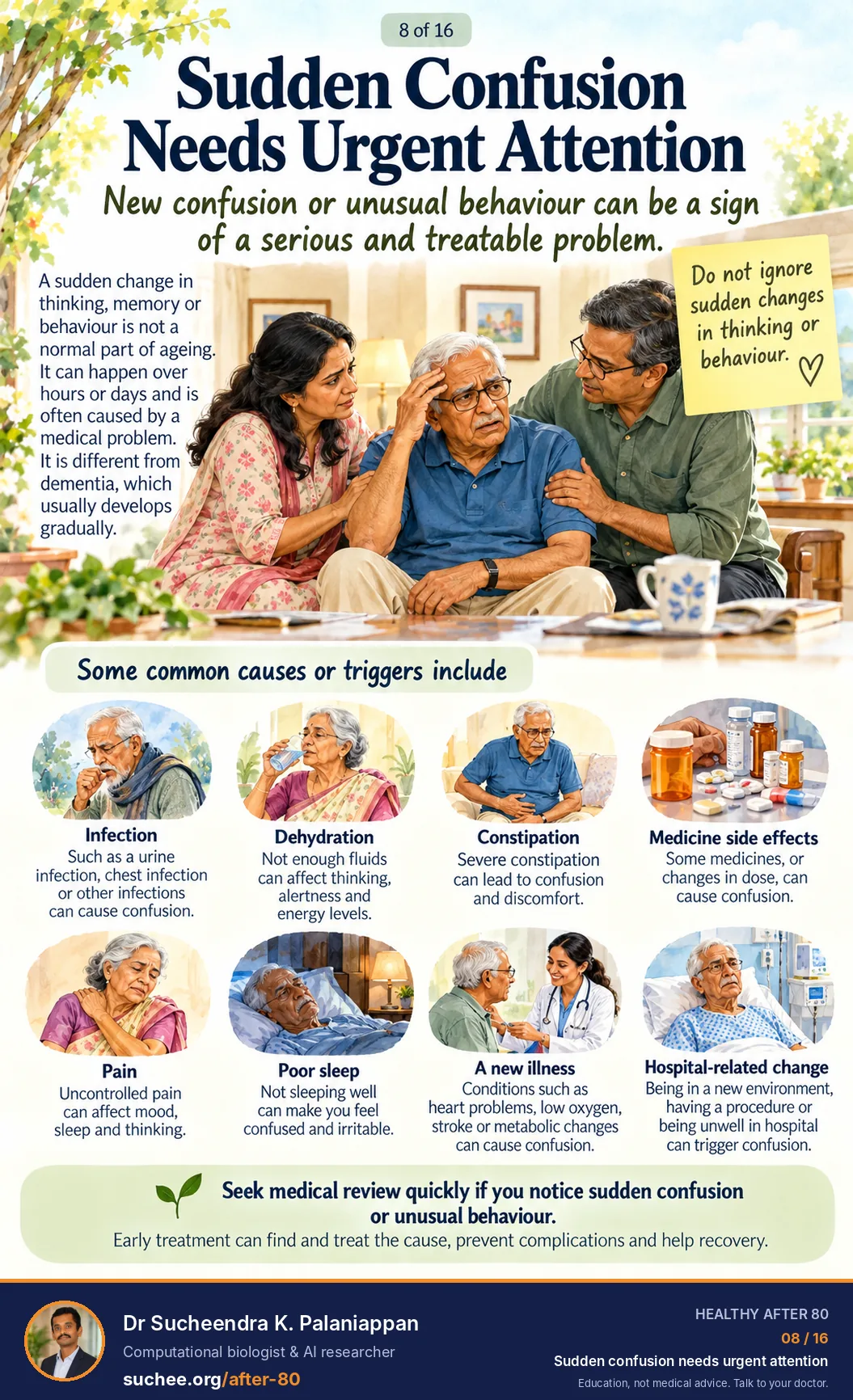
- Confusion that starts over hours or days is not normal ageing. Doctors call it delirium, and it usually has a medical cause. Delirium
- It can look like agitation, or like being unusually quiet and sleepy, which is easy to miss. Delirium
- People with dementia are at higher risk, so a sudden worsening still needs a doctor. Delirium
- Common causes are infections, dehydration, severe constipation, pain, poor sleep, new or changed medicines, low blood sugar or salt, and a stay in hospital.
- Call 112 or go to emergency now for face drooping, weakness on one side, slurred speech, trouble breathing, a seizure, or confusion after a fall or a knock to the head. Emergency numbers
- Otherwise see a doctor the same day, and take the list of medicines.
-
 09 / 16
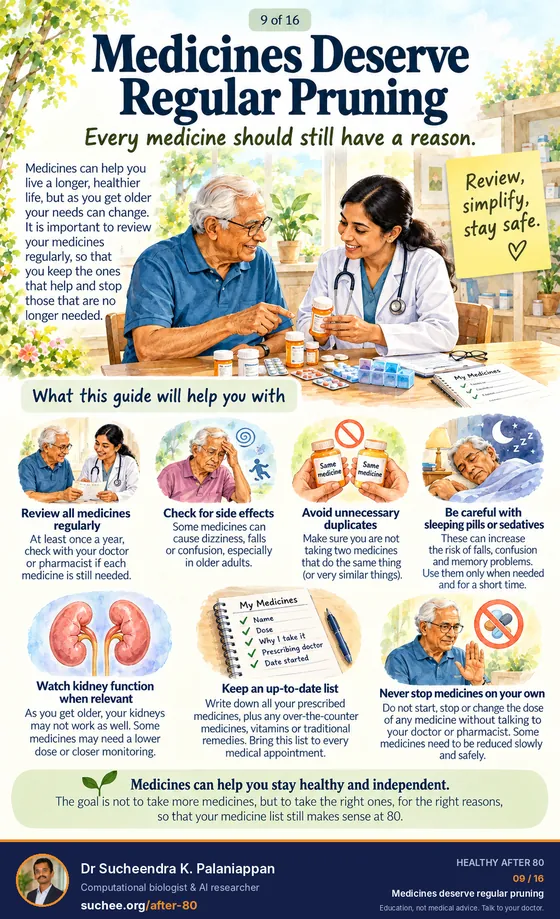
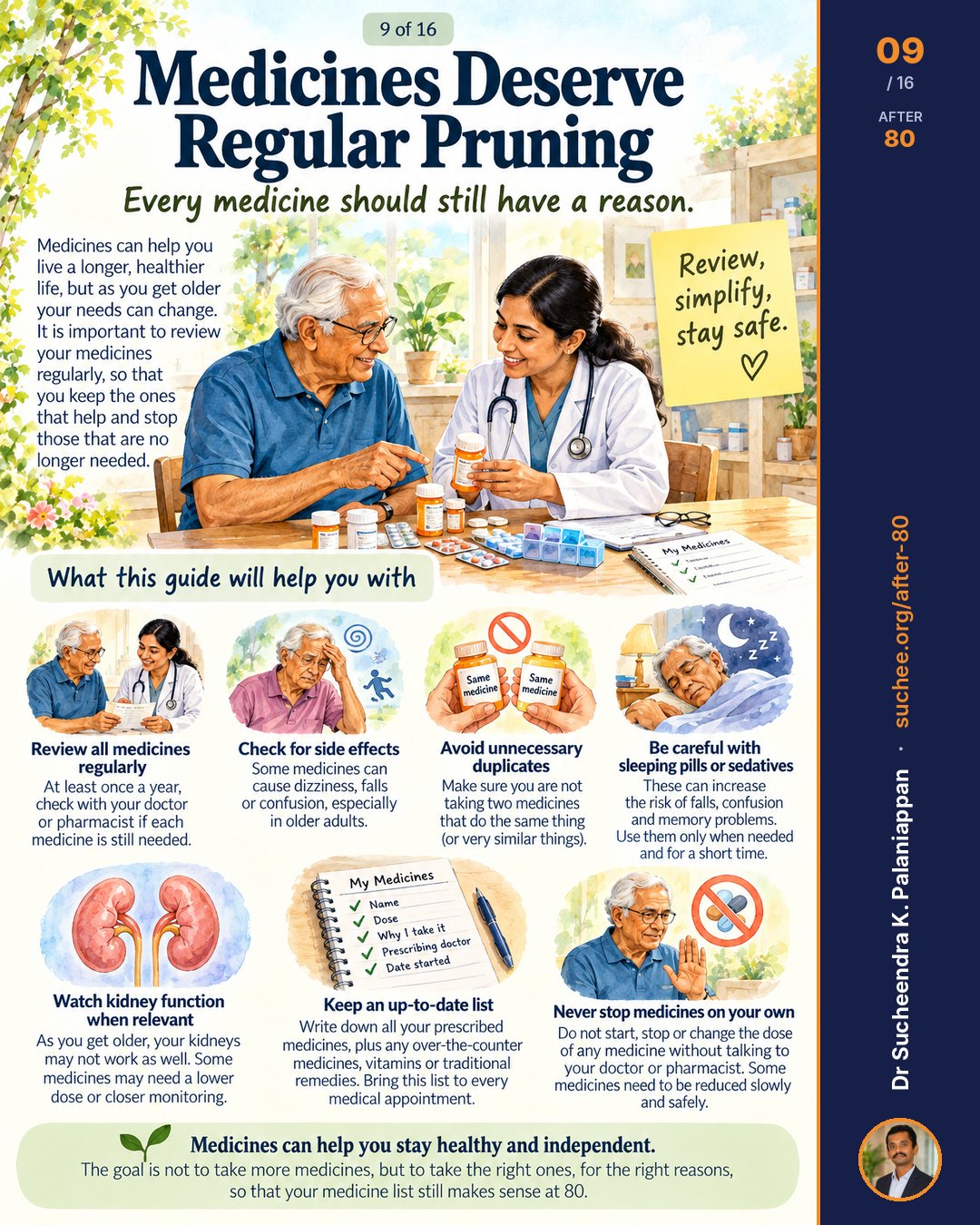
Medicines deserve regular pruning
Every medicine should still have a reason.
Read as text
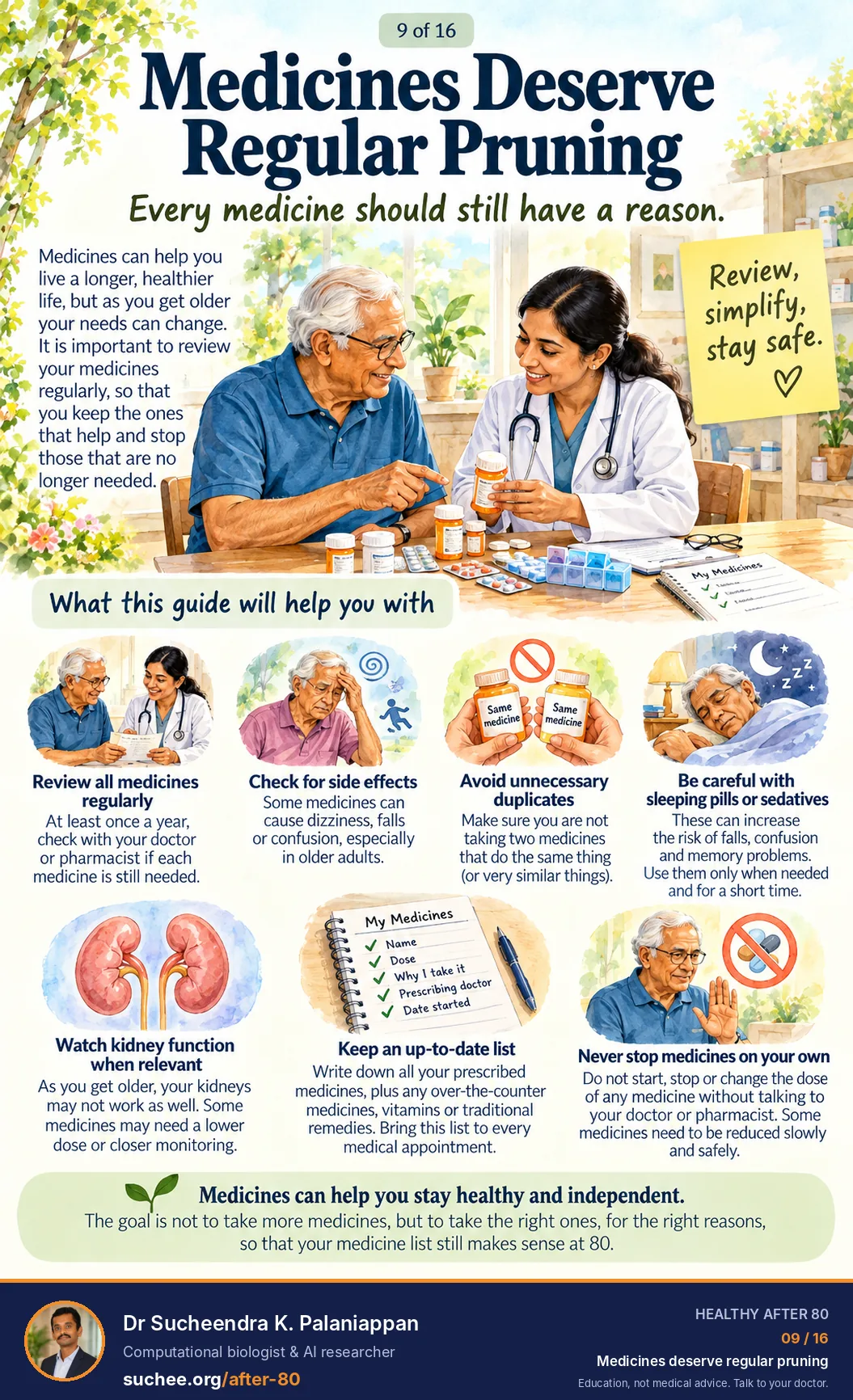
- At least once a year, and after any hospital stay, go through every medicine with your doctor or pharmacist and ask whether each one is still needed.
- Some medicines are usually best avoided after 65, and some need a lower dose as the kidneys slow down. Medicines to review after 65
- Sleeping pills and sedatives raise the risk of confusion, falls and fractures. If you take one, ask whether you still need it, and do not stop it suddenly. Medicines to review after 65
- Watch for two medicines that do the same thing, often prescribed by different doctors.
- Tell your doctor about new dizziness, falls, confusion or drowsiness.
- Keep one list of everything you take, including over-the-counter medicines, vitamins and traditional remedies, and bring it to every visit.
- Never start, stop or change a dose on your own. Some medicines have to be reduced slowly.
-
 10 / 16
Unplanned weight loss is a warning sign
Losing weight without trying needs a doctor's look.
Read as text
- Losing 5% of your weight in 6 to 12 months without trying, about 3 kg if you weigh 60 kg, needs a doctor's assessment. Weigh yourself once a month, or notice clothes getting looser. Weight loss
- Causes range from teeth and swallowing problems to depression, medicines and serious illness, so it is worth finding out. Weight loss
- Eat enough, with protein at each meal: dal, milk and curd, paneer, eggs, fish or meat. Protein · Protein from food
- Familiar energy-rich foods help: rice, chapati, dosa, upma, a little ghee or oil. Use ground nuts if chewing is hard. With diabetes, heart or kidney disease, ask your doctor first.
- For a poor appetite, try small, frequent meals and eat with others.
- See a dentist about painful teeth or loose dentures.
-
 11 / 16
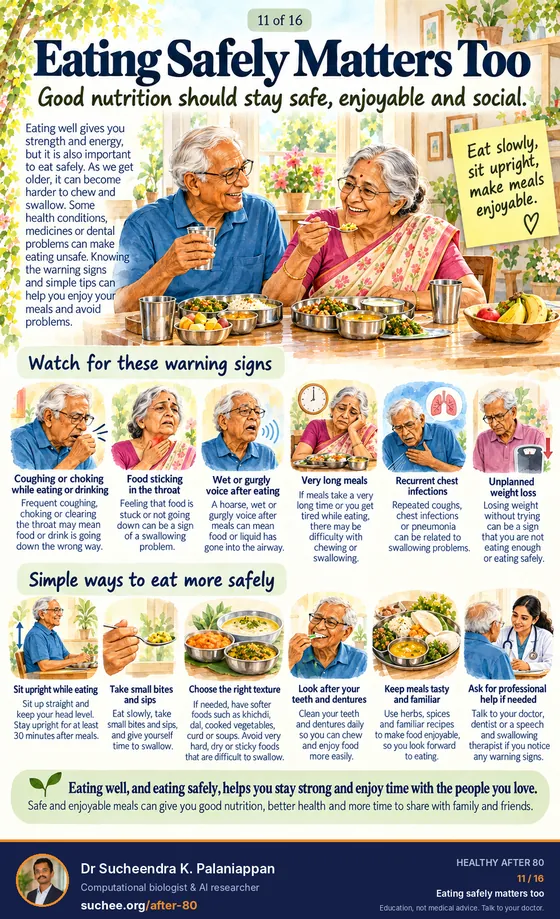
Eating safely matters too
Chewing and swallowing problems are common after 80, and help is available.
Read as text
- Warning signs: coughing or choking while eating or drinking, food sticking, a wet or gurgly voice after meals, very long meals, and repeated chest infections. Swallowing problems
- Sit upright to eat and stay upright for a while after meals. Keep your chin level when you drink; do not tip your head back.
- Eat slowly, with small bites and sips, and finish swallowing before you talk.
- If swallowing is hard, ask a doctor or speech therapist which textures are safe. Thin drinks and soups with pieces can be harder to swallow than they look. Swallowing problems
- Clean teeth and dentures every day so that chewing stays comfortable.
- If someone cannot breathe, speak or cough, call 112. Emergency numbers
-
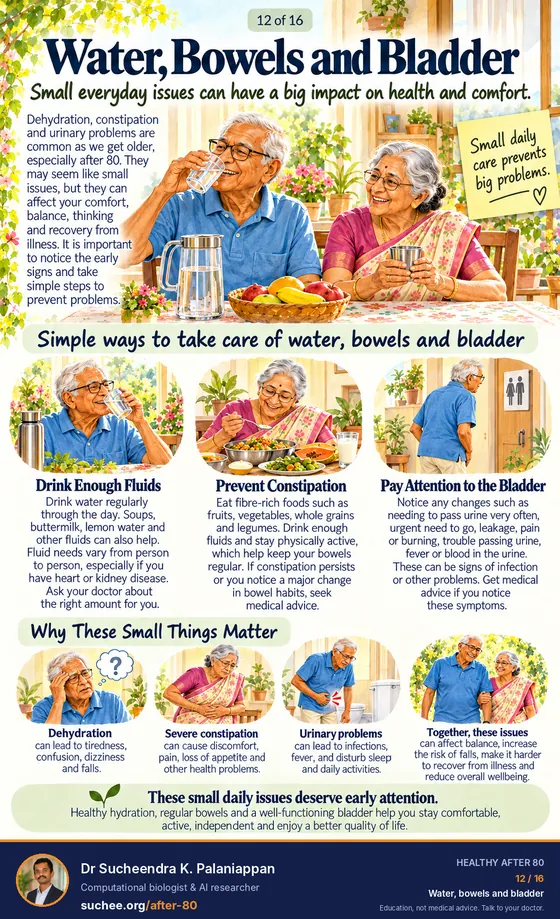 12 / 16
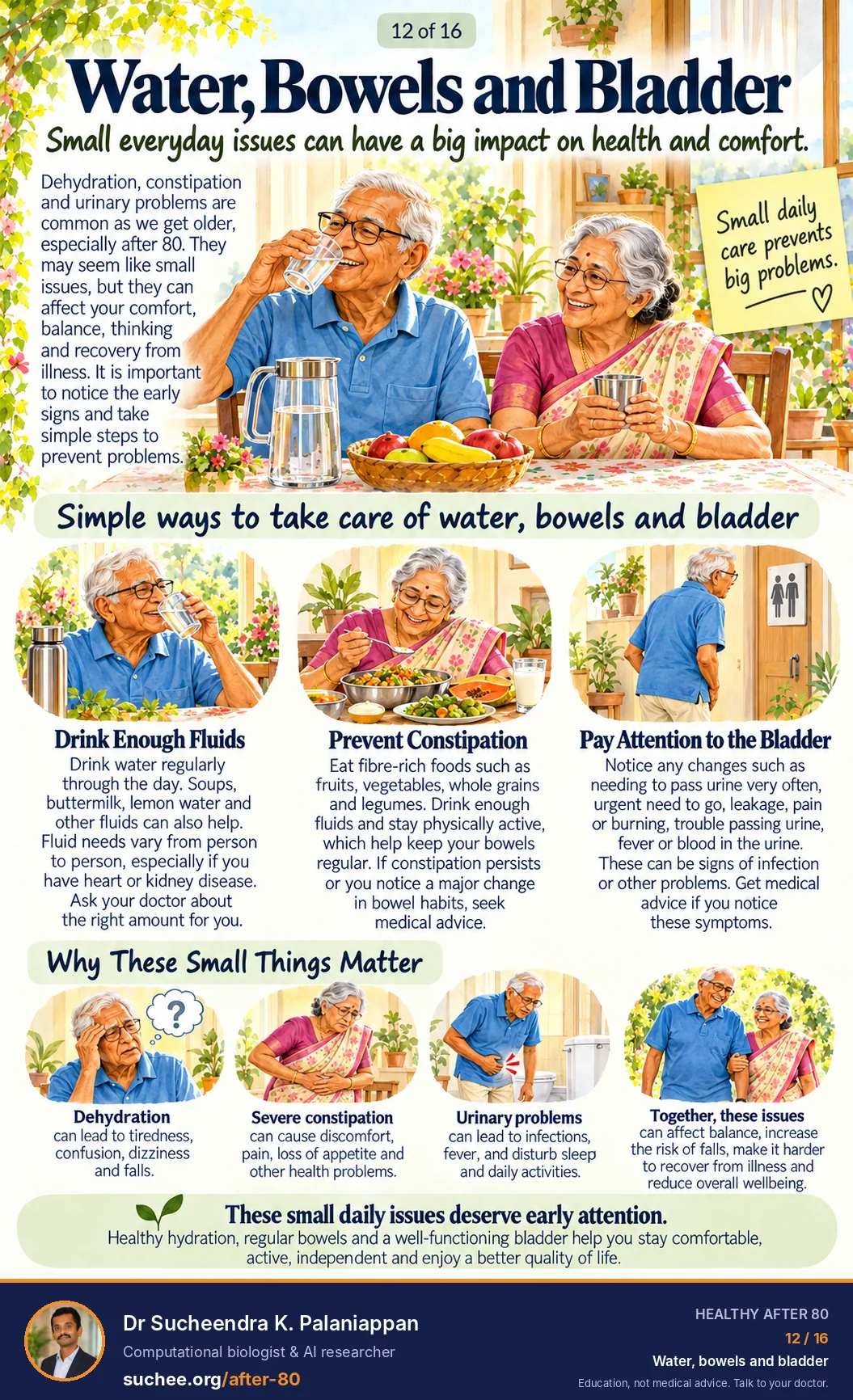
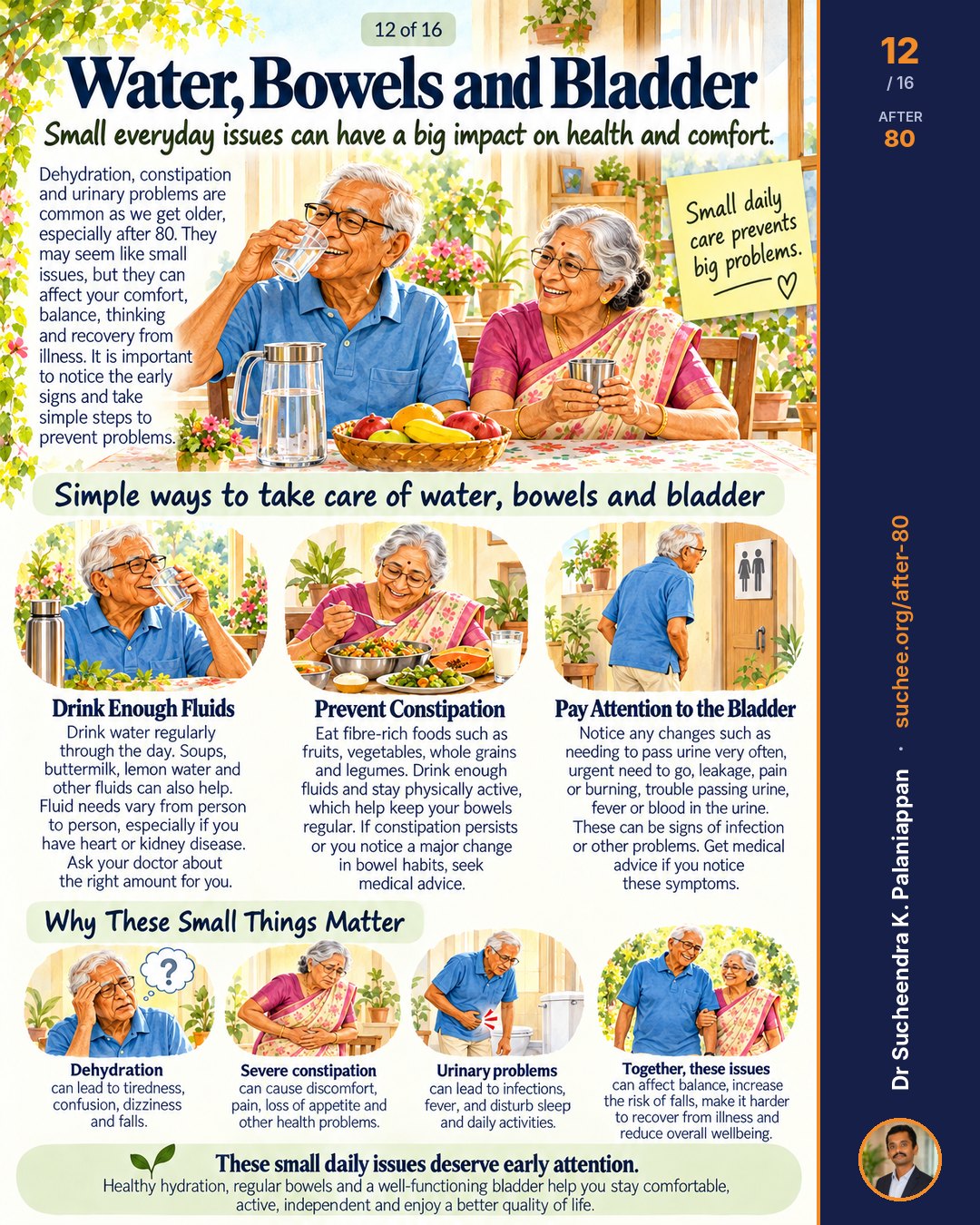
Water, bowels and bladder
Everyday problems that affect comfort, balance and thinking.
Read as text
- Thirst fades with age. Women should aim for about 1.6 litres of drinks a day and men about 2 litres, counting water, buttermilk, soups and tea. How much to drink
- Some people with heart or kidney failure must limit fluids. Follow the amount your doctor gives you. How much to drink
- Dehydration can cause tiredness, dizziness, confusion and falls.
- Fibre from fruit, vegetables, whole grains and dal, enough fluid and daily movement keep bowels regular. Some medicines cause constipation, so ask your doctor.
- Do not cut down on drinks to avoid leaks. Bladder problems are common and often treatable.
- See a doctor promptly for blood in the urine or stool, fever, pain, trouble passing urine, or a lasting change in bowel habit.
-
 13 / 16
See well, hear well, stay connected
Vision and hearing are part of staying safe, social and independent.
Read as text
- Cataract is the leading cause of blindness in Indians over 50, and most blindness at this age can be avoided with treatment. Sight in India
- Have your eyes checked regularly and keep glasses up to date.
- Sudden blurring, double vision or loss of sight needs care the same day. Sudden hearing loss in one ear needs a doctor promptly.
- If following conversations is harder, have your hearing checked and use hearing aids if advised. Hearing, sight and memory
- Hearing loss and untreated vision loss are both linked to a higher risk of dementia, and both can be treated. Hearing, sight and memory
- Good light, larger print and less glare make reading and moving around easier.
- Keep in touch by phone or video, and keep going to the groups, prayers and hobbies you enjoy. Staying connected
- Do not clean ears with cotton buds, hairpins or keys.
-
 14 / 16
Make the home do some of the work
Small changes make falls less likely and daily tasks less tiring.
Read as text
- Home safety changes lower the risk of falls, most clearly for people at higher risk and when an occupational therapist advises. A safer home
- Light rooms, corridors and stairs well, with night lights on the way from bed to bathroom.
- Fit handrails on stairs and grab bars fixed firmly into the bathroom wall, and use stable chairs with armrests.
- Keep floors clear of clutter, loose rugs and wires, and dry, especially in the bathroom. Ask family to lift rugs and move furniture.
- In the bathroom, use an anti-slip mat and a bath stool. A commode chair or a raised seat helps where the toilet is a squat toilet.
- Keep everyday things within easy reach so that you never need to climb on a stool.
- Keep a phone within reach, and do not lock the bathroom door from inside.
- An occupational therapist or physiotherapist, often through a hospital's geriatric or rehabilitation department, can suggest changes for your home.
-
 15 / 16
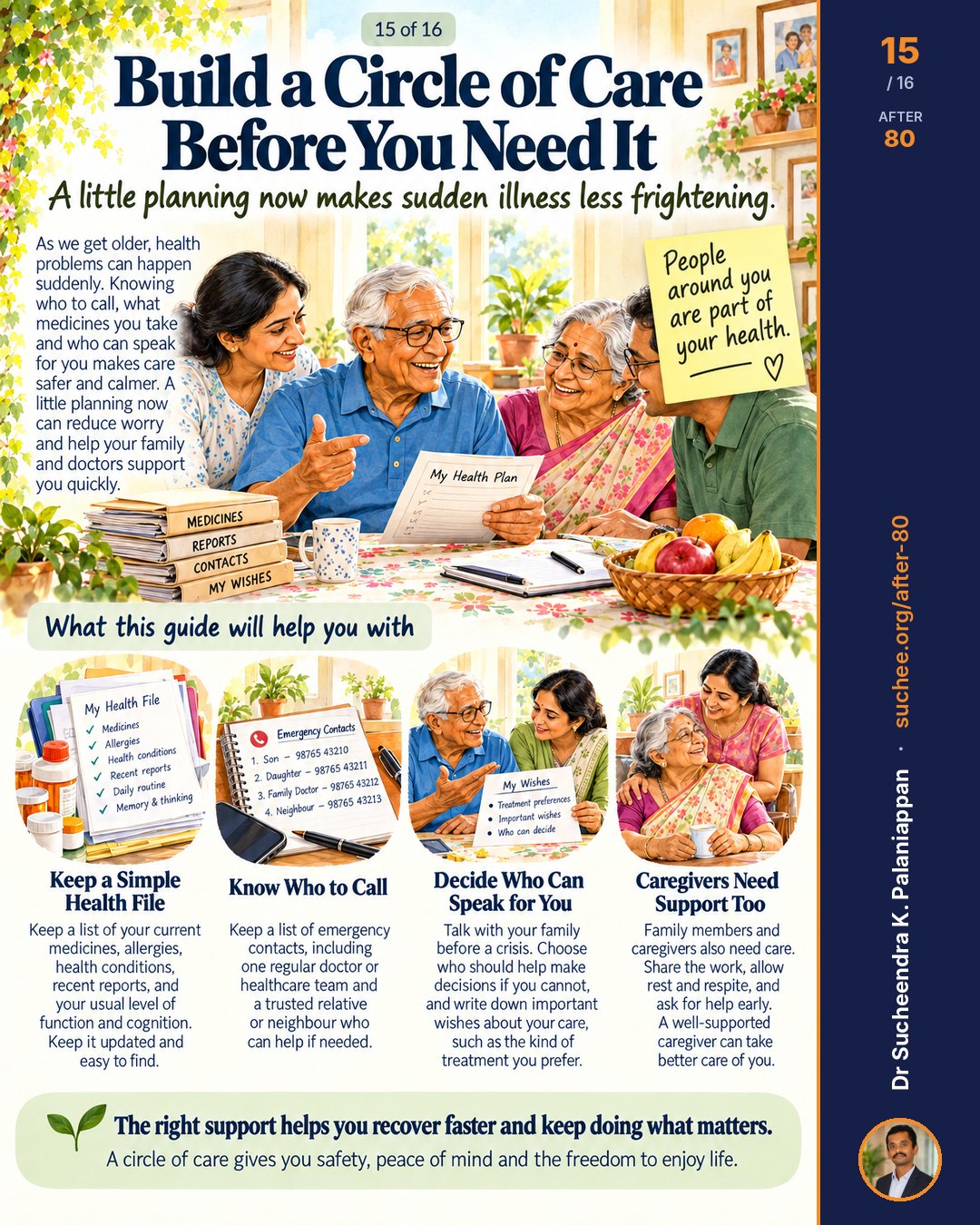
Build a circle of care before you need it
A little planning makes a sudden illness less frightening.
Read as text
- Keep a simple health file: medicines and doses, allergies, conditions, recent reports, doctors' names, blood group, insurance or Ayushman Bharat card, and how you usually manage day to day. Keep it by the phone.
- Start the emergency list with 112, then your doctor and a relative or neighbour who can come quickly. Emergency numbers
- Talk with your family before a crisis about the care you would and would not want, and who should decide if you cannot.
- A living will, or advance medical directive, puts this in writing. It is signed before two witnesses and attested by a notary or gazetted officer. Living wills in India
- Elderline, 14567, is a free national helpline for senior citizens, with information, guidance and support. Elderline
- Carers need care too: share the work, take breaks and ask for help early.
-
 16 / 16
A good life at 80
Ageing well is about keeping what matters.
Read as text
- Ageing well is not about becoming young again, but about keeping the life you value, with help when you need it.
- Keep up hobbies, routines, faith and learning, and help others where you can.
- Spend time with family, friends and community. Strong social ties go with longer lives. Staying connected
- Glasses, hearing aids, walking aids and handrails are not signs of weakness. They keep you doing things.
- Find some joy each day: food, music, prayer, nature, grandchildren. Take the sun in the cooler morning hours.
- These give you the best chance of a full life after 80. When health changes, the aim is to adapt, not to give up.















What each guide stands on
Most health advice on WhatsApp has no source. Each claim here links to one, with the kind of evidence it is, so you can check it or show your doctor.
- India's oldest oldThe number of Indians aged 80 and over is projected to grow by about 279% between 2022 and 2050, against 134% for everyone over 60. Many of the very old will be widowed women who depend on others.UNFPA India and IIPS, India Ageing Report 2023 National report
- What WHO checks after 60WHO's approach to care for older people starts from what a person can do (moving, eating, seeing, hearing, memory and mood) rather than a count of diseases, and builds the care plan from that.
- The chair-rise checkWHO's ICOPE screening asks a person to stand up from a chair five times without using their arms. Taking longer than 14 seconds marks reduced mobility and calls for a fuller assessment.WHO, ICOPE handbook, 2nd edition, 2024 WHO guidance · Validation of the ICOPE screening tool: the chair rise test Cohort study
- How much to move after 65150 to 300 minutes of moderate activity a week, muscle strengthening on 2 or more days, and varied activity that trains balance and strength on 3 or more days, to improve function and prevent falls. Those who cannot do this much should be as active as their abilities allow.
- Exercise and fallsAcross 59 trials in people over 60 living at home, exercise cut the rate of falls by about 23%. Programmes built on balance and functional exercise worked best.Sherrington et al., Exercise for preventing falls in older people living in the community, Cochrane 2019 Systematic review · 12,981 people No Indian review covers this.
- Falls worldwideFalls are the second leading cause of unintentional injury death worldwide, about 684,000 deaths a year, and adults over 60 suffer the greatest number of fatal falls.WHO, Falls fact sheet, 2021 Fact sheet
- After a fallAll older adults should get advice on preventing falls and staying active. Anyone at high risk, including after a fall, should have a full falls assessment and a plan built with them.Montero-Odasso et al., World guidelines for falls prevention and management, Age and Ageing 2022 International guideline
- What frailty meansIn the most widely used definition, a person is frail with 3 or more of: losing about 4.5 kg in a year without trying, exhaustion, weak grip, slow walking and low activity. One or two signs mark pre-frailty. Frailty predicted falls, disability, hospital stays and death.Fried et al., Frailty in older adults: evidence for a phenotype, J Gerontol 2001 Cohort study · 5,317 people aged 65+ No Indian study covers this.
- Bed rest and muscleTen days of bed rest made healthy older adults, average age 67, lose about 1 kg of muscle from their legs.Kortebein et al., Effect of 10 days of bed rest on skeletal muscle in healthy older adults, JAMA 2007 Experimental study · 12 adults No Indian study covers this.
- ProteinOlder people should get at least 1 g of protein per kg of body weight a day, adjusted for their health, activity and tolerance. People with kidney disease should follow their doctor's advice.Volkert et al., ESPEN practical guideline: clinical nutrition and hydration in geriatrics, Clinical Nutrition 2022 Guideline No Indian guideline sets a figure for this age.
- How much to drinkOlder women should be offered at least 1.6 litres of drinks a day and older men at least 2 litres, unless a medical condition calls for a different amount. All older adults are at risk of drinking too little.Volkert et al., ESPEN practical guideline: clinical nutrition and hydration in geriatrics, Clinical Nutrition 2022 Guideline No Indian guideline covers this.
- Swallowing problemsOlder people with signs of a swallowing problem should be screened and assessed, and food and drink textures should be adapted to what they can swallow safely.Volkert et al., ESPEN practical guideline: clinical nutrition and hydration in geriatrics, Clinical Nutrition 2022 Guideline No Indian guideline covers this.
- Protein from foodGet protein from food, such as dal and other pulses, milk and curd, eggs, fish or meat, rather than protein supplements.ICMR-NIN, Dietary Guidelines for Indians, 2024 National guideline
- DeliriumDelirium is a change in thinking and behaviour that starts over hours or days and can come and go. Some people become agitated; others become quiet, sleepy and withdrawn, which is easily missed. Age over 65 and dementia raise the risk, and 20 to 30% of people on medical wards have it.NICE, Delirium: prevention, diagnosis and management (CG103), updated 2023 Guideline No Indian guideline covers this.
- Emergency numbers112 is India's single emergency number. It brings together the older numbers, including 100 for police, 101 for fire and 108 for an ambulance.Ministry of Home Affairs, Emergency Response Support System 112 National service
- Medicines to review after 65An expert list of medicines older adults should usually avoid or use with care. It includes benzodiazepine and ‘Z-drug’ sleeping pills, which raise the risk of confusion, falls and fractures, and medicines that need a lower dose when the kidneys work less well.American Geriatrics Society, 2023 Updated Beers Criteria, J Am Geriatr Soc 2023 Expert criteria No Indian list covers this; brand names differ in India.
- Weight lossIn adults over 65, losing 5% or more of body weight over 6 to 12 months without trying needs a doctor's assessment. Causes include cancer, depression, medicines, mouth and swallowing problems, and loneliness or low income. Sometimes no cause is found.Gaddey and Holder, Unintentional weight loss in older adults, American Family Physician 2021 Clinical review No Indian guideline covers this.
- Sight in IndiaAmong Indians aged 50 and over, cataract caused 66.2% of blindness, and about 93% of blindness was avoidable with existing treatment.MoHFW and AIIMS, National Blindness and Visual Impairment Survey 2015–19 National survey · 31 districts
- Hearing, sight and memoryHearing loss and untreated vision loss are two of 14 changeable risk factors that together account for nearly half of dementia worldwide.Livingston et al., Dementia prevention, intervention, and care: 2024 report of the Lancet standing Commission, The Lancet 2024 Expert commission No Indian study covers this.
- A safer homeHome safety assessment and changes reduced falls, most clearly in people at higher risk of falling and when an occupational therapist did the assessment.Gillespie et al., Interventions for preventing falls in older people living in the community, Cochrane 2012 Systematic review · 159 trials No Indian review covers this.
- Staying connectedAcross 148 studies, people with stronger social ties had about 1.5 times the odds of survival, an effect comparable to well-known risks such as smoking.Holt-Lunstad et al., Social relationships and mortality risk, PLoS Medicine 2010 Meta-analysis · 308,849 people, 148 studies
- Living wills in IndiaSince 2018 Indians can make an advance medical directive, or living will, saying which treatments they would not want if they cannot decide, and naming who should decide for them. In 2023 the Supreme Court simplified the process: it is signed before two witnesses and attested by a notary or gazetted officer.
- ElderlineElderline, 14567, is the national toll-free helpline for senior citizens, open 8 am to 8 pm every day. It gives information on care and services, guidance on pensions and legal matters, emotional support, and field help in cases of abuse or neglect.
Guidance changes as evidence grows. When it does, the guides and this list will be updated. Last updated .
How these are made
- Guidelines, not headlines. Every number comes from a guideline, a national survey or a systematic review, linked above.
- Written for Indian families. Indian emergency numbers and helplines, khichdi and dal, squat toilets, and the family members who do most of the caring.
- Function before numbers. What a person can do matters as much as a test result. Targets and medicines stay with the doctor who knows them.
- Nothing to sell. No clinic, no supplements, no product. Free to print and share.
Want the science behind it?
Longevity, Interpreted. is my weekly reading of longevity research: what was shown, at what stage, and what it does not yet support.