Health by age · 60 and over
Healthy after 60 what is proven, in plain words
I read longevity research every week. Most of it is early and changes nothing a 65-year-old should do today.
What works is older and well tested: exercise, protein, blood pressure and sugar checks, sleep, and company.
My parents, like my friends’ parents, are getting older. So I wrote the basics down, with a source for every number. For my family, for yours, and for me later on.
Sources are listed below: Indian ones where they exist (ICMR-NIN, LASI, ICMR-INDIAB, the national NCD programme), WHO and Cochrane for the rest.
 Sucheendra Kumar PalaniappanComputational biologist
Five simple guides
One idea per box, large text, Indian food.
Start with the basics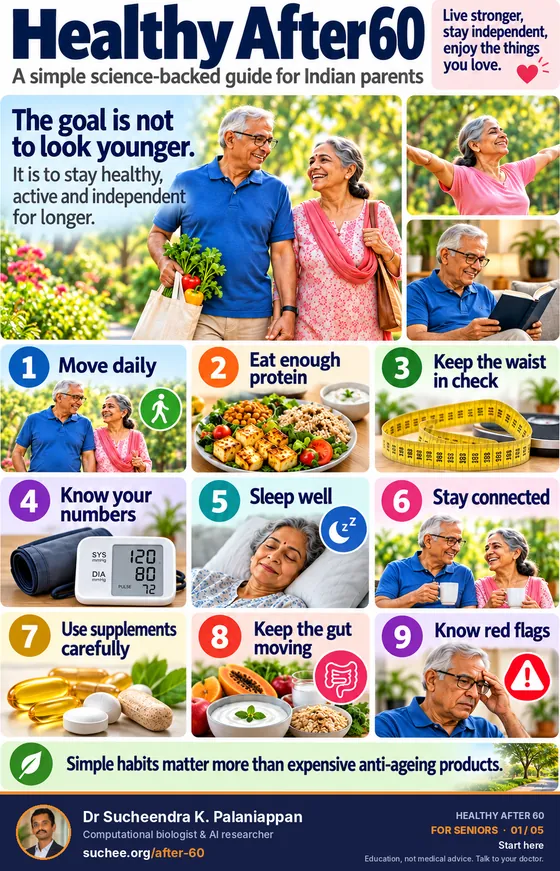
The same five, in depth
The numbers, the sources, and what is still unproven.
Go deeper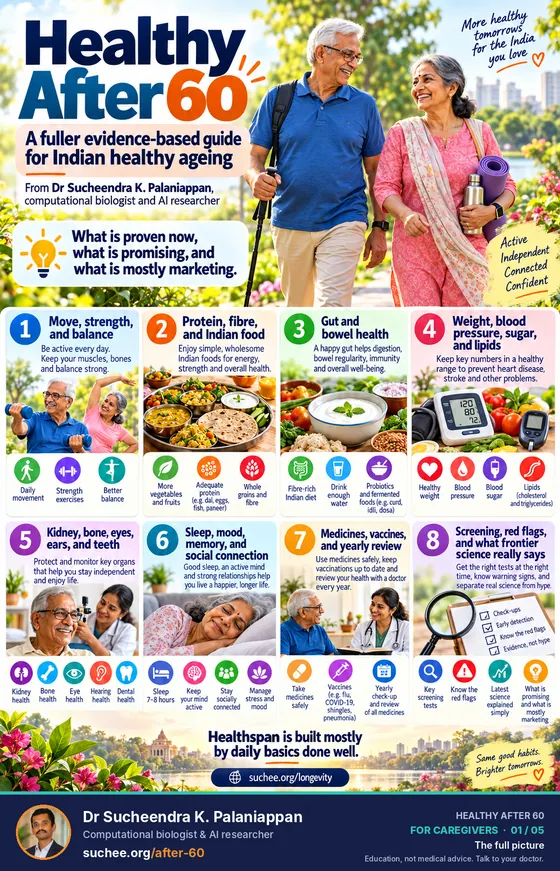
The basics, one page at a time
Habits beat products. Start with the first, then take one a month.
-
01 / 05
Start here
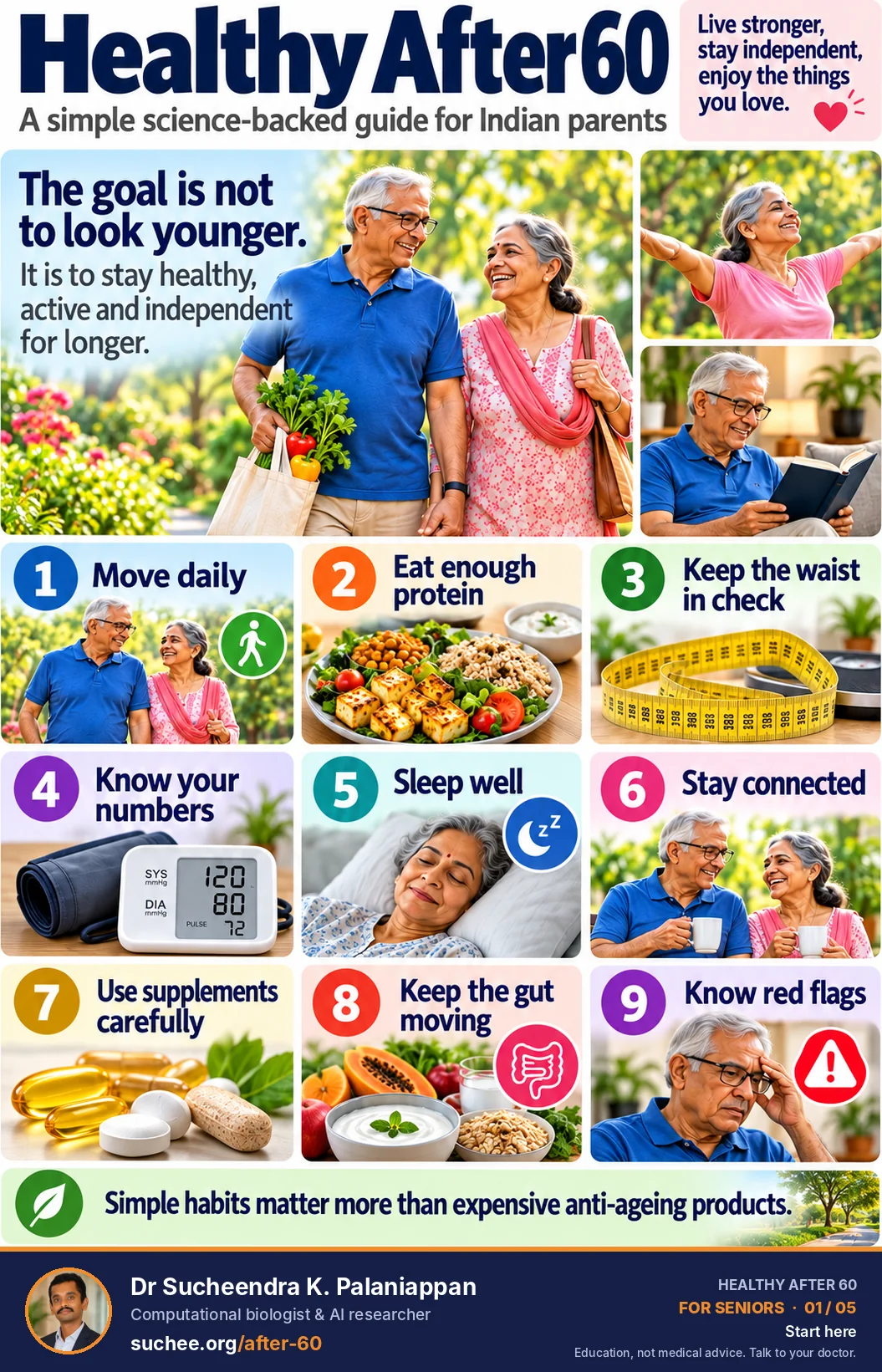
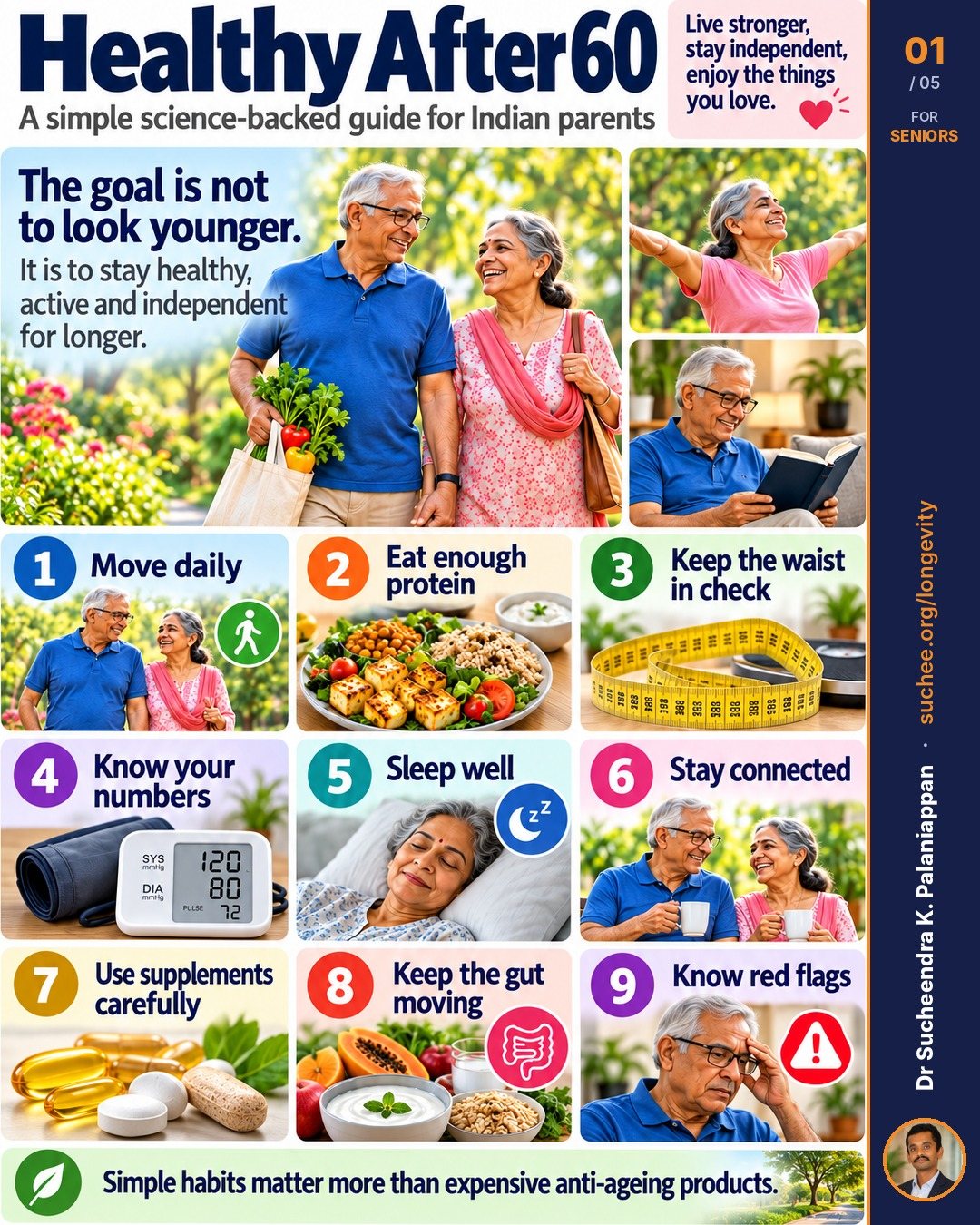
Not to look younger, but to stay healthy, active and independent. Nine habits, one page.
Read as text
- The goal is not to look younger. It is to stay healthy, active and independent for longer.
- Move every day, and keep up strength and balance. Exercise prevents falls
- Eat enough protein, at every meal. Protein after 65
- Know your numbers: blood pressure and sugar, checked every year. Get checked
- Sleep 7 to 8 hours, and stay connected with people. Sleep · Staying connected
- Use supplements carefully. Simple habits matter more than expensive products. Other supplements
-
 02 / 05
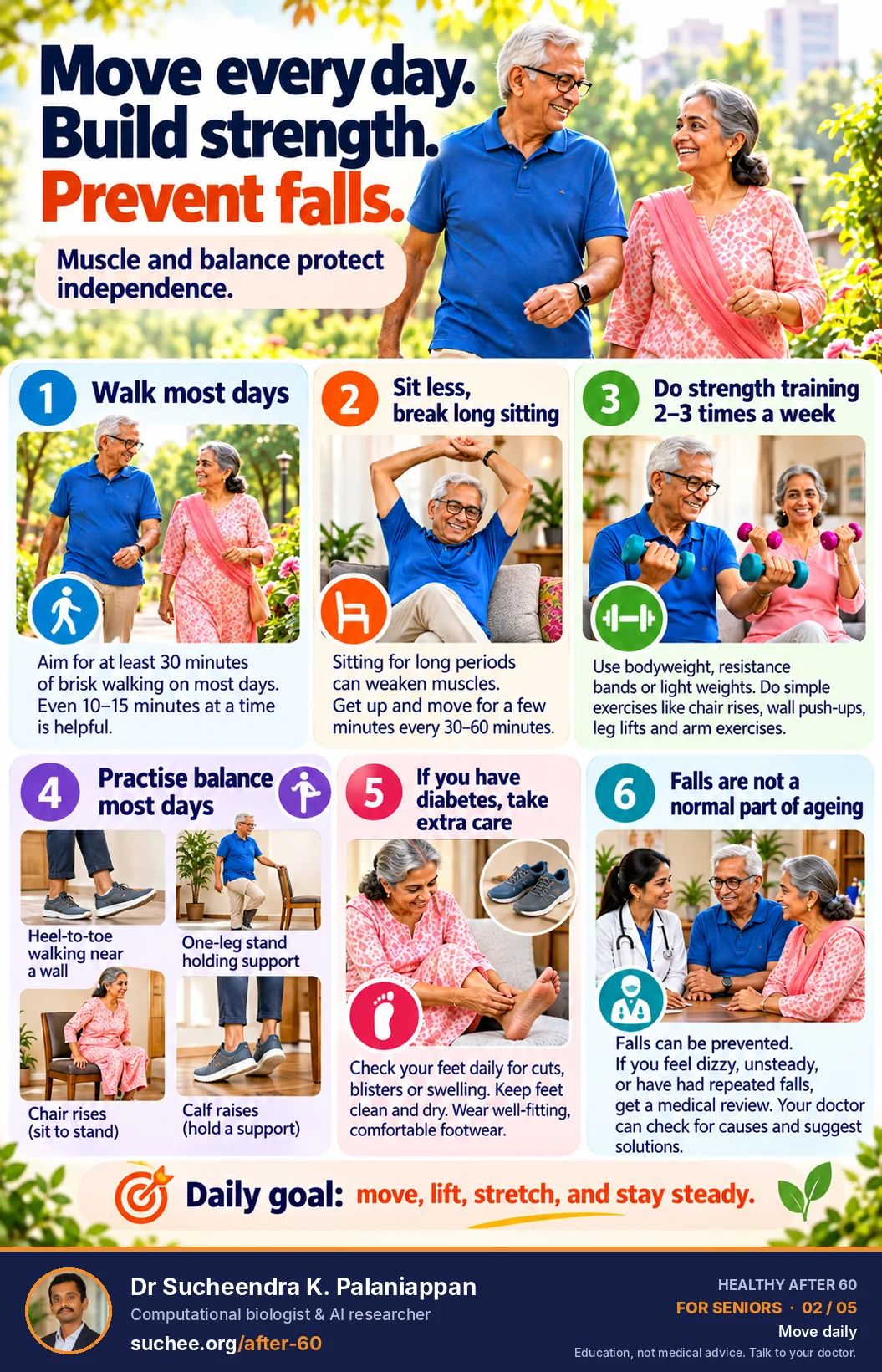
Move daily
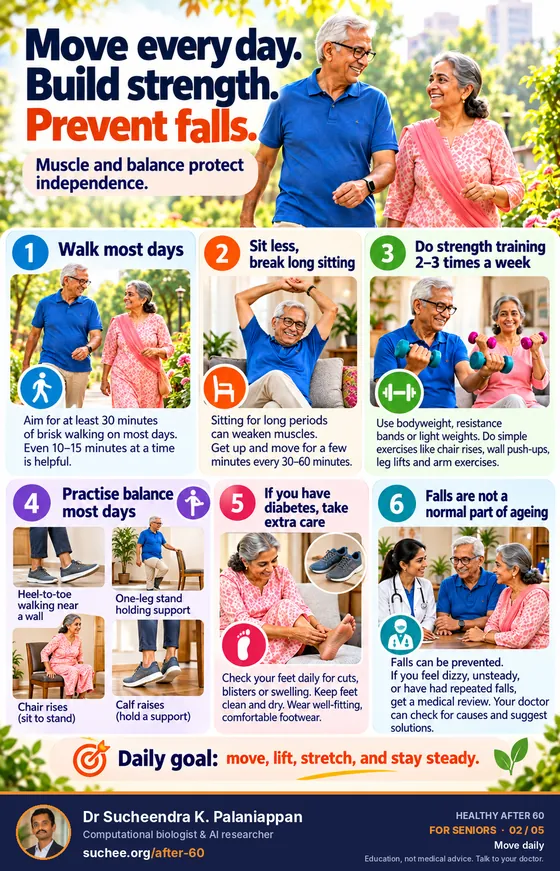
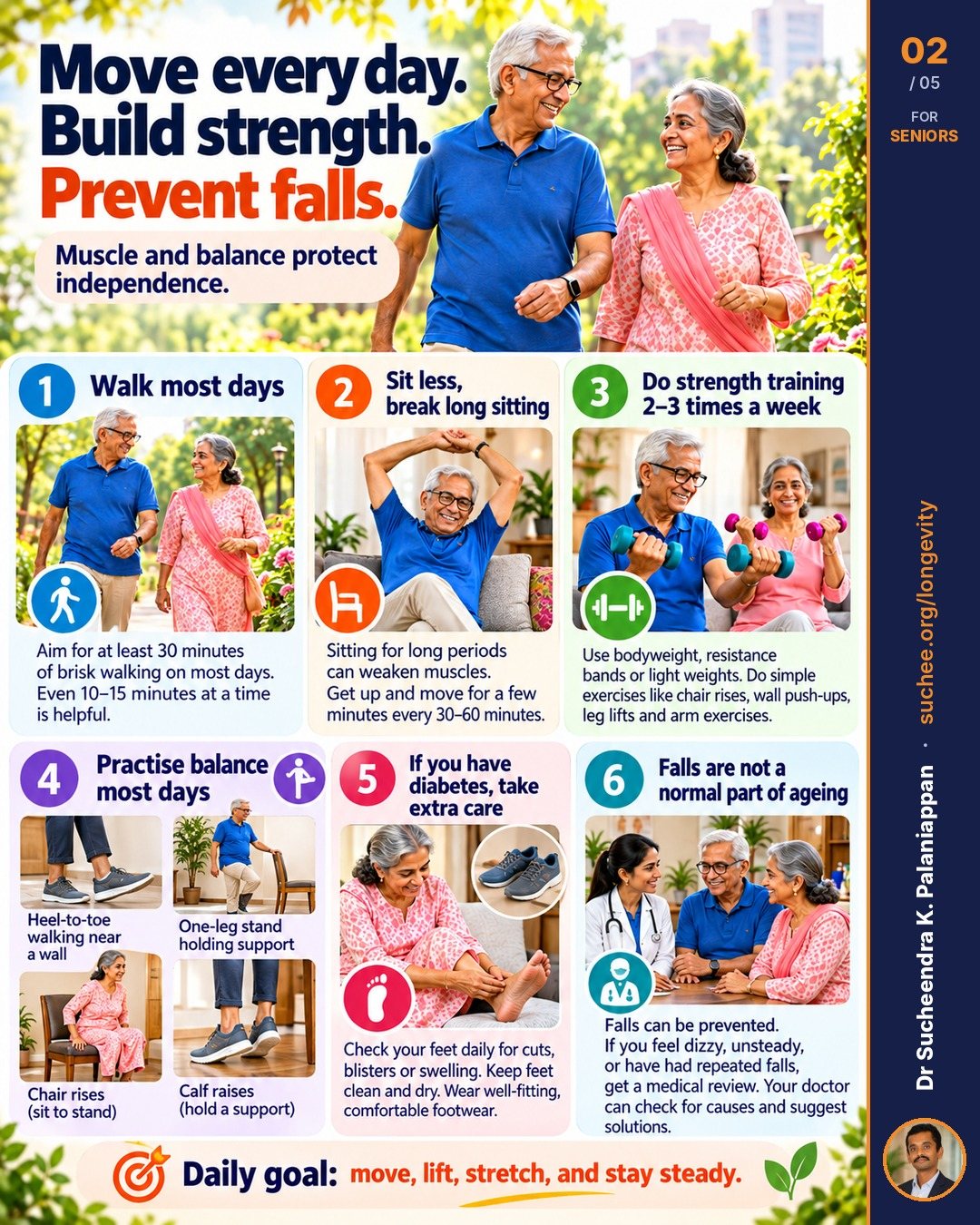
Walk most days, sit less, build strength twice a week and practise balance.
Read as text
- Walk at least 30 minutes on most days. Even 10 to 15 minutes at a time helps. How much to move
- Sit less. Get up and move for a few minutes every 30 to 60 minutes. How much to move
- Do strength training 2 to 3 times a week: chair rises, wall push-ups, bands or light weights. How much to move
- Practise balance most days: heel-to-toe walking, a one-leg stand holding a support, calf raises. Exercise prevents falls
- With diabetes, check your feet daily and wear well-fitting shoes.
- Falls are not a normal part of ageing. If you feel dizzy or unsteady, or have fallen more than once, see your doctor. Falls are preventable
-
 03 / 05
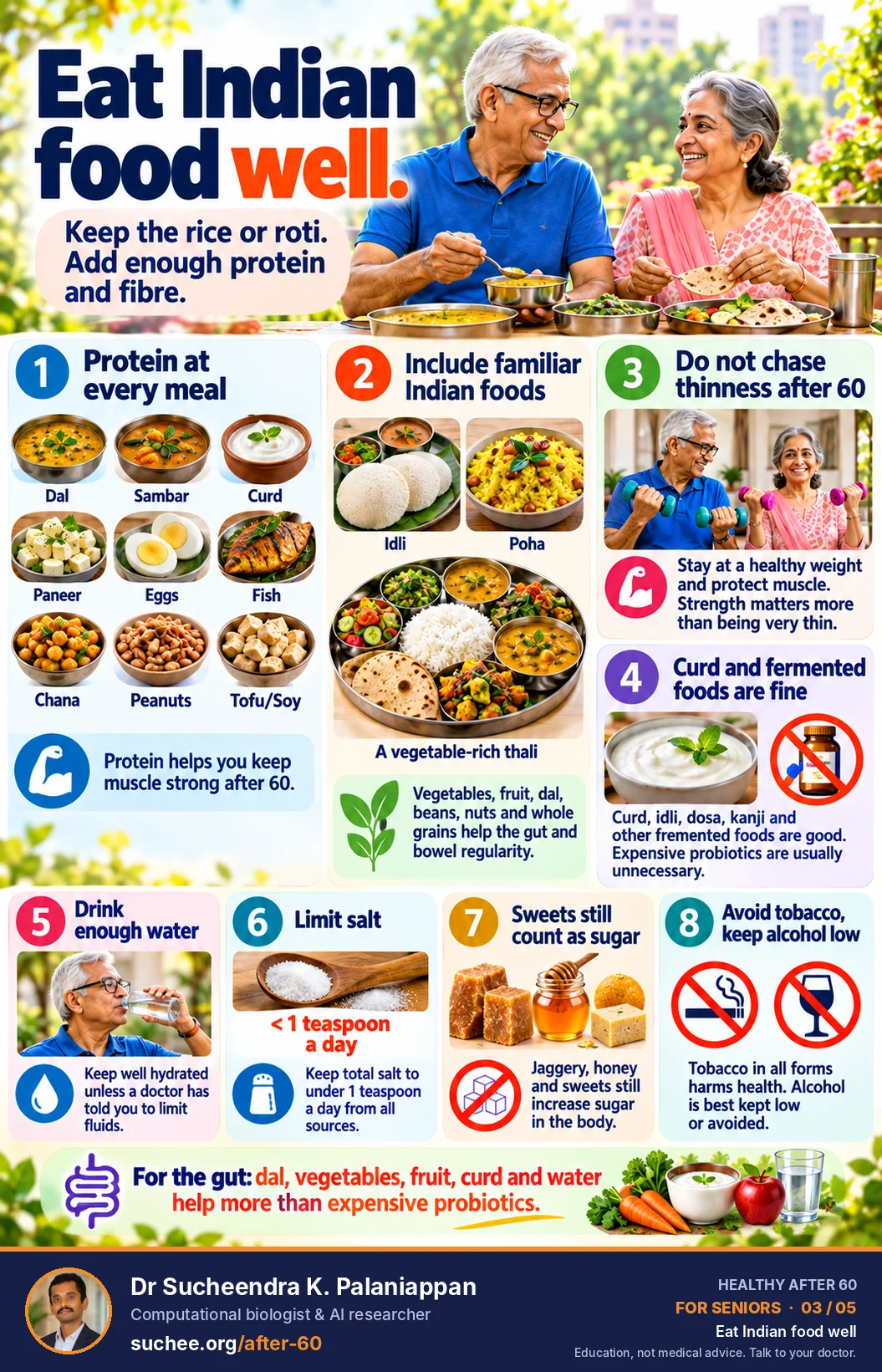
Eat Indian food well
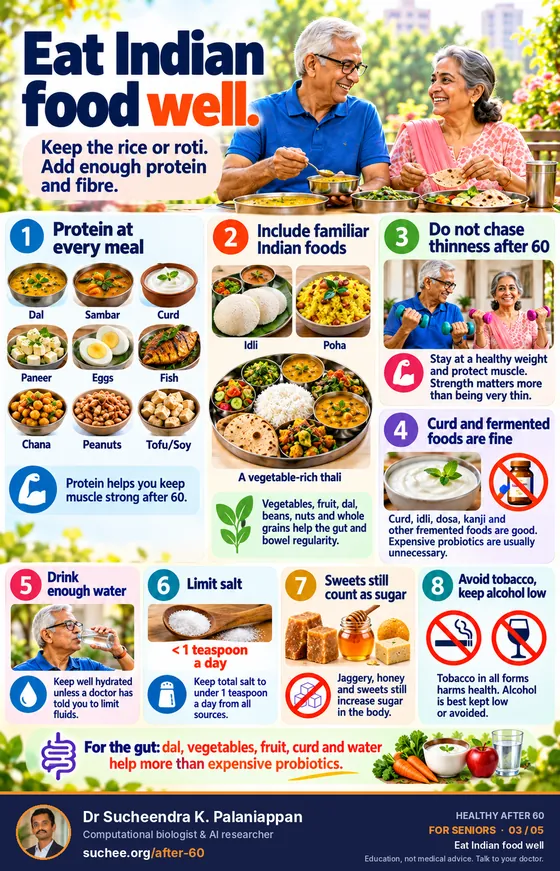
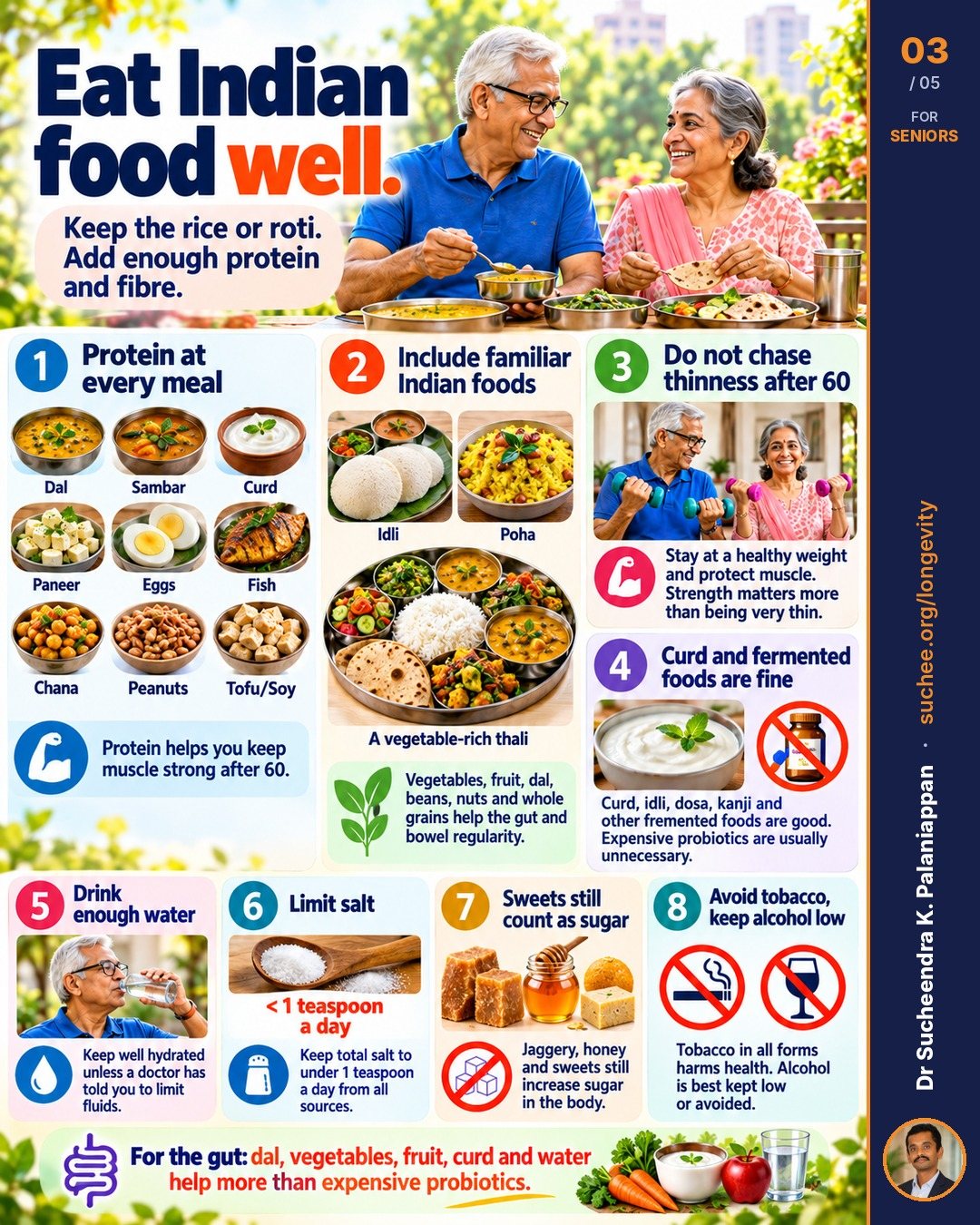
Keep the rice or roti. Add protein at every meal, more vegetables, and under a teaspoon of salt.
Read as text
- Keep the rice or roti. Add protein at every meal: dal, sambar, curd, paneer, eggs, fish, chana, peanuts or soy. The Indian plate
- Vegetables, fruit, dal, beans, nuts and whole grains help the gut. The Indian plate
- Do not chase thinness after 60. Strength matters more than being very thin. Protein after 65
- Keep total salt under 1 teaspoon a day, from all sources. Salt
- Jaggery, honey and sweets still count as sugar. The Indian plate
- Drink enough water, unless a doctor has told you to limit fluids.
-
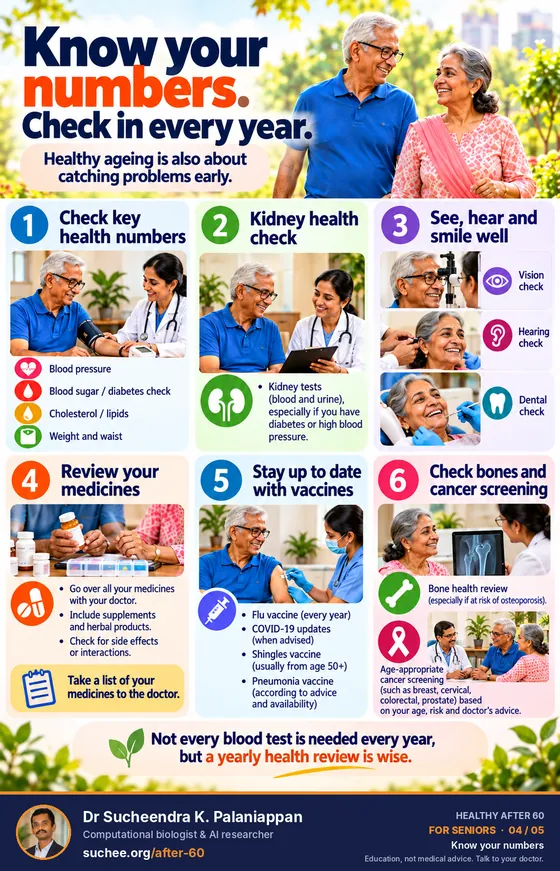 04 / 05
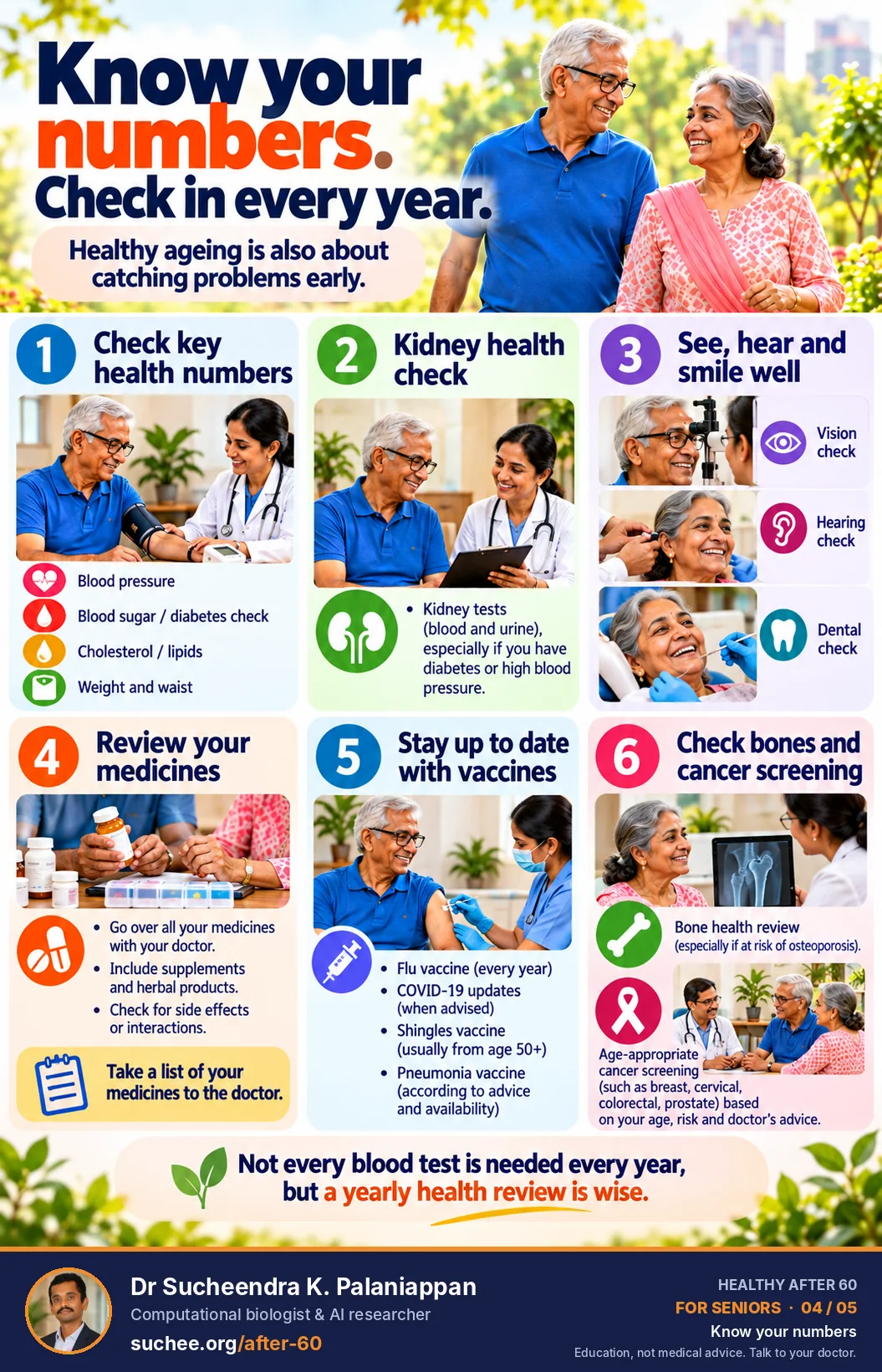
Know your numbers
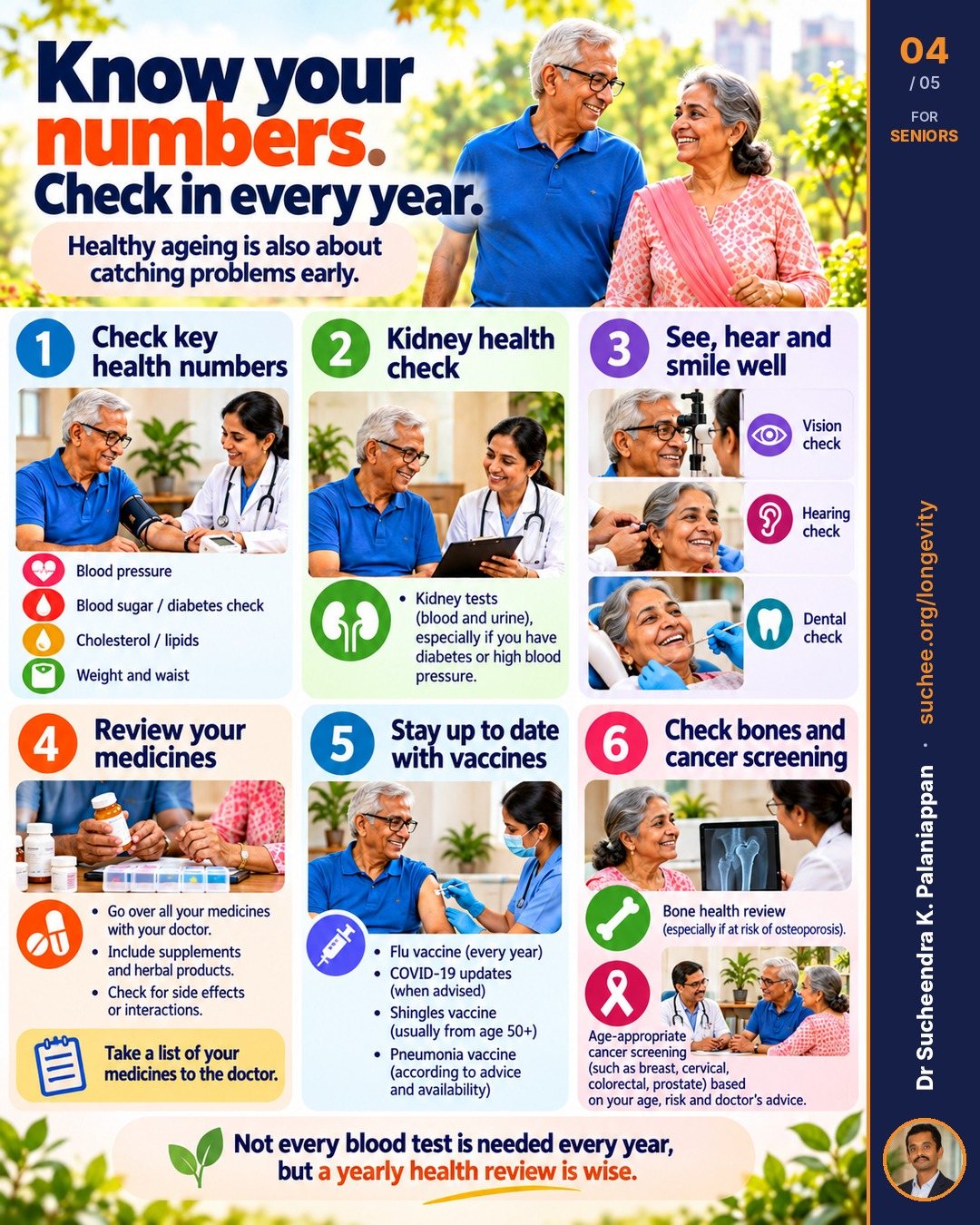
A yearly check of blood pressure, sugar, kidneys, eyes, ears, medicines and vaccines.
Read as text
- Every year, check blood pressure, blood sugar, cholesterol, and weight and waist. Blood pressure and sugar in India · Get checked
- Go over all your medicines with your doctor, including supplements and herbal products. Take a list. Falls are preventable
- Stay up to date with vaccines: flu every year, shingles usually from 50, pneumonia as advised. Shingles
- Have cancer screening that suits your age and risk, as your doctor advises. Get checked
- Get your eyes, hearing and teeth checked.
- Not every blood test is needed every year, but a yearly review is wise. Get checked
-
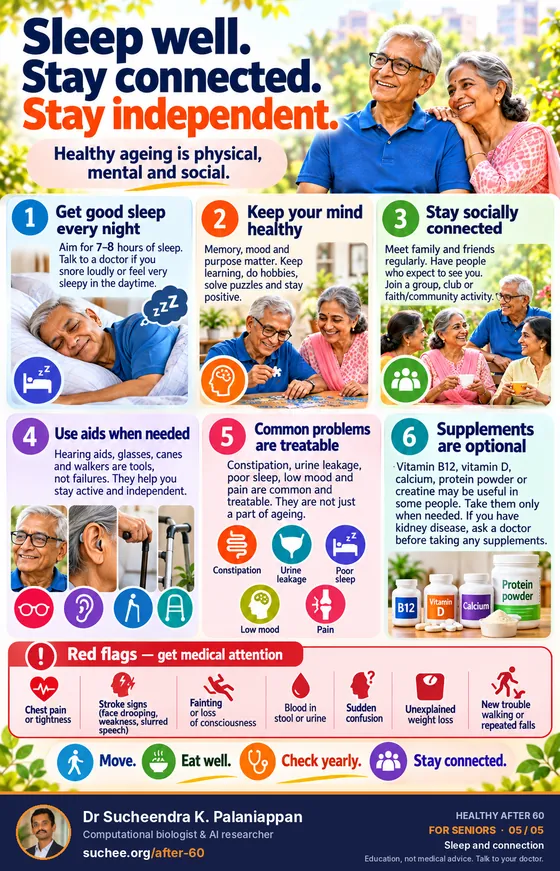 05 / 05
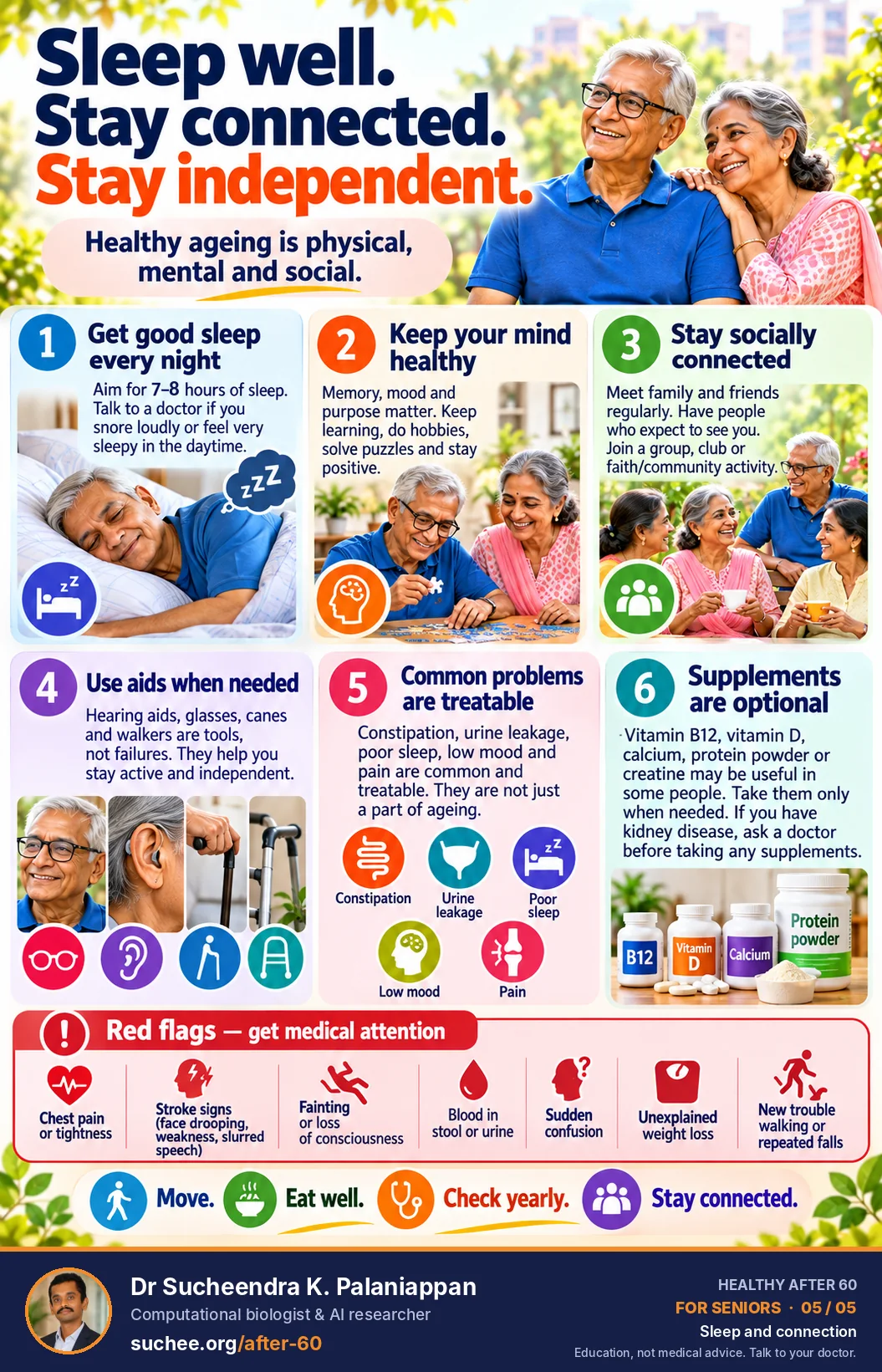
Sleep and connection
Seven to eight hours of sleep, an active mind, people around you, and red flags for the doctor.
Read as text
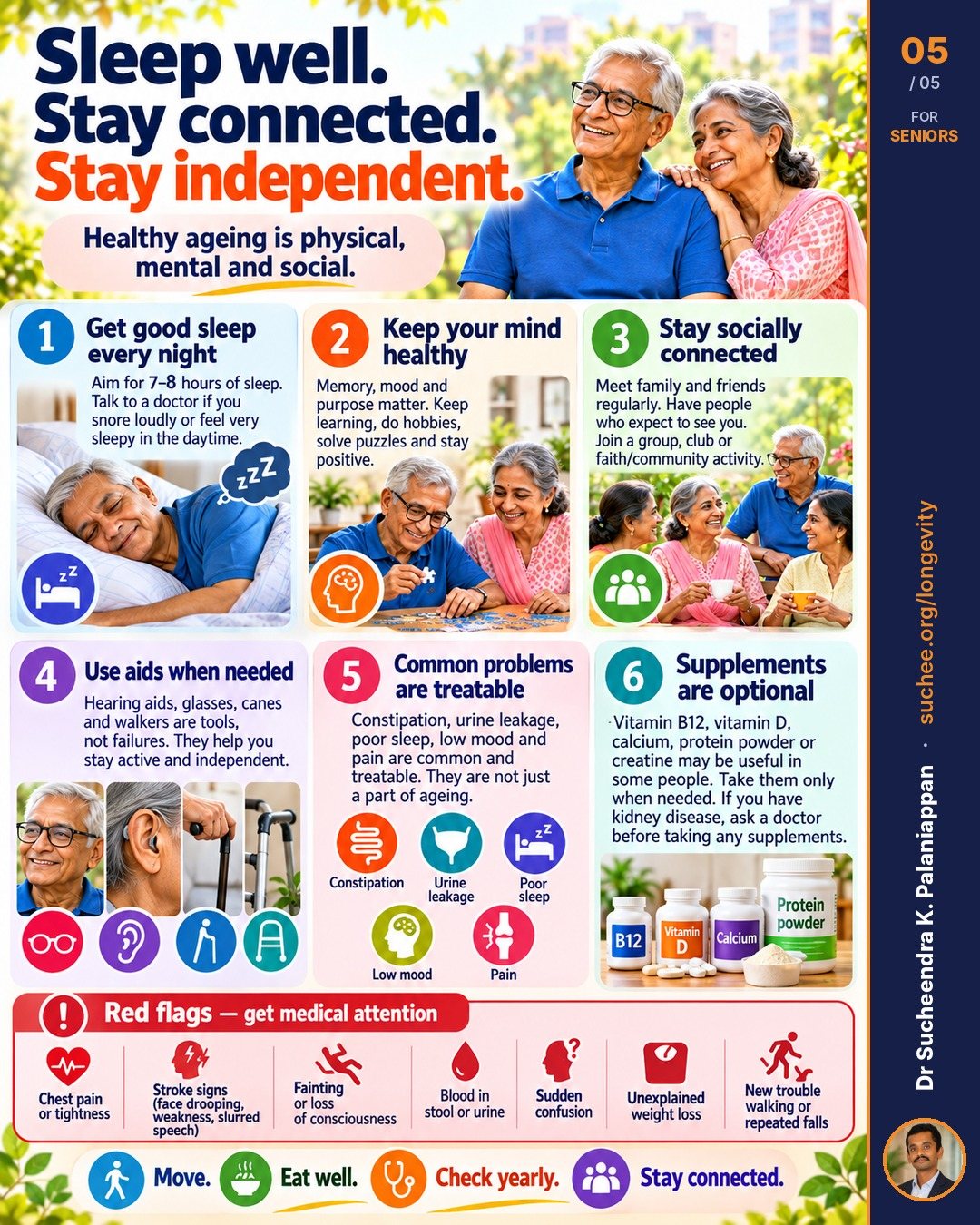
- Aim for 7 to 8 hours of sleep. See a doctor if you snore loudly or are very sleepy in the day. Sleep
- Meet family and friends regularly. Join a group, club or community activity. Staying connected
- Keep learning, do hobbies, solve puzzles.
- Supplements are optional. Take vitamin B12, vitamin D, calcium or protein powder only when needed, and ask a doctor first if you have kidney disease. Other supplements · Vitamin D in India
- Red flags need a doctor now: chest pain, stroke signs, fainting, blood in stool or urine, sudden confusion, unexplained weight loss, new trouble walking or repeated falls.
Swipe for all five →
The same topics, with the evidence
Proven, promising or marketing. Detailed enough to take to the doctor.
-
01 / 05
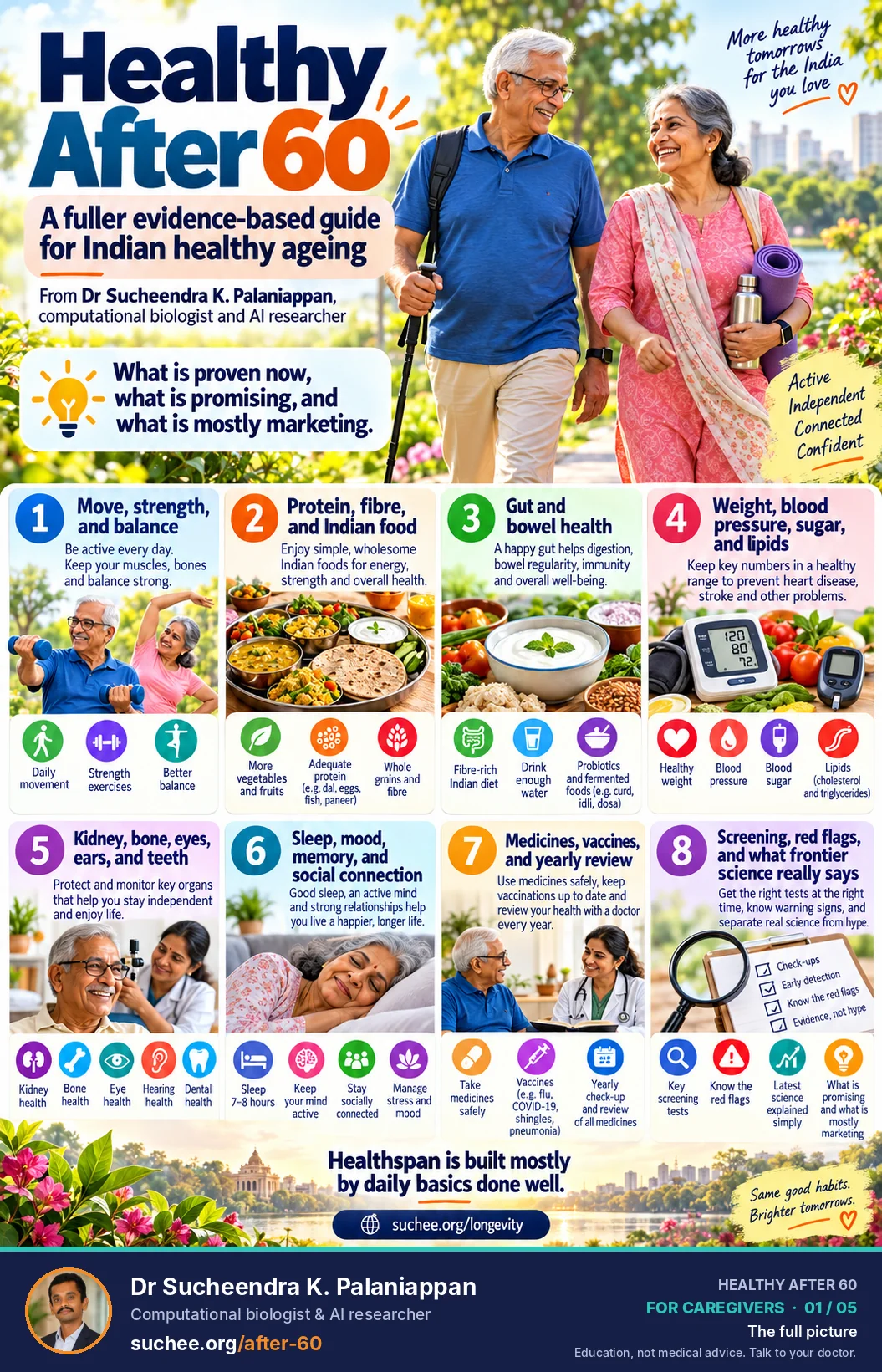
The full picture
The whole picture, from strength and food to screening and red flags.
Read as text
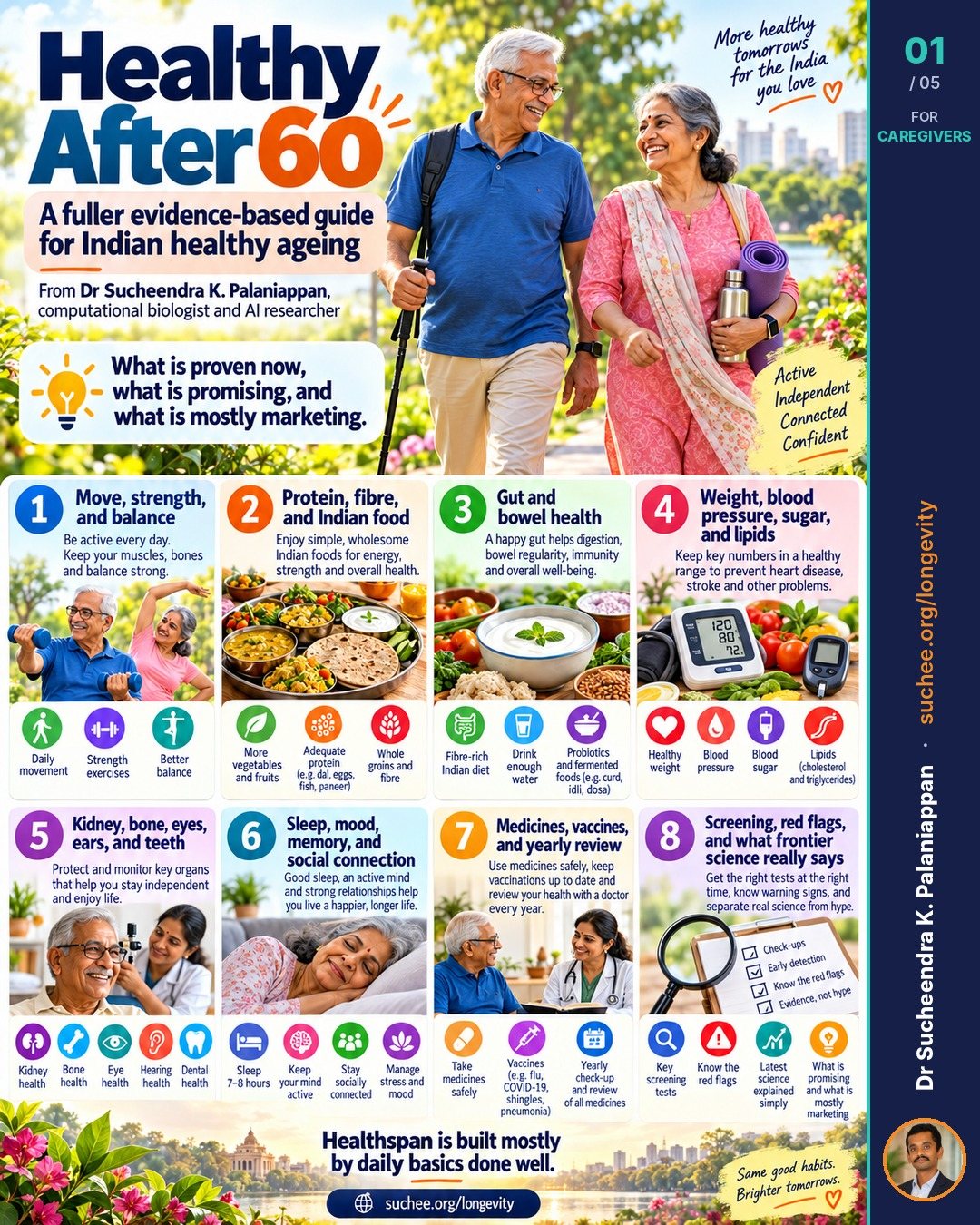
- Be active every day, and keep muscles, bones and balance strong. How much to move
- Simple Indian food with enough protein and fibre. The Indian plate · Protein after 65
- Keep weight, blood pressure, sugar and lipids in a healthy range. Blood pressure and sugar in India
- Sleep well, keep the mind active, stay connected. Sleep · Staying connected
- Use medicines safely, keep vaccines up to date, and have a yearly review. Shingles · Get checked
- Get the right tests at the right time, and separate real science from hype. Other supplements
-
 02 / 05
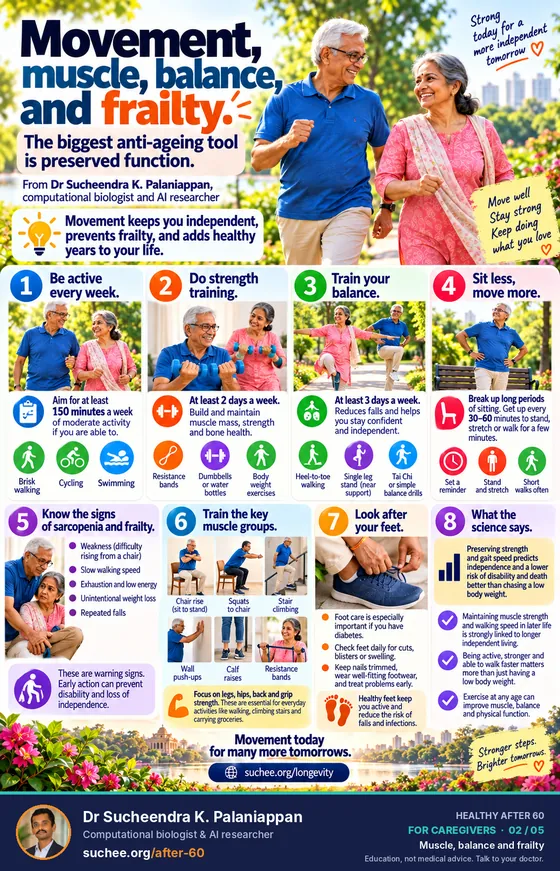
Muscle, balance and frailty
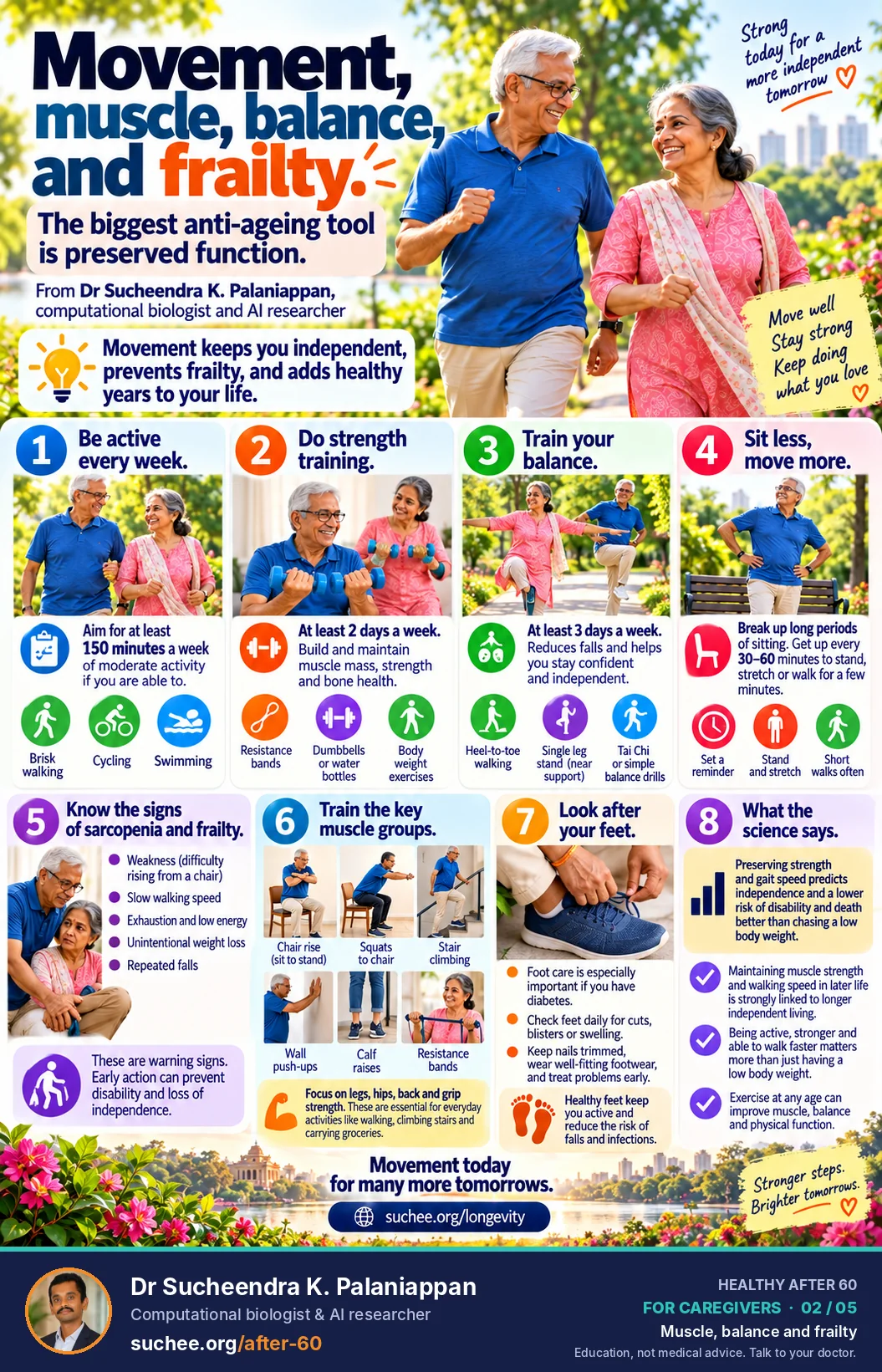
150 minutes a week, strength on two days, balance on three, and early signs of muscle loss.
Read as text
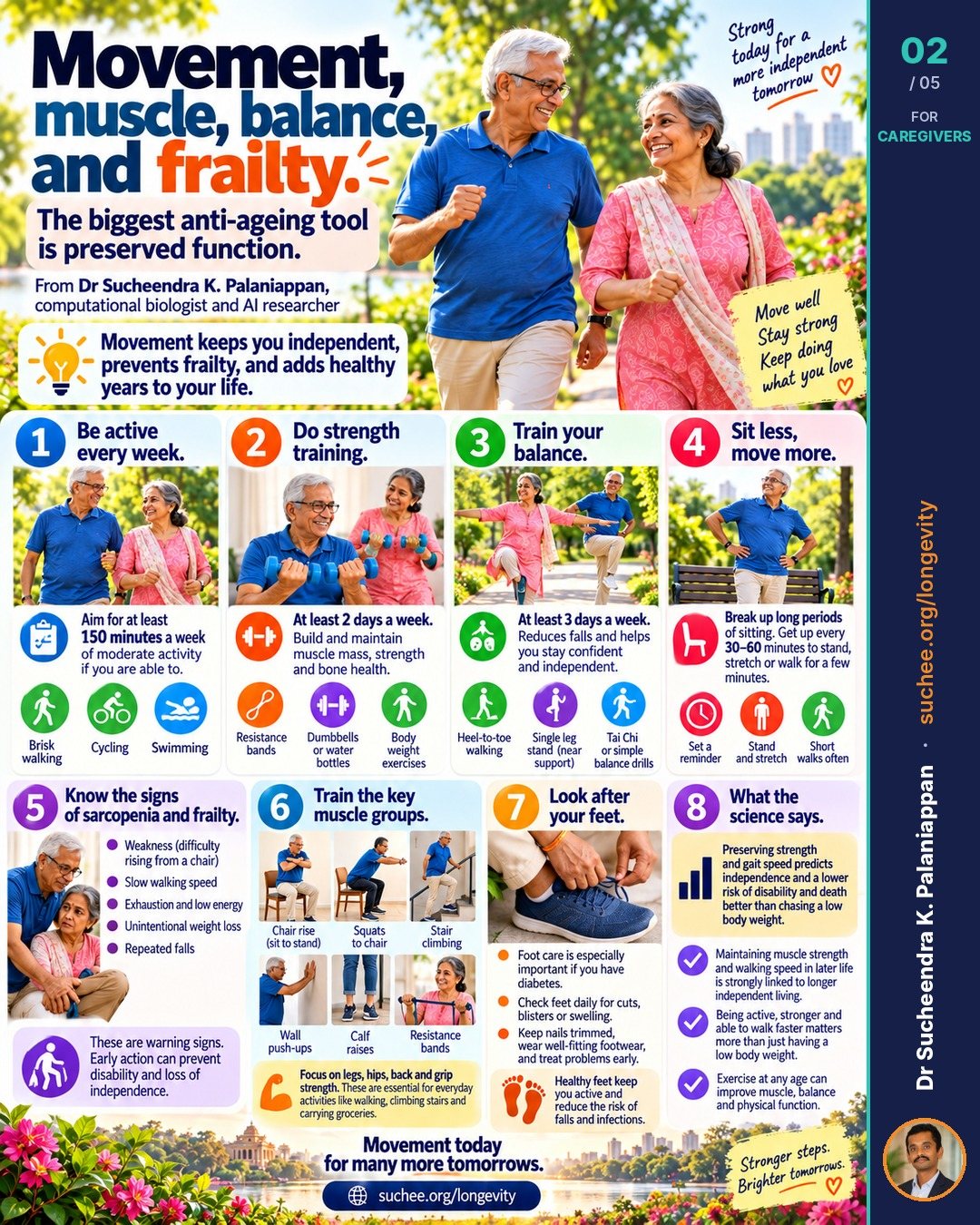
- At least 150 minutes of moderate activity a week, if able. How much to move
- Strength training on at least 2 days a week, focused on legs, hips, back and grip. How much to move
- Balance training on at least 3 days a week. It reduces falls. How much to move · Exercise prevents falls
- Break up sitting every 30 to 60 minutes. How much to move
- Signs of muscle loss and frailty: weakness rising from a chair, slow walking, exhaustion, unintended weight loss, repeated falls. Act early. Falls are preventable
- Foot care matters, especially with diabetes: check daily, trim nails, wear well-fitting shoes.
-
 03 / 05
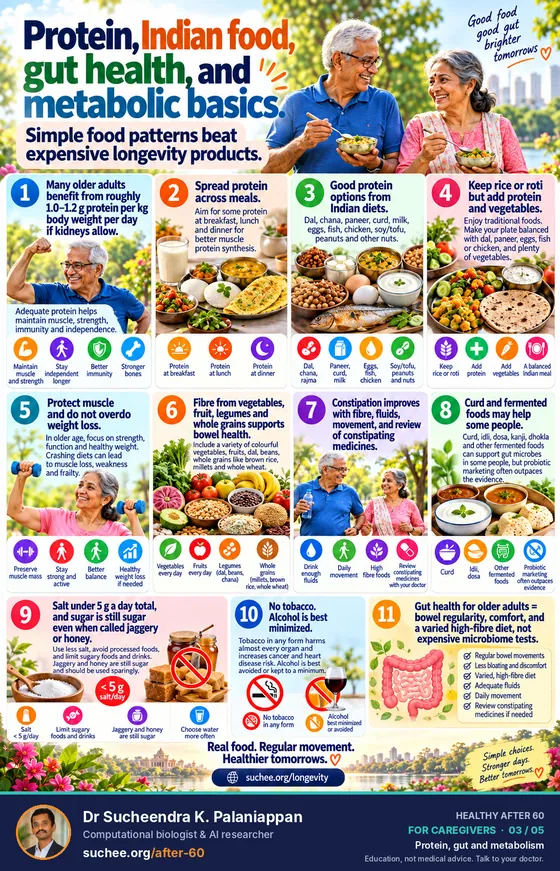
Protein, gut and metabolism
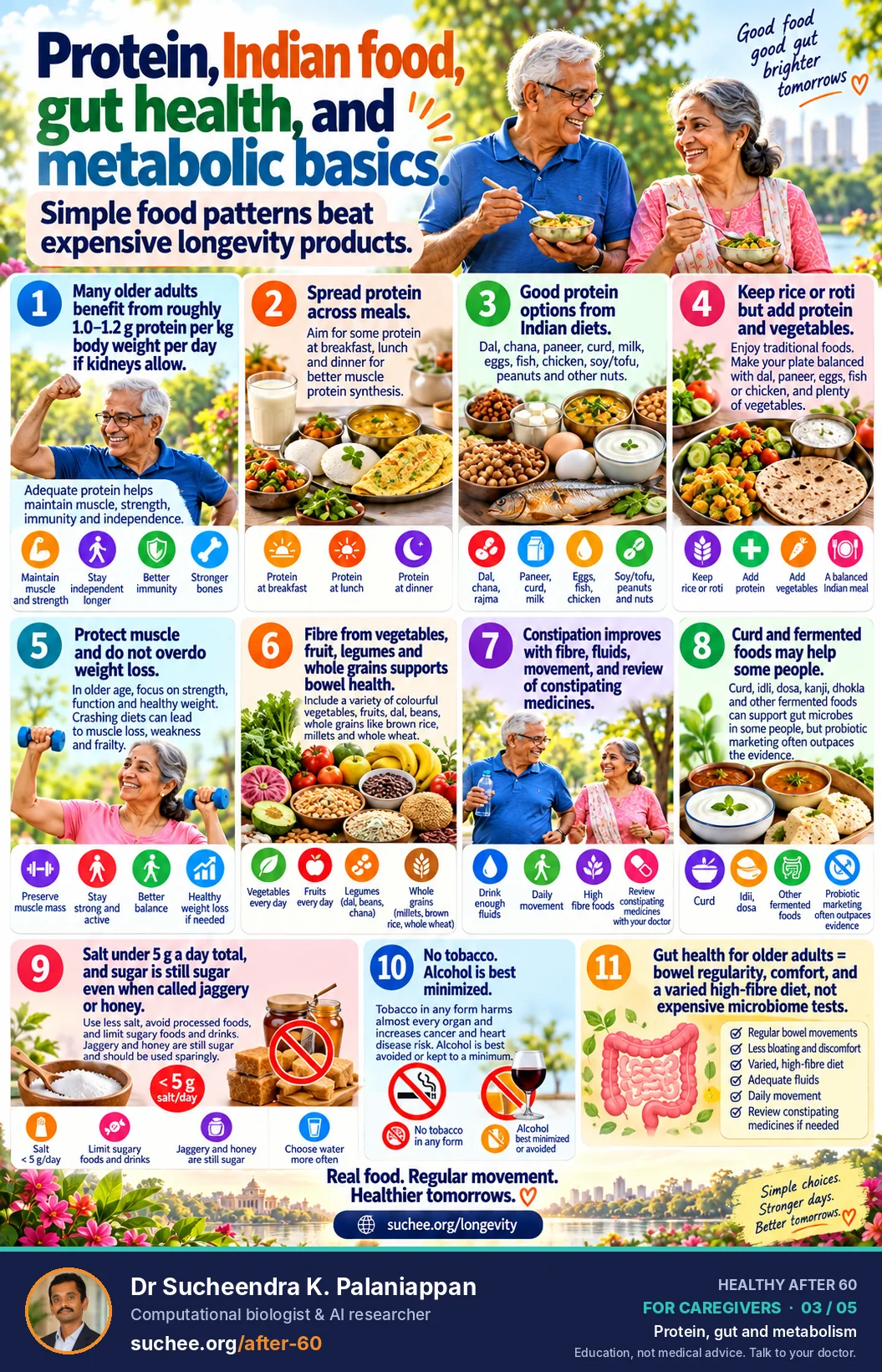
1.0–1.2 g of protein per kg from everyday Indian foods, fibre and curd for the gut, and salt under 5 g.
Read as text
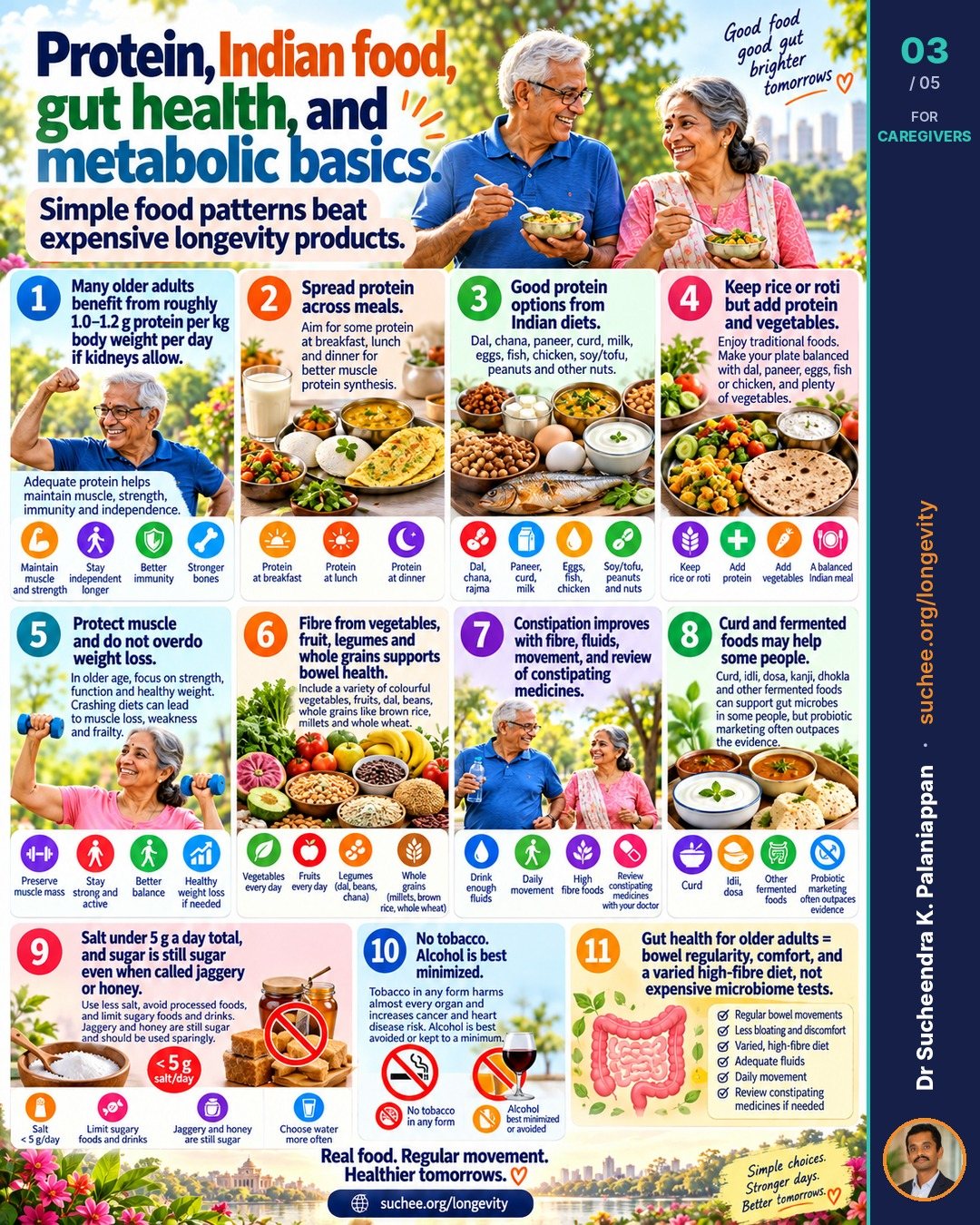
- Many older adults benefit from about 1.0 to 1.2 g of protein per kg of body weight a day, if kidneys allow. Protein after 65
- Spread protein across breakfast, lunch and dinner. Protein after 65
- Indian sources: dal, chana, rajma, paneer, curd, milk, eggs, fish, chicken, soy, peanuts. The Indian plate
- Fibre from vegetables, fruit, legumes and whole grains supports bowel health. The Indian plate
- Salt under 5 g a day in total. Jaggery and honey are still sugar. Salt · The Indian plate
- Protect muscle. Crash diets cause muscle loss, weakness and frailty. Protein after 65
-
 04 / 05
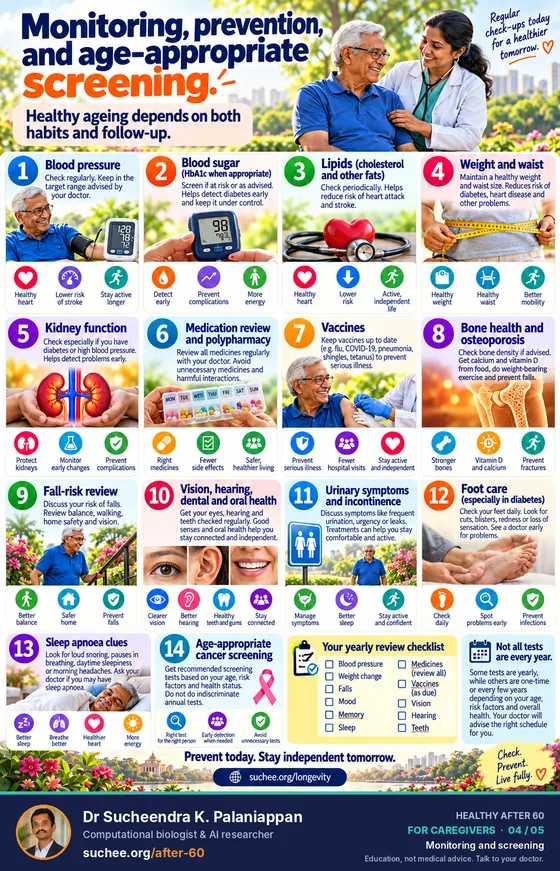
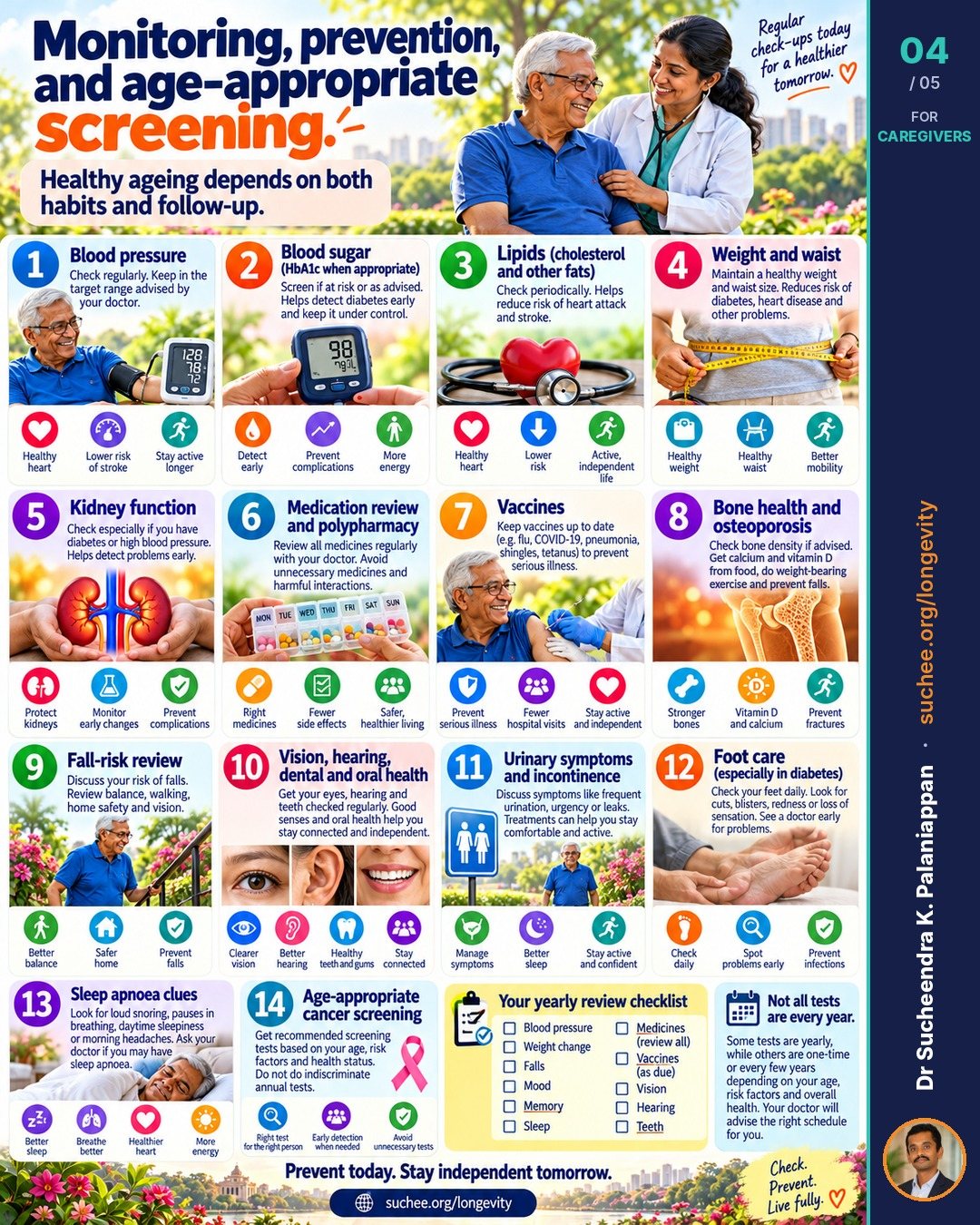
Monitoring and screening
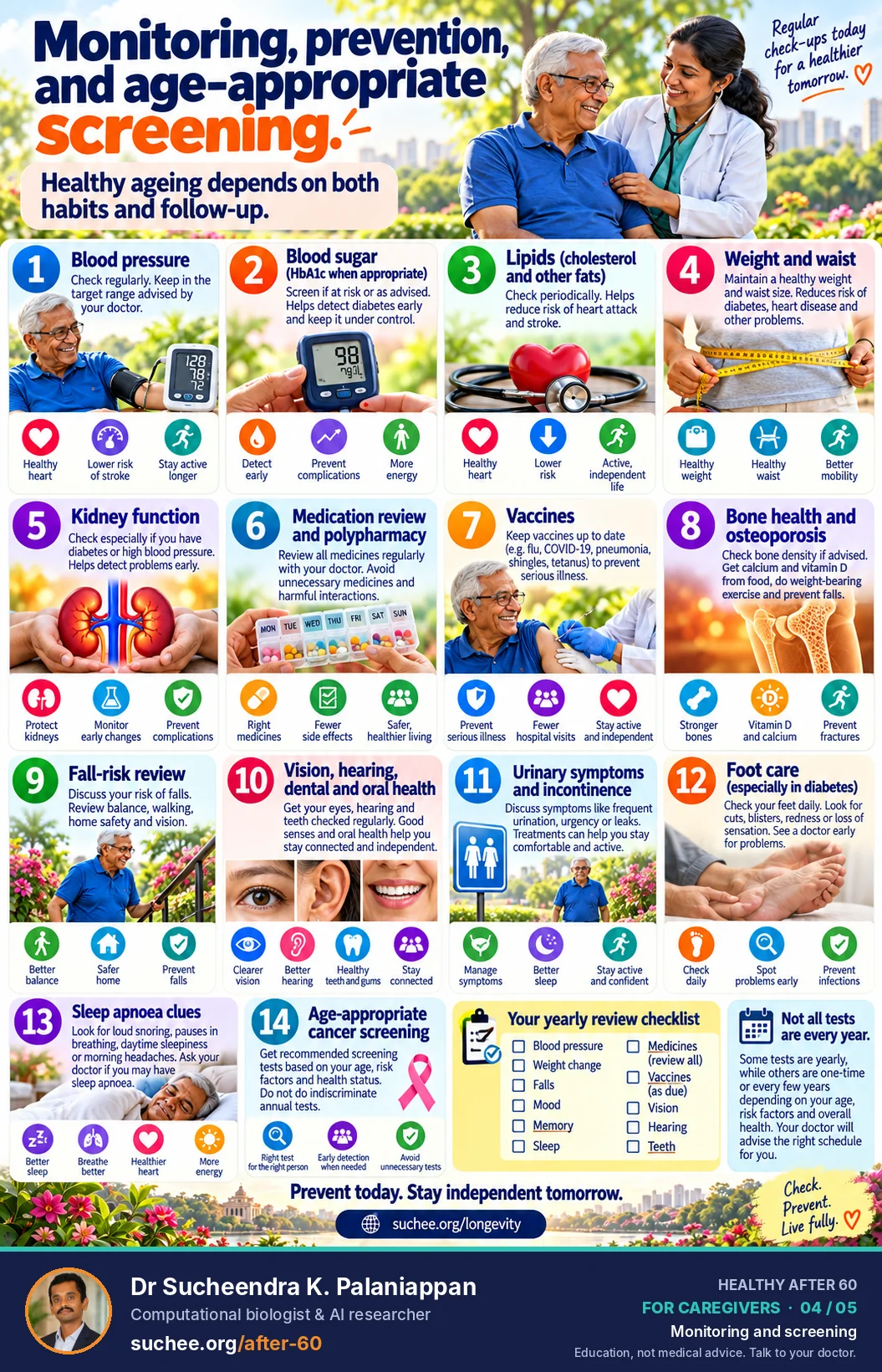
What to check, how often, and a yearly checklist to take along.
Read as text
- Check blood pressure regularly, and keep it in the range your doctor advises. Blood pressure and sugar in India · Get checked
- Screen blood sugar if at risk or as advised. Get checked
- Review all medicines regularly to avoid unnecessary ones and harmful interactions. Falls are preventable
- Keep vaccines up to date: flu, COVID-19, pneumonia, shingles. Shingles
- For bones, get calcium and vitamin D from food, do weight-bearing exercise, and prevent falls. Calcium and vitamin D pills · Falls are preventable
- Not every test is yearly. Your doctor will advise the schedule. Get checked
-
 05 / 05
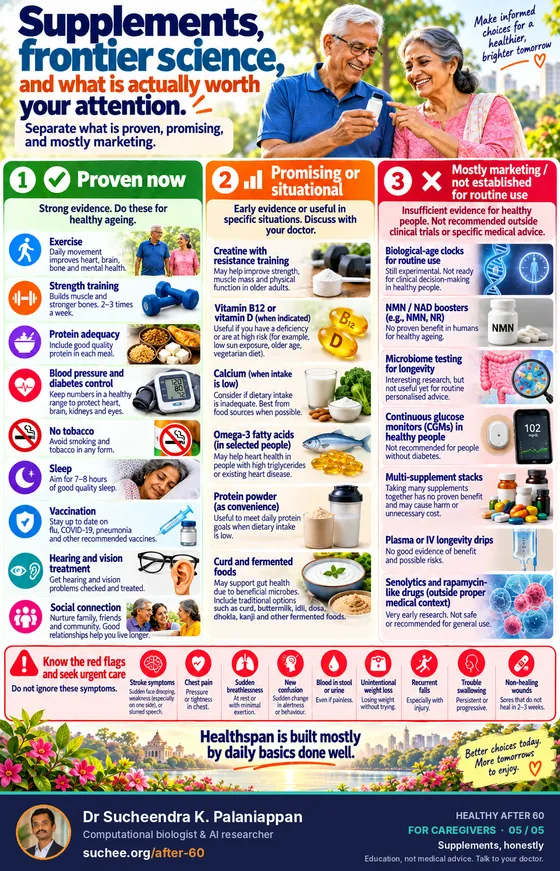
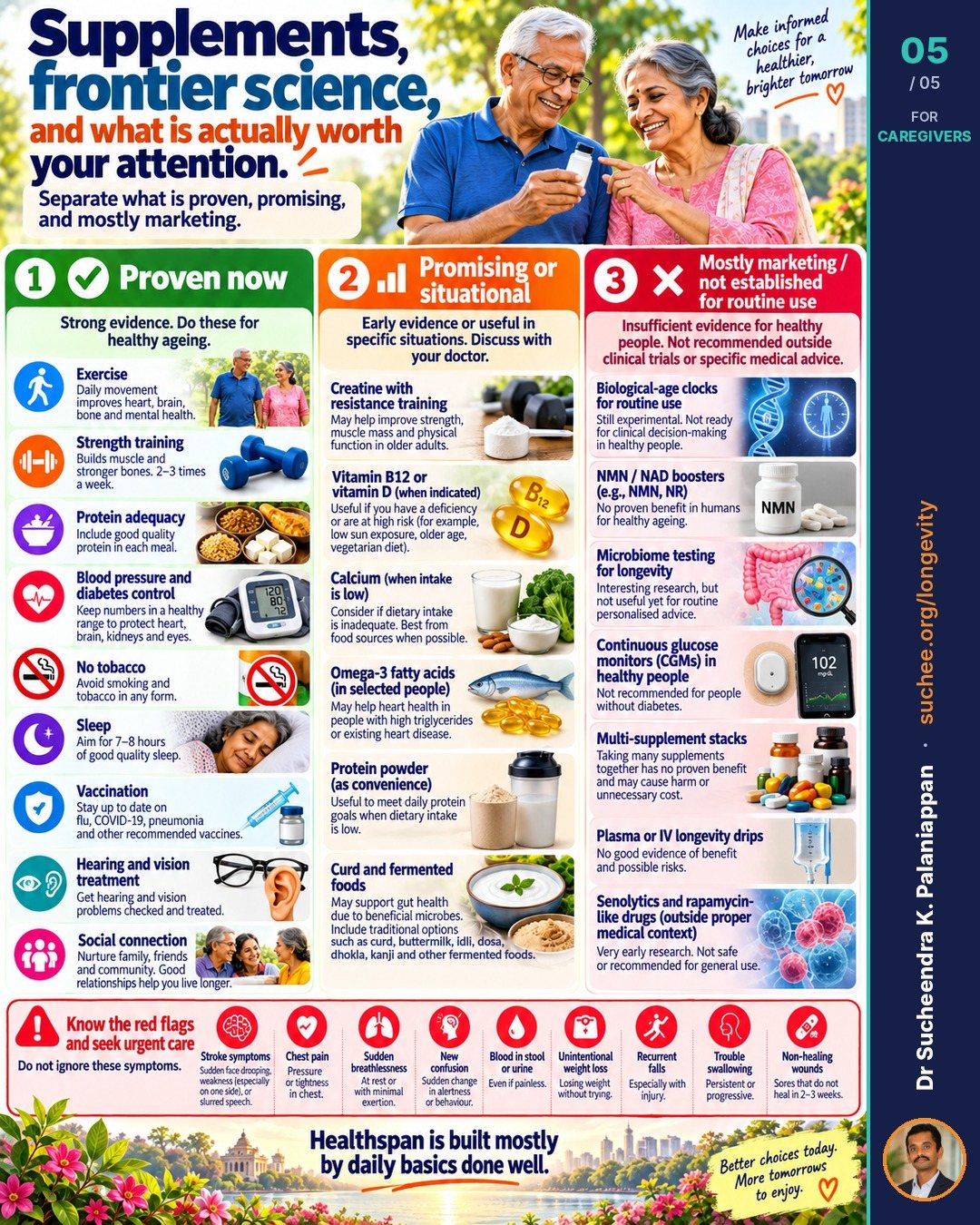
Supplements, honestly
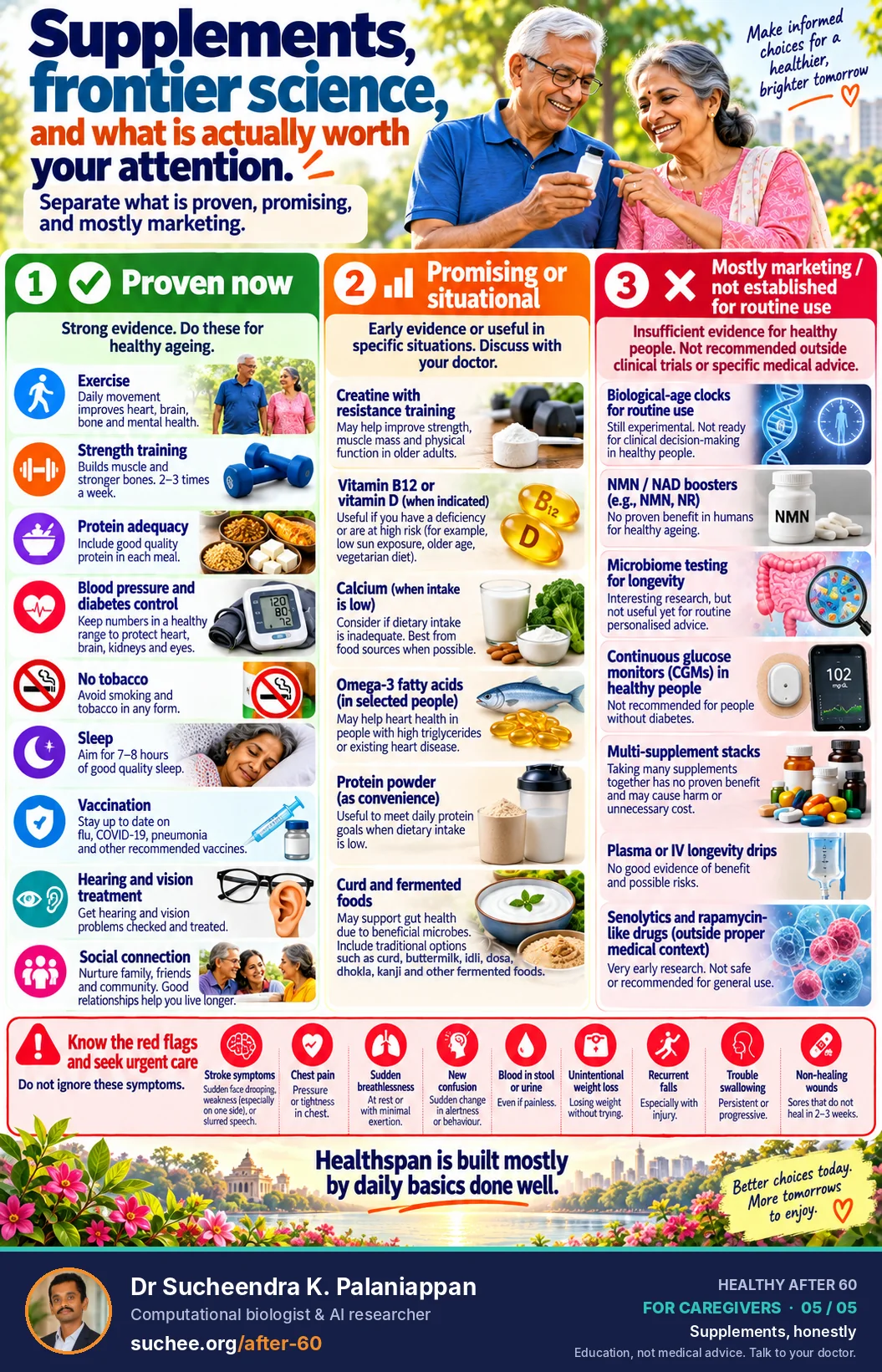
Proven, promising or marketing: where money is well spent, and where it is not.
Read as text
- Proven now: exercise, strength training, enough protein, blood pressure and diabetes control, no tobacco, 7 to 8 hours of sleep, vaccines, social connection. Exercise prevents falls · Sleep · Staying connected
- Useful in some people: vitamin B12 or D when deficient or at high risk, and calcium when intake is low, food first. Discuss with your doctor. Vitamin D in India · Calcium and vitamin D pills
- Taking many supplements together has no proven benefit and may cause harm. Other supplements
- Not established for healthy people: NMN or NAD boosters, routine biological-age clocks, microbiome tests, glucose monitors without diabetes, IV drips.
- Do not ignore red flags such as stroke signs, chest pain, sudden breathlessness or blood in stool or urine.
Swipe for all five →
What each guide stands on
Most health advice on WhatsApp has no source. Each claim here links to one, with the kind of evidence it is, so you can check it or show your doctor.
- Falls in IndiaAbout 1 in 8 Indians over 60 reported a fall in the past two years: 13.6% of women and 11.4% of men. People with several long-term conditions fell more often.Multimorbidity and falls among older adults in India, LASI Wave 1 National survey · 28,567 adults over 60
- Falls are preventableWorldwide, falls are the second leading cause of unintentional injury death, and adults over 60 suffer the most fatal falls. Exercise, a safer home and a review of medicines prevent many of them.WHO, Falls fact sheet Fact sheet · Montero-Odasso et al., World guidelines for falls prevention, Age and Ageing 2022 Guideline · 96 experts, 39 countries
- Exercise prevents fallsIn people over 60, exercise lowers the rate of falls by about 23%. Balance and functional exercises do most of the work.Sherrington et al., Exercise for preventing falls in older people living in the community, Cochrane 2019 Systematic review · 108 trials · high-certainty evidence
- How much to move150 to 300 minutes of moderate activity a week, muscle strengthening on 2 or more days, and, after 65, balance and strength training on 3 or more days. Any movement is better than sitting. ICMR-NIN also asks older adults to stay active; WHO sets the numbers.
- The Indian plateGet good-quality protein from food combinations such as dal with rice or roti, not from protein powders. Eat a wide variety of foods with more vegetables and pulses, and keep added salt to 5 g a day at most.ICMR-NIN, Dietary Guidelines for Indians, 2024 National guideline
- Protein after 65India’s guidelines set 0.83 g of protein per kg of body weight a day for adults in general. Geriatric experts recommend more after 65, on average 1.0 to 1.2 g/kg, and less with severe kidney disease. This is why the guides say “if kidneys allow” and pair protein with strength training.ICMR-NIN, Dietary Guidelines for Indians, 2024 National guideline · Bauer et al., PROT-AGE Study Group position paper, JAMDA 2013 Expert consensus
- SaltLess than 5 g of salt a day, about one teaspoon. ICMR-NIN sets the same limit for Indians. Most adults eat roughly double that.WHO, Sodium reduction fact sheet Fact sheet
- Blood pressure and sugar in IndiaAmong Indian adults, 35.5% have high blood pressure, 11.4% have diabetes and another 15.3% have prediabetes. That is about 315 million and 101 million people.Anjana et al., ICMR-INDIAB-17, Lancet Diabetes & Endocrinology 2023 National survey · 113,043 adults, 31 states and UTs
- Get checkedIndia’s national NCD programme screens every adult over 30 for high blood pressure, diabetes and common cancers of the mouth, breast and cervix, at government health centres. Use it, and keep the numbers.MoHFW, NP-NCD Operational Guidelines National programme
- ShinglesThe recombinant shingles vaccine is licensed in India for adults aged 50 and over, and India’s adult immunisation guidance from the Association of Physicians of India includes it. The schedule of two doses, even after a past episode, comes from the US CDC, because no Indian public schedule sets it out.Review of the API adult immunisation guidelines, IJCMPH 2024 Review of Indian guideline · CDC, Shingles vaccine recommendations US guideline
- Vitamin D in IndiaLow vitamin D is very common in older Indians. In a Delhi study of healthy adults over 50, 91% were deficient. Data from other regions is thin.Marwaha et al., Vitamin D status in healthy Indians aged 50 and above, JAPI 2011 Cross-sectional study · 1,346 adults, Delhi
- Calcium and vitamin D pillsGet calcium and vitamin D from food and sunlight first. Low-dose supplements do not prevent fractures in healthy older adults, so take one only if your doctor advises it, for example after a blood test.USPSTF, Vitamin D and calcium to prevent fractures US guideline · update in progress No Indian guideline covers this.
- Other supplementsBeta-carotene and vitamin E should not be taken to prevent heart disease or cancer, and for multivitamins the evidence is too thin either way. ICMR-NIN advises against protein powders. That is why the guides sort supplements into proven, promising and mostly marketing.USPSTF, Vitamin, mineral and multivitamin supplementation, 2022 US guideline No Indian guideline covers this.
- Sleep7 to 8 hours a night for adults over 65, a little narrower than the 7 to 9 hours for younger adults.Hirshkowitz et al., National Sleep Foundation recommendations, Sleep Health 2015 Expert panel No Indian guideline covers this.
- Staying connectedAcross 148 studies, people with stronger social ties had about 1.5 times the odds of survival, an effect comparable to well-known risks such as smoking.Holt-Lunstad et al., Social relationships and mortality risk, PLoS Medicine 2010 Meta-analysis · 308,849 people, 148 studies
Guidance changes as evidence grows. When it does, the guides and this list will be updated. Last updated .
How these are made
- Guidelines, not headlines. Every number comes from a guideline or systematic review, linked above. One exciting study does not change a guide.
- Written for Indian families. Dal, curd, idli and roti, not kale and quinoa.
- Habits before products. Products come last, and only if proven.
- Nothing to sell. No clinic, no supplements, no product. Free to print and share.
Want the science behind it?
Longevity, Interpreted. is my weekly reading of longevity research: what was shown, at what stage, and what it does not yet support.