Health by age · 20s and 30s
Healthy after 20 use these years to become strong
In your 20s health feels automatic. It is also when bone reaches its peak and the habits that carry you through your 40s are set.
The guides cover the ordinary things that work: moving most days, lifting twice a week, real Indian food, sleep, your mind, sexual health, the obvious risks, a few numbers and a few vaccines.
Sixteen one-page guides, meant to be read in order, each with a source for every number.
Sources are listed below: Indian ones where they exist (ICMR-NIN, ICMR-INDIAB, Tele MANAS, NACO, the road transport ministry), WHO and international guidelines for the rest, labelled as such.
 Sucheendra Kumar PalaniappanComputational biologist
Read them in order
Tap a guide to open it full screen, then swipe through all sixteen. Each one has a text version and its sources.
-
 01 / 16
Start here
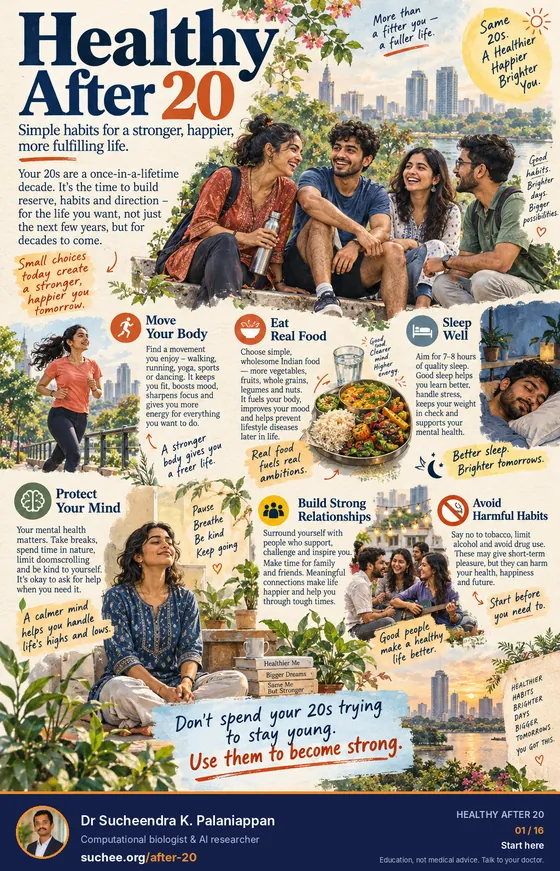
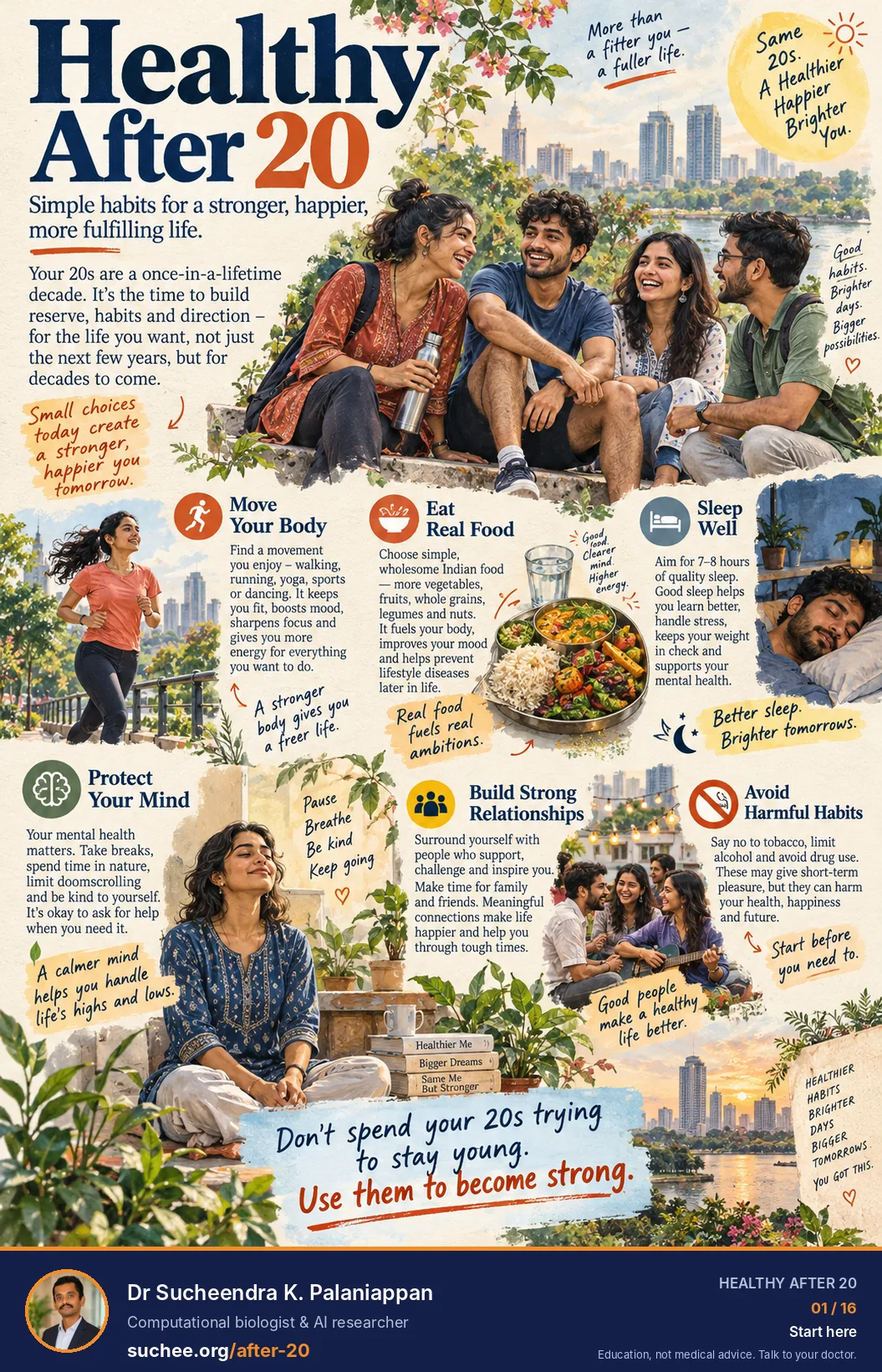
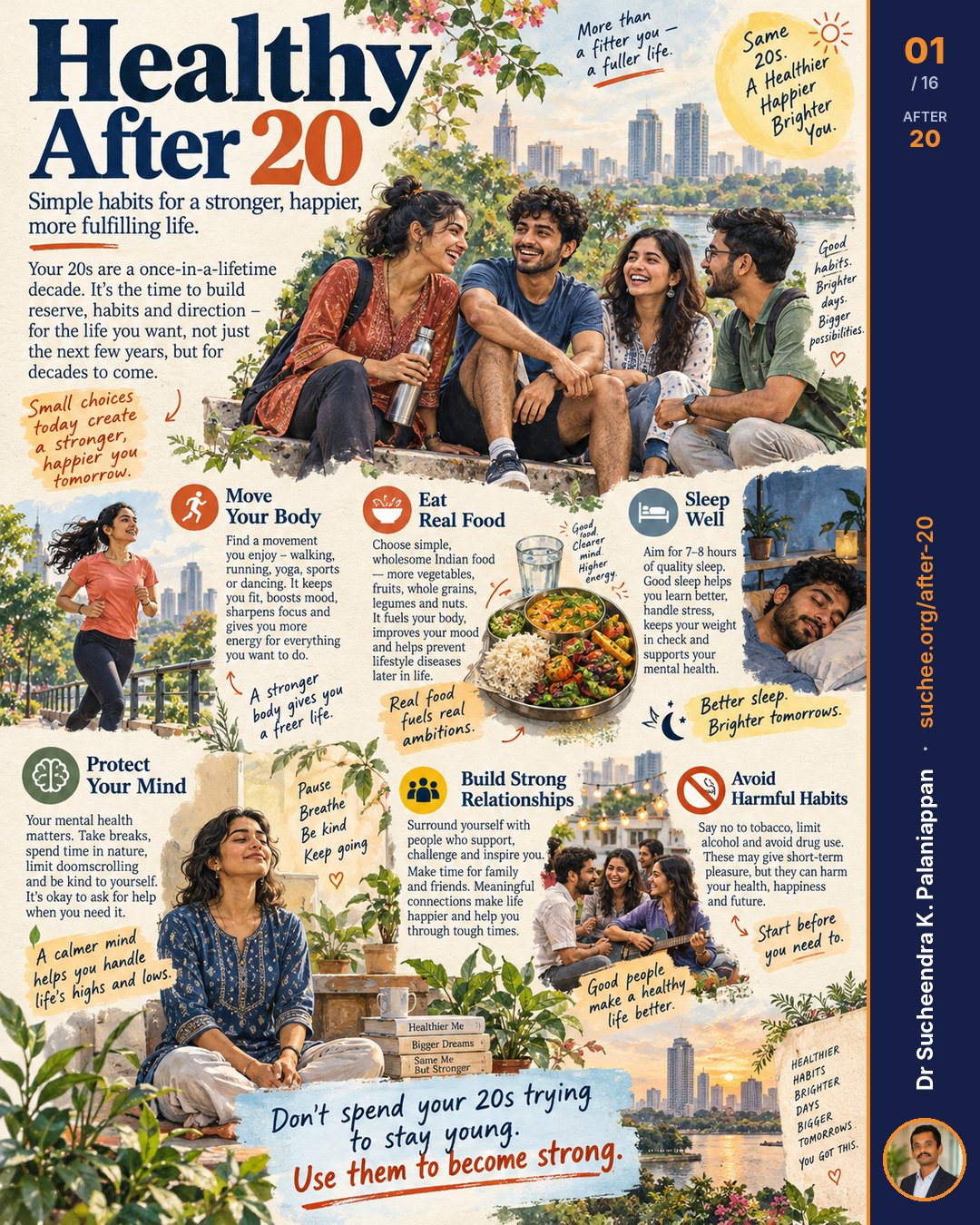
Six habits on one page: move, eat, sleep, mind, people, and what to avoid.
Read as text
- Your 20s are the decade to build reserve, habits and direction for the decades ahead.
- Move in ways you enjoy: walking, running, yoga, sport or dancing. How much to move
- Eat simple Indian food: more vegetables, fruit, whole grains, legumes and nuts. The Indian plate
- Aim for 7 to 9 hours of sleep. Sleep
- Look after your mind: take breaks, limit doomscrolling, and ask for help when you need it. Help for your mind
- Make time for people who support and challenge you. Staying connected
- Say no to tobacco, keep alcohol low and avoid drugs. Tobacco in India · Alcohol
-
 02 / 16
Your 20s are construction years
What you build now shapes how you feel in your 30s, 40s and beyond.
Read as text
- Every habit is a brick in your future self. You do not need to be perfect, only consistent.
- Risk builds quietly: among Indian adults, about a third have high blood pressure and more than a quarter have diabetes or prediabetes. Risk in Indian adults
- Good sleep helps you think clearly, manage emotions and stay healthy. Sleep
- Regular movement lifts mood and energy. It does not have to be intense, just consistent. How much to move
- Learning to pause and manage stress helps you make clearer choices.
- The friends and community you build bring support and opportunity. Staying connected
-
 03 / 16
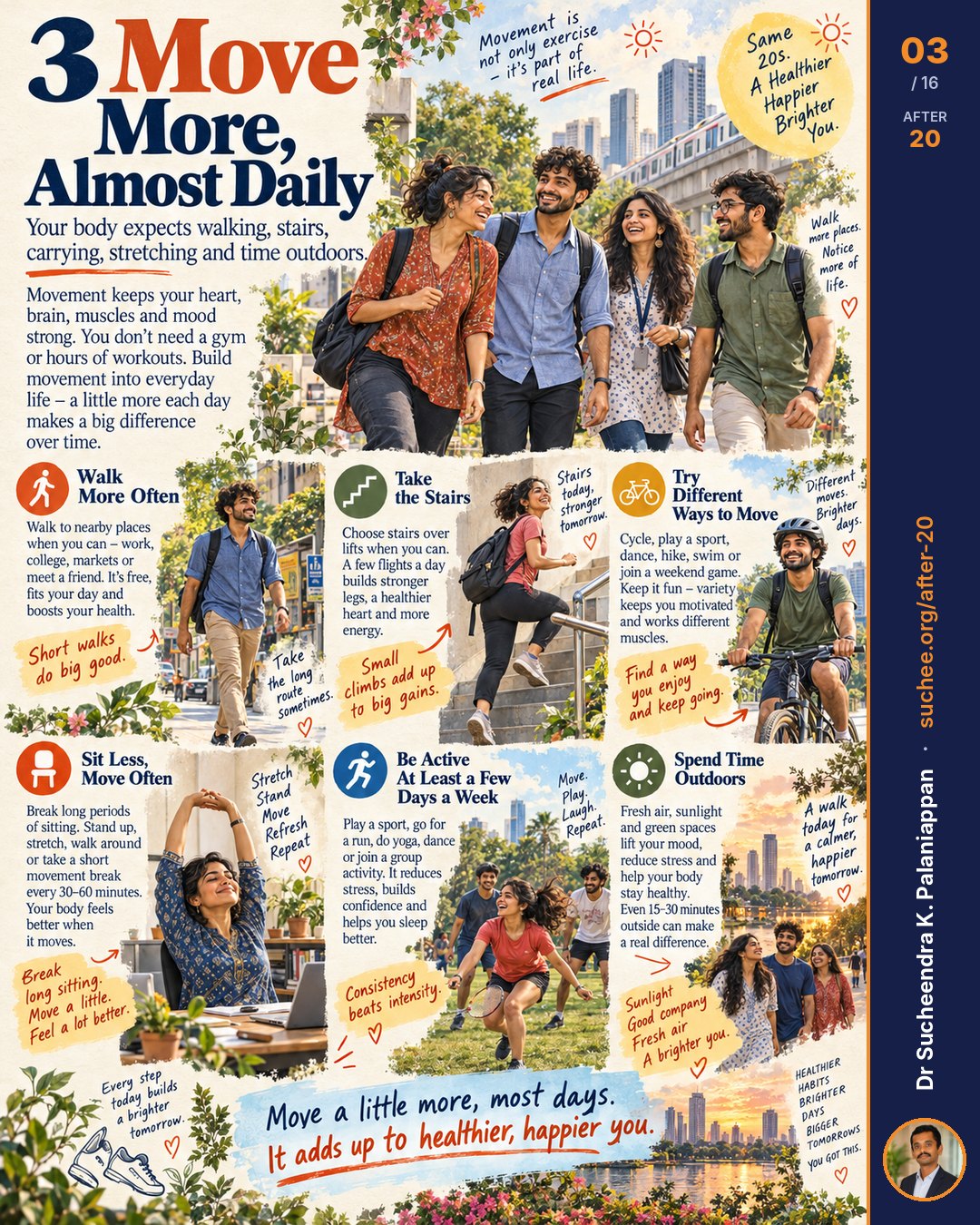
Move more, almost daily
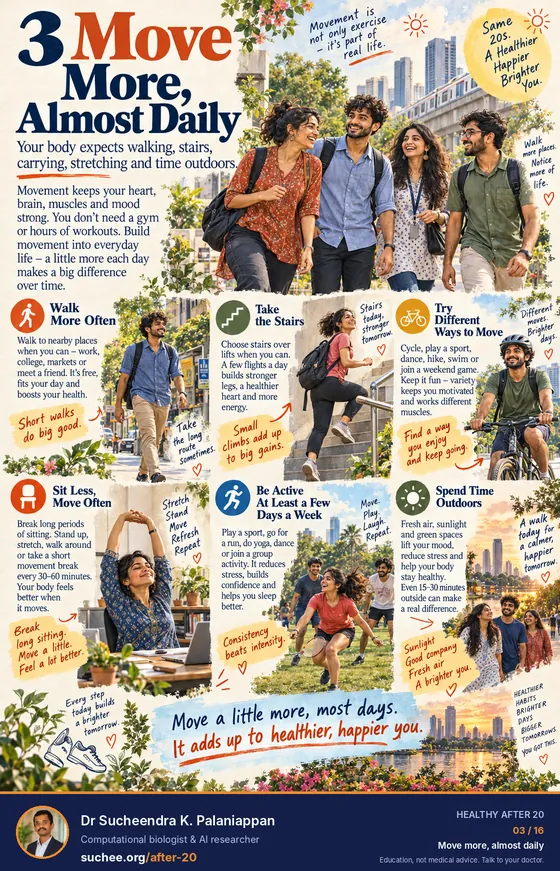
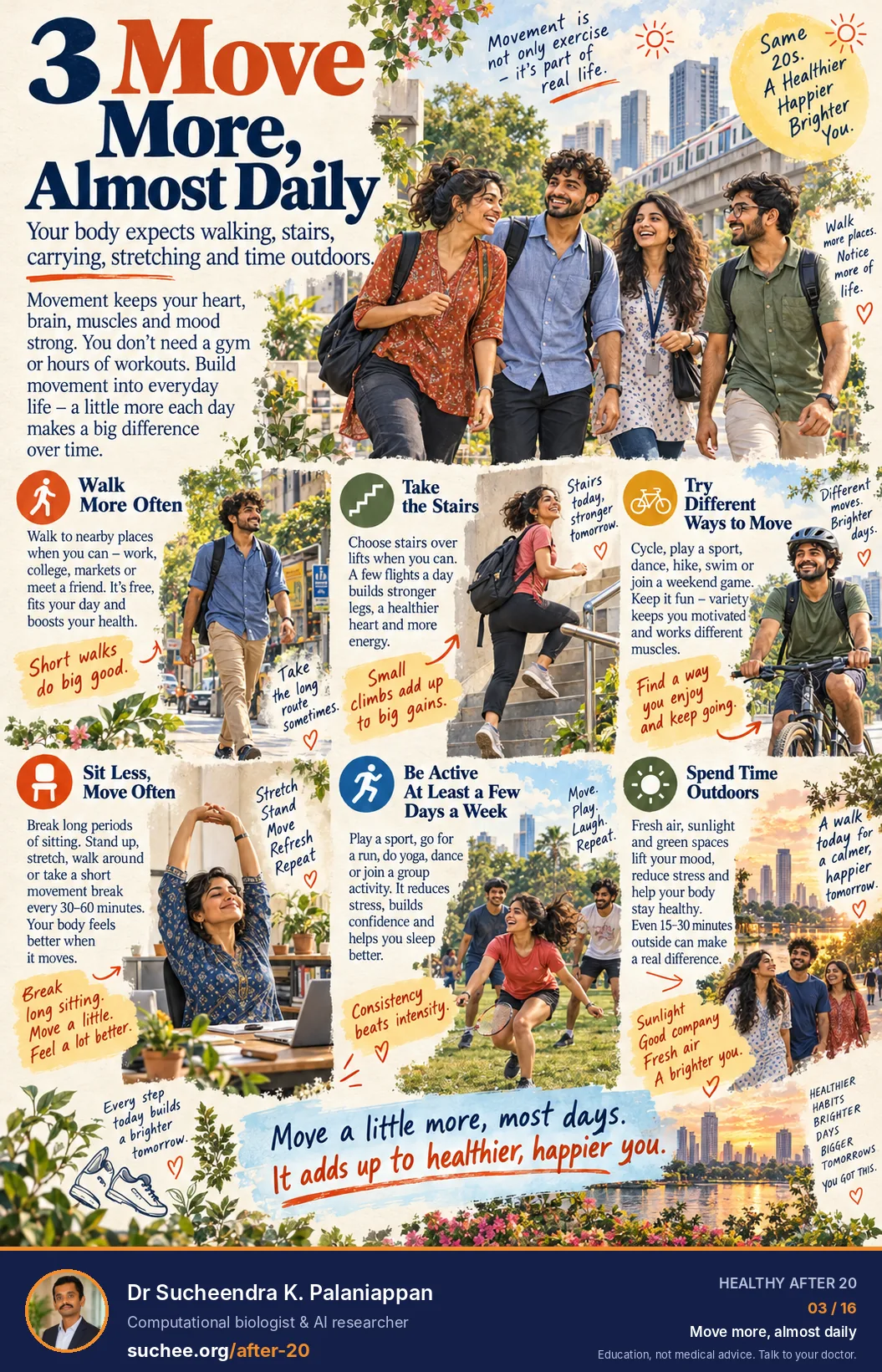
Walking, stairs, carrying, stretching and time outdoors.
Read as text
- Aim for 150 to 300 minutes of moderate activity a week, such as brisk walking, or 75 to 150 minutes of vigorous activity. How much to move
- Walk to nearby places and take the stairs. Everyday movement counts. How much to move
- Try cycling, sport, dance, hiking or swimming, and keep the one you enjoy.
- Break up long sitting every 30 to 60 minutes: stand, stretch or walk. How much to move
- Spend time outdoors. Even 15 to 30 minutes can lift mood and ease stress.
- Consistency beats intensity.
-
 04 / 16
Build muscle early
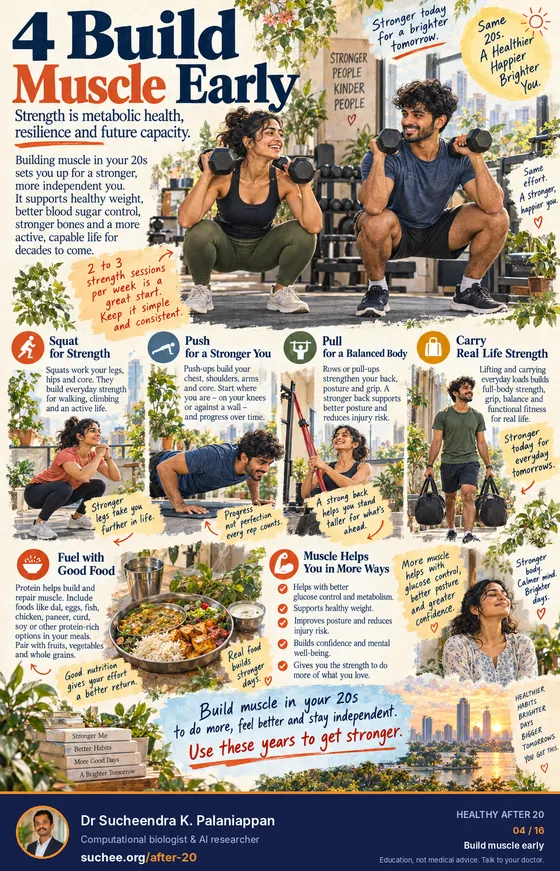
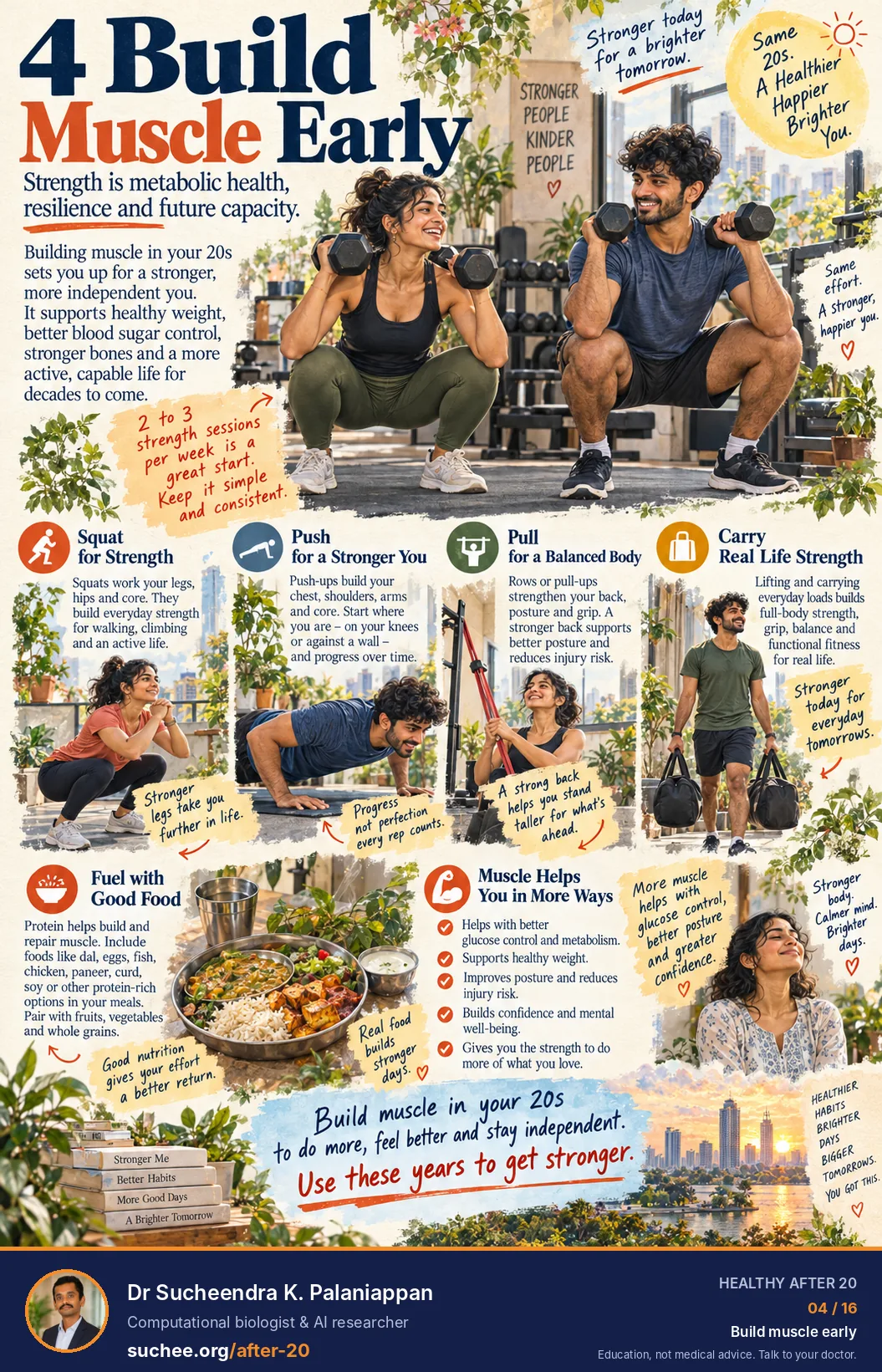
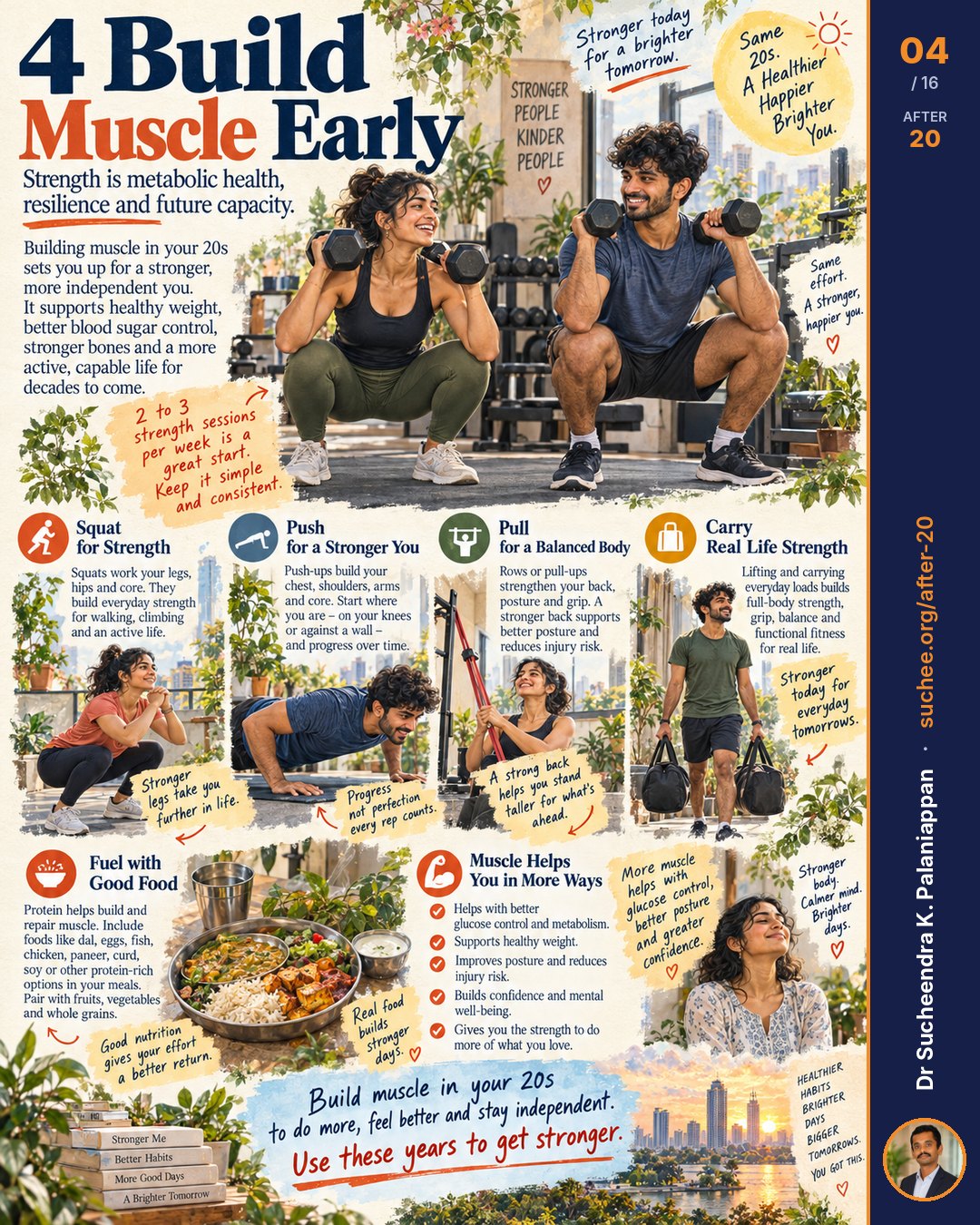
Strength is metabolic health, resilience and future capacity.
Read as text
- Do muscle-strengthening work on at least 2 days a week. Two or three sessions is a good start. How much to move
- Cover the basics: squats for the legs, push-ups for chest and arms, rows or pull-ups for the back, and carrying loads.
- Start where you are, with push-ups against a wall or on your knees, and progress over time.
- Get protein from food: dal, eggs, fish, chicken, paneer, curd or soy, with vegetables and whole grains. The Indian plate
- Strength training builds bone as well as muscle. Peak bone mass
- More muscle helps blood sugar control, weight, posture and confidence.
-
 05 / 16
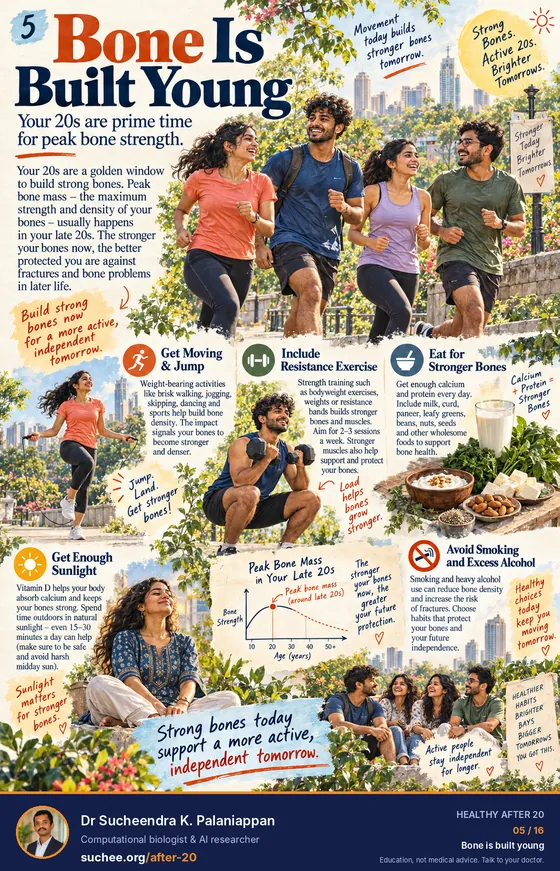
Bone is built young
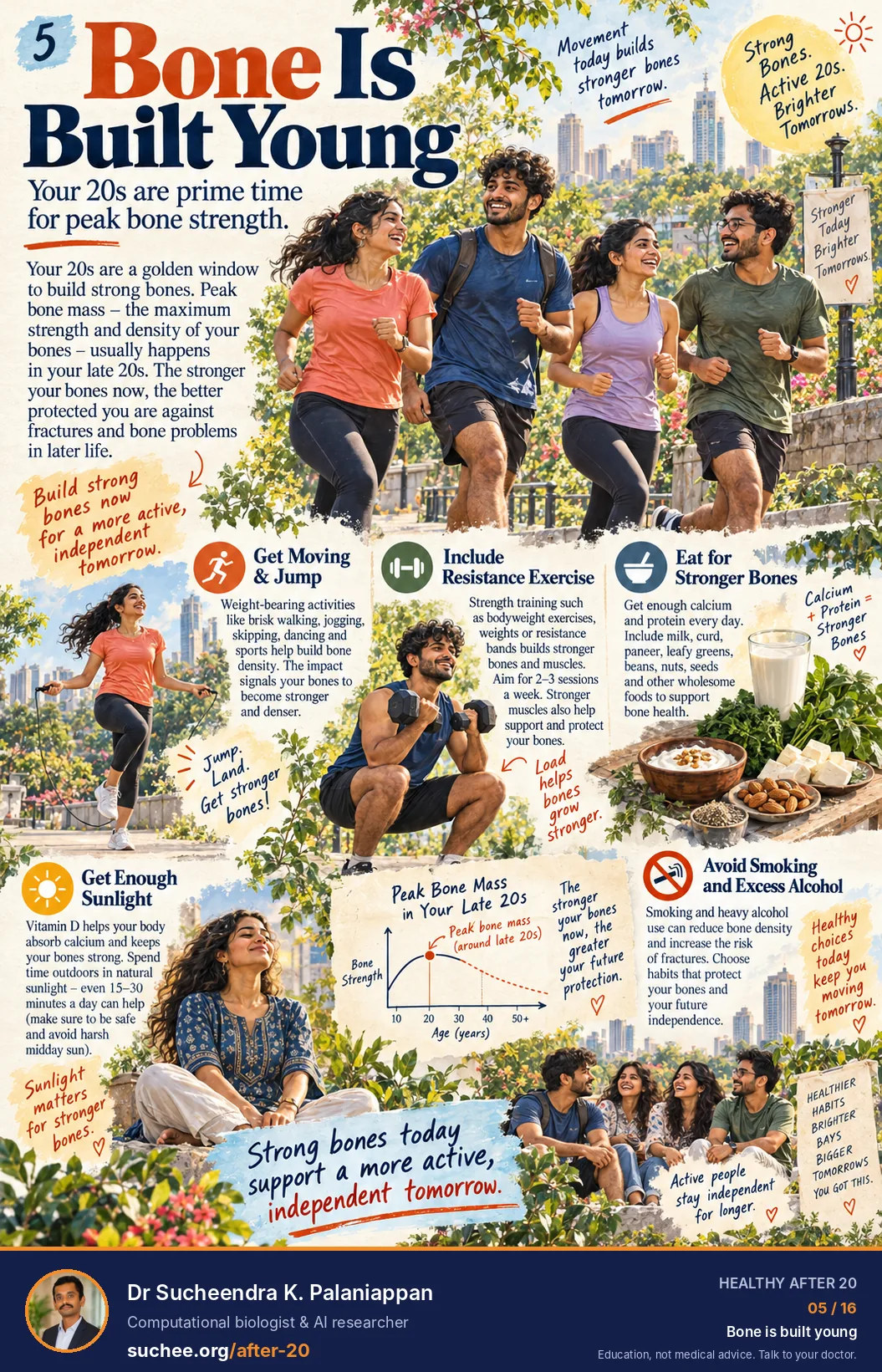
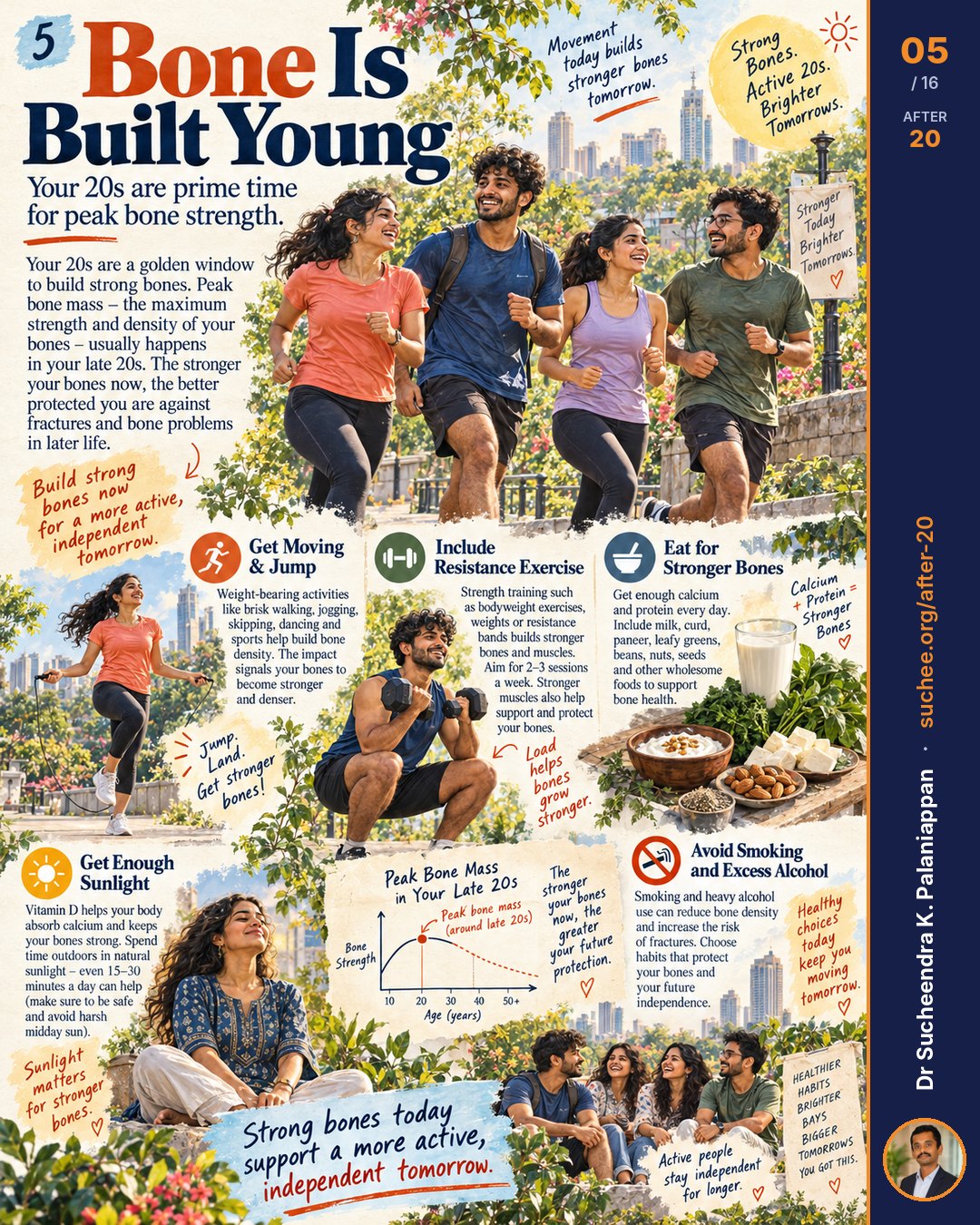
Your 20s are prime time for peak bone strength.
Read as text
- Bone mass peaks between the late teens and the late 20s. What you build now protects you against fractures later. Peak bone mass
- Weight-bearing activity such as brisk walking, jogging, skipping, dancing and sport helps build bone. Peak bone mass
- Strength training 2 to 3 times a week builds bone as well as muscle. Peak bone mass · How much to move
- Eat calcium-rich foods every day: milk, curd, paneer, leafy greens, beans, nuts and seeds. The Indian plate
- Vitamin D helps you absorb calcium. Time outdoors in sunlight helps; avoid the harsh midday sun. Peak bone mass
- Smoking and heavy drinking weaken bone.
-
 06 / 16
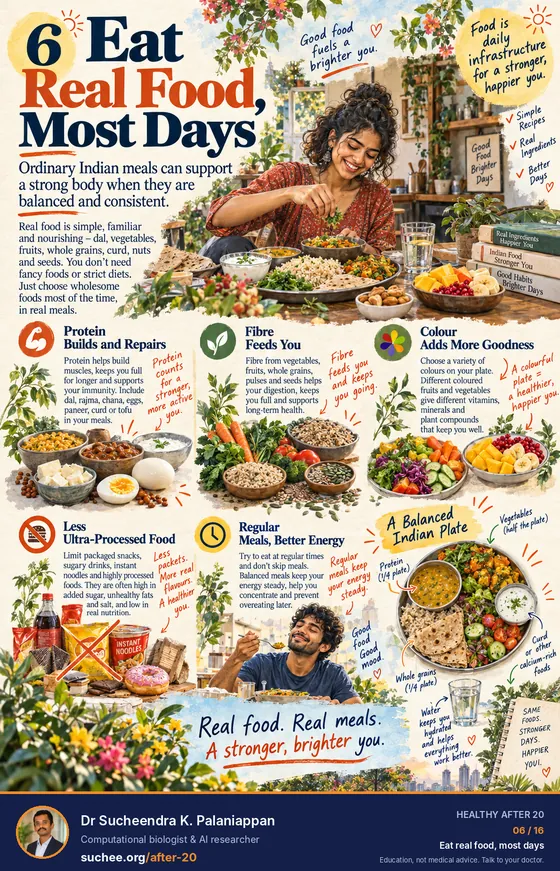
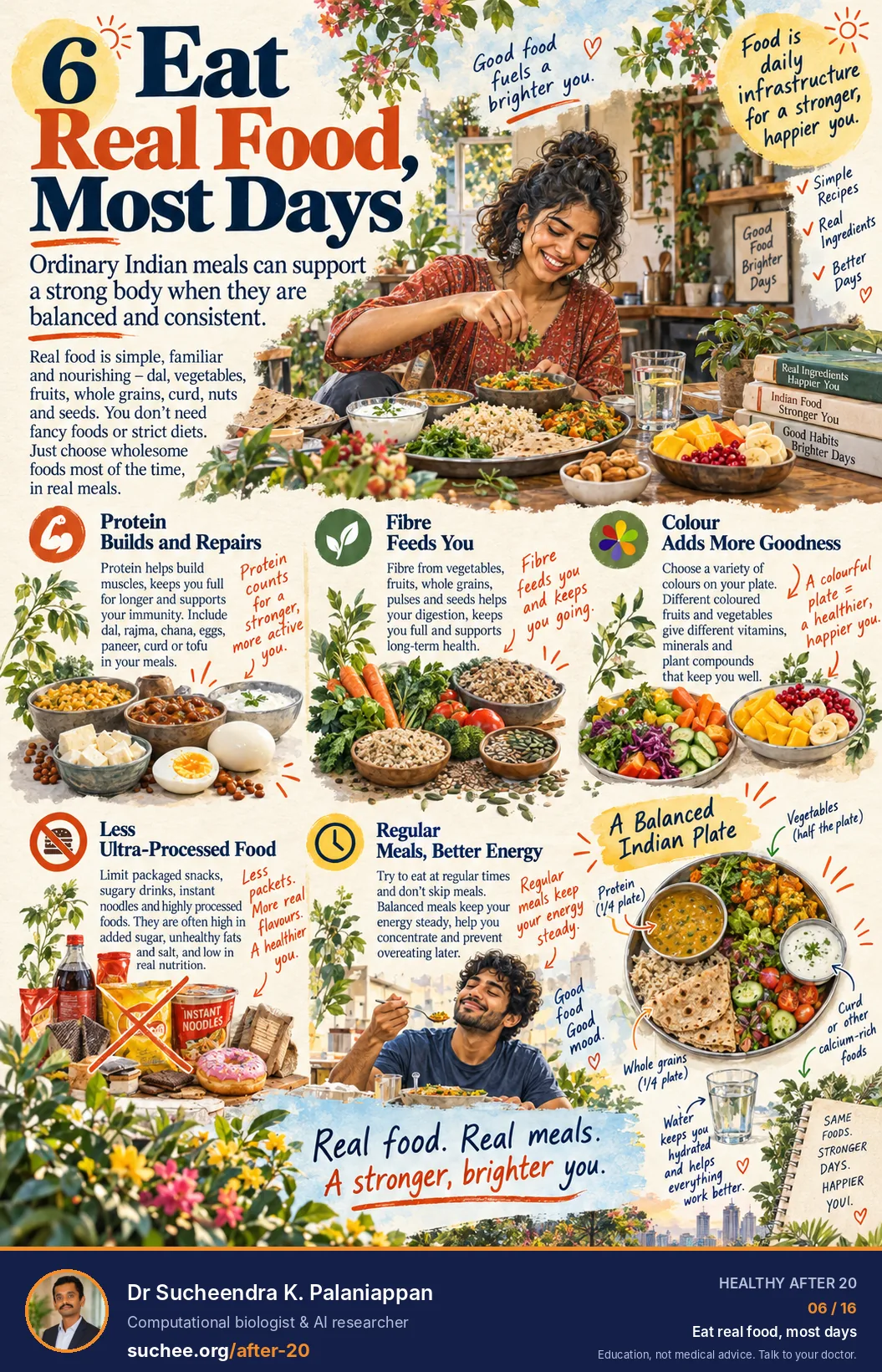
Eat real food, most days
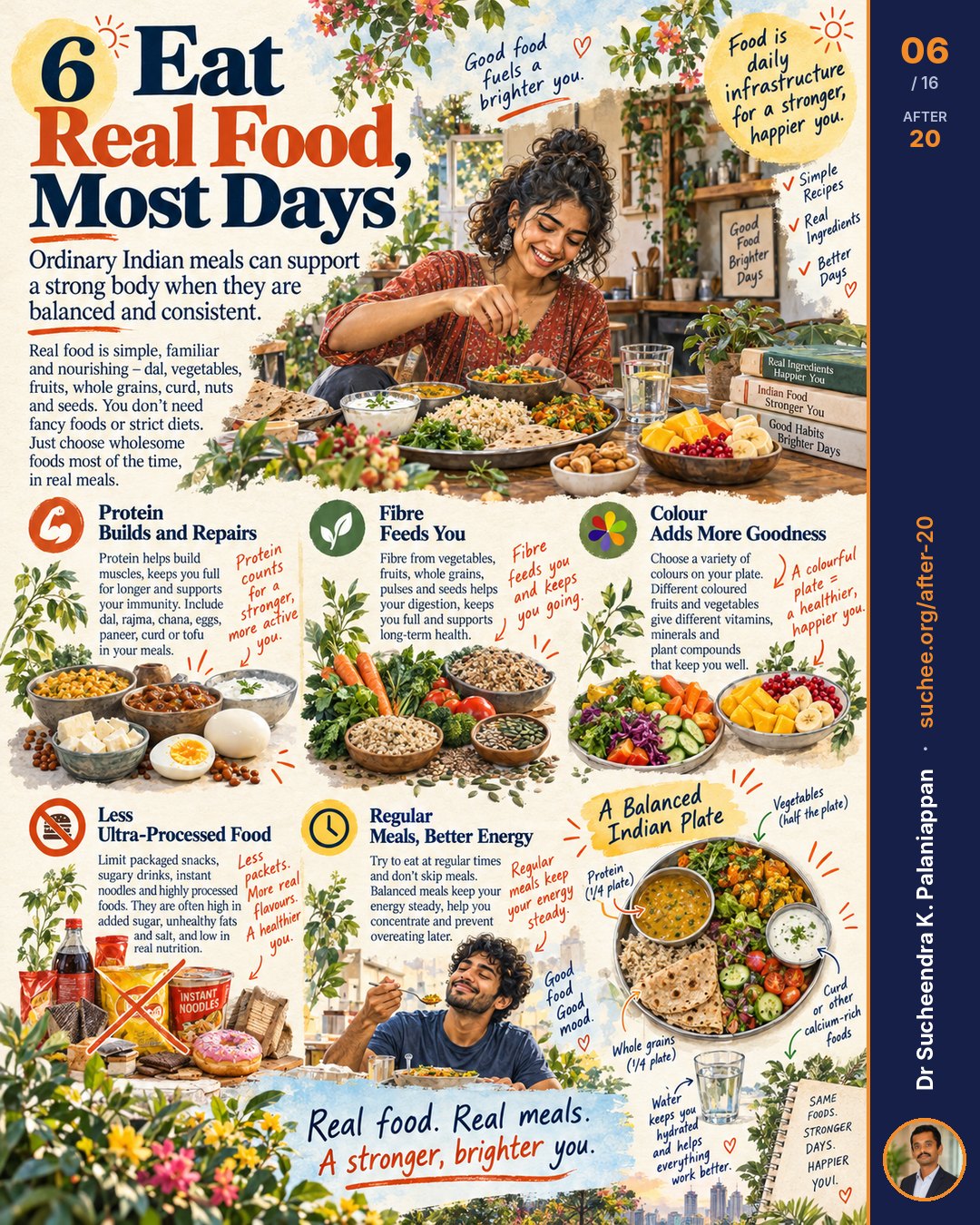
Ordinary Indian meals, balanced and consistent.
Read as text
- A balanced Indian plate: about half vegetables, a quarter whole grains, a quarter dal, eggs, fish, chicken or paneer, with curd. The Indian plate
- Protein at each meal: dal, rajma, chana, eggs, paneer, curd or tofu. The Indian plate
- Fibre from vegetables, fruit, whole grains, pulses and seeds helps digestion and keeps you full. The Indian plate
- Eat many colours of vegetables and fruit.
- Limit packaged snacks, sugary drinks, instant noodles and other highly processed foods. The Indian plate
- Eat at regular times, and drink water.
-
 07 / 16
Sleep is not optional
Mood, memory, hormones, training and long-term health.
Read as text
- Most adults in their 20s need 7 to 9 hours of sleep. Sleep
- Sleep and wake at about the same time every day, weekends included.
- Switch off screens 30 to 60 minutes before bed. Screens before bed
- Keep coffee, strong tea, energy drinks and cola to earlier in the day. Caffeine and sleep
- Get 10 to 20 minutes of morning daylight to help set your body clock.
-
 08 / 16
Take your mind seriously
Stress, loneliness, burnout and low mood deserve attention early.
Read as text
- Notice changes in mood, sleep, appetite or energy. Acting early is easier.
- Talk to a trusted friend, family member or counsellor. Asking for help is a sign of strength.
- India’s free mental health helpline, Tele MANAS, is open 24x7: call 14416 or 1-800-891-4416. Help for your mind
- Rest is not lazy. Sleep, breaks and downtime help your mind recover. Sleep
- A short walk, a park or time with plants can lift your mood.
- Stay close to people who make you feel seen and accepted. Staying connected
-
 09 / 16
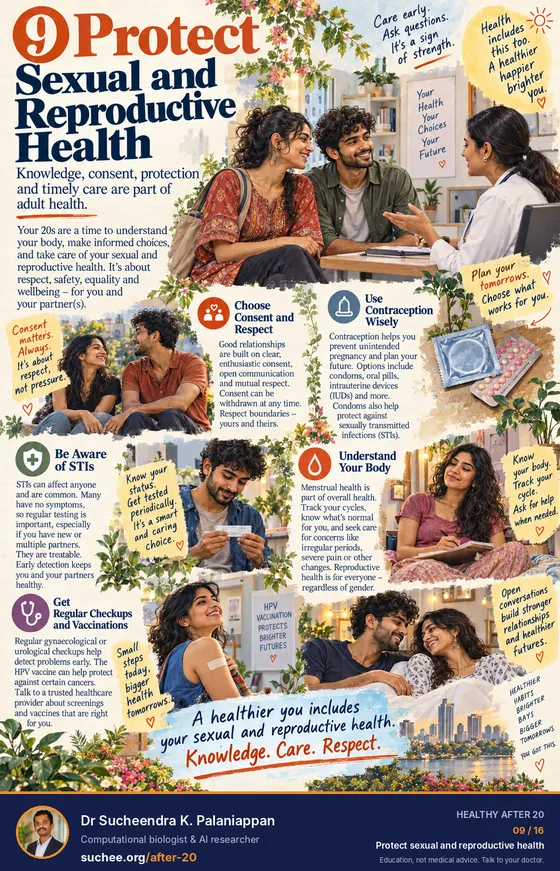
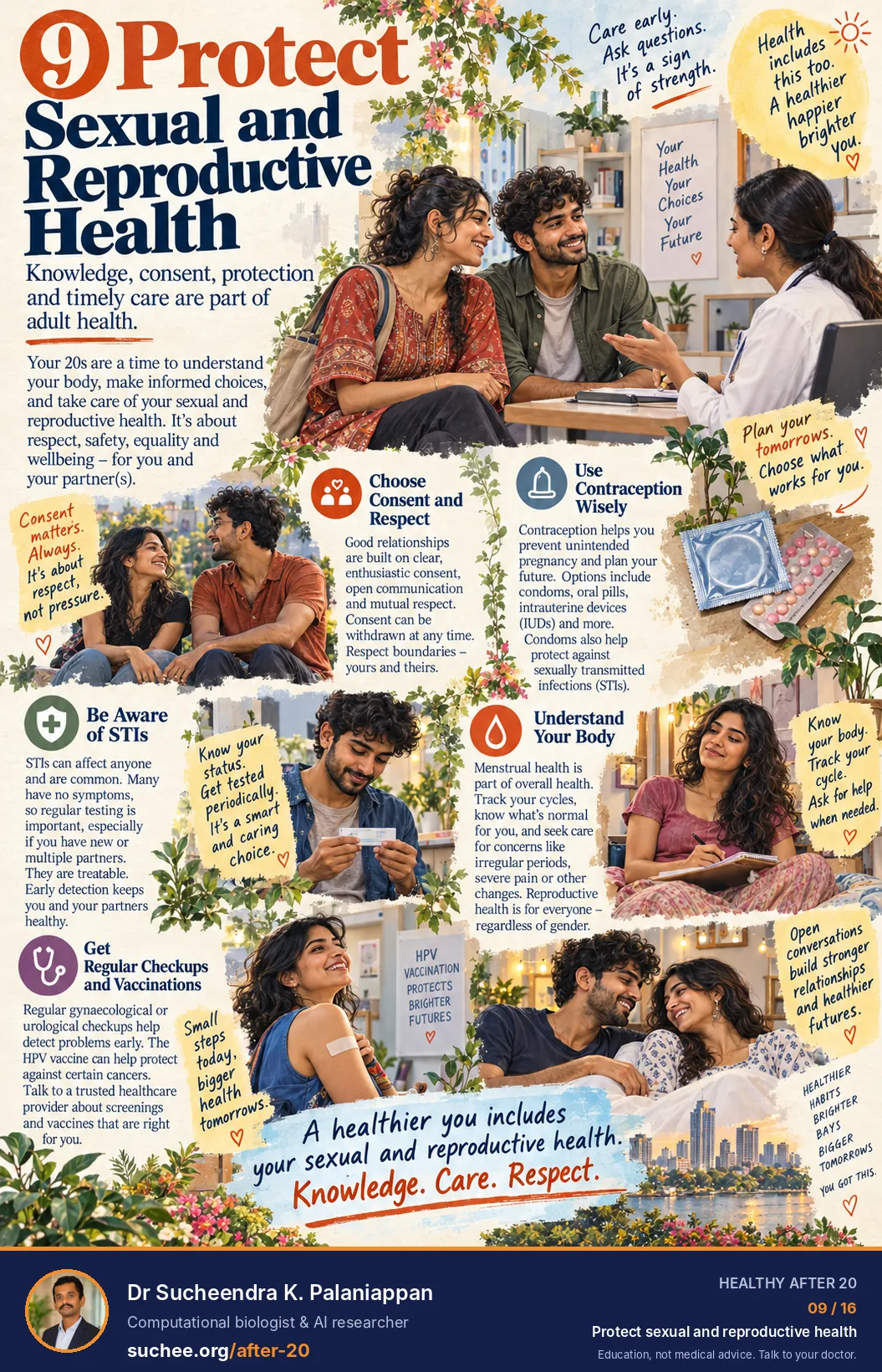
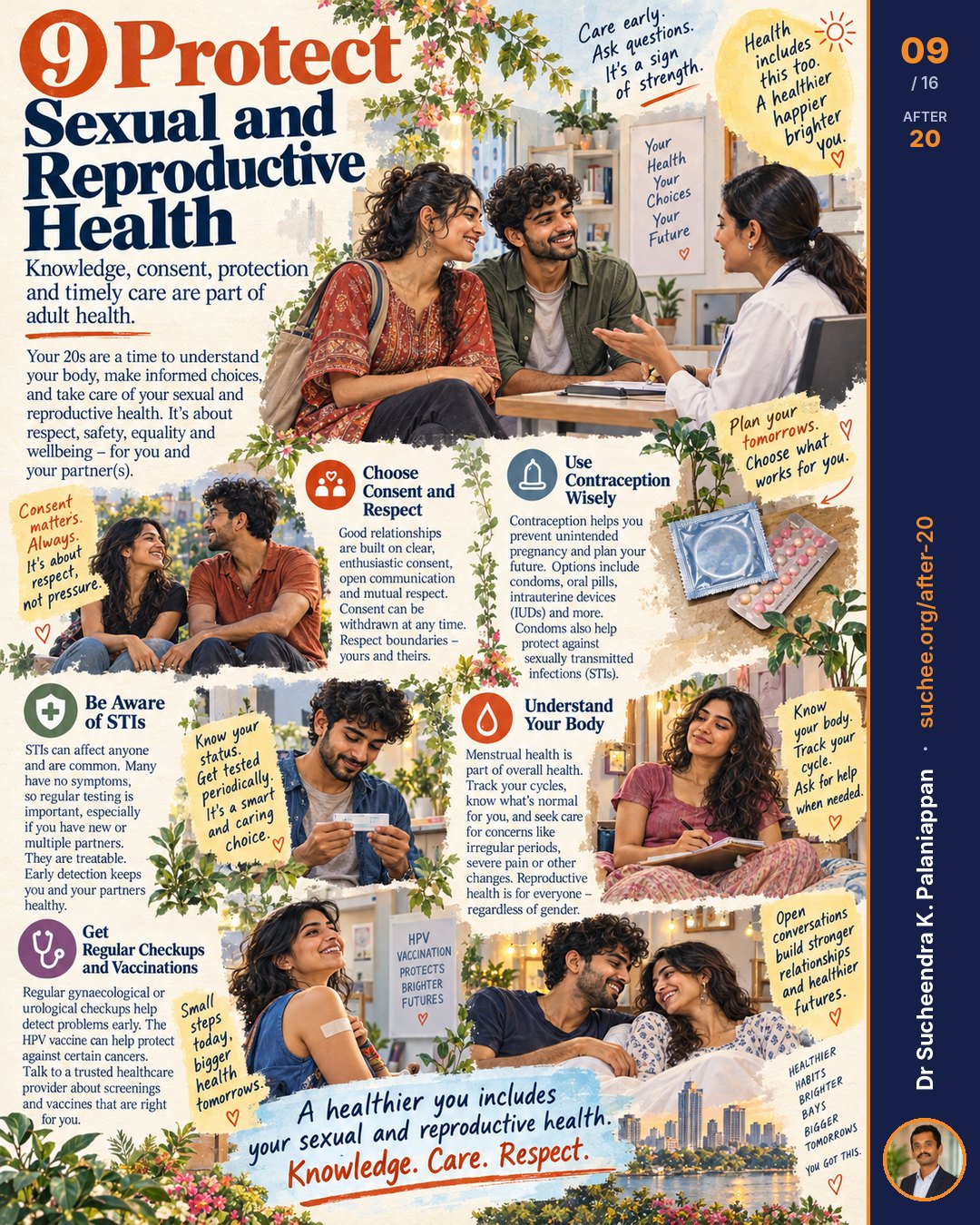
Protect sexual and reproductive health
Knowledge, consent, protection and timely care.
Read as text
- Good relationships rest on clear consent and respect. Consent can be withdrawn at any time.
- Contraception such as condoms, pills or an IUD prevents unintended pregnancy. Condoms also protect against STIs. Sexually transmitted infections
- Many sexually transmitted infections cause no symptoms. Get tested if you have a new partner or more than one. They are treatable. Sexually transmitted infections
- Government Suraksha clinics offer STI care and free condoms. The national AIDS helpline is 1097. Sexually transmitted infections
- Track your cycle, and see a doctor for irregular periods, severe pain or other changes.
- The HPV vaccine protects against cervical and other cancers. If you missed it, ask your doctor. HPV vaccine
-
 10 / 16
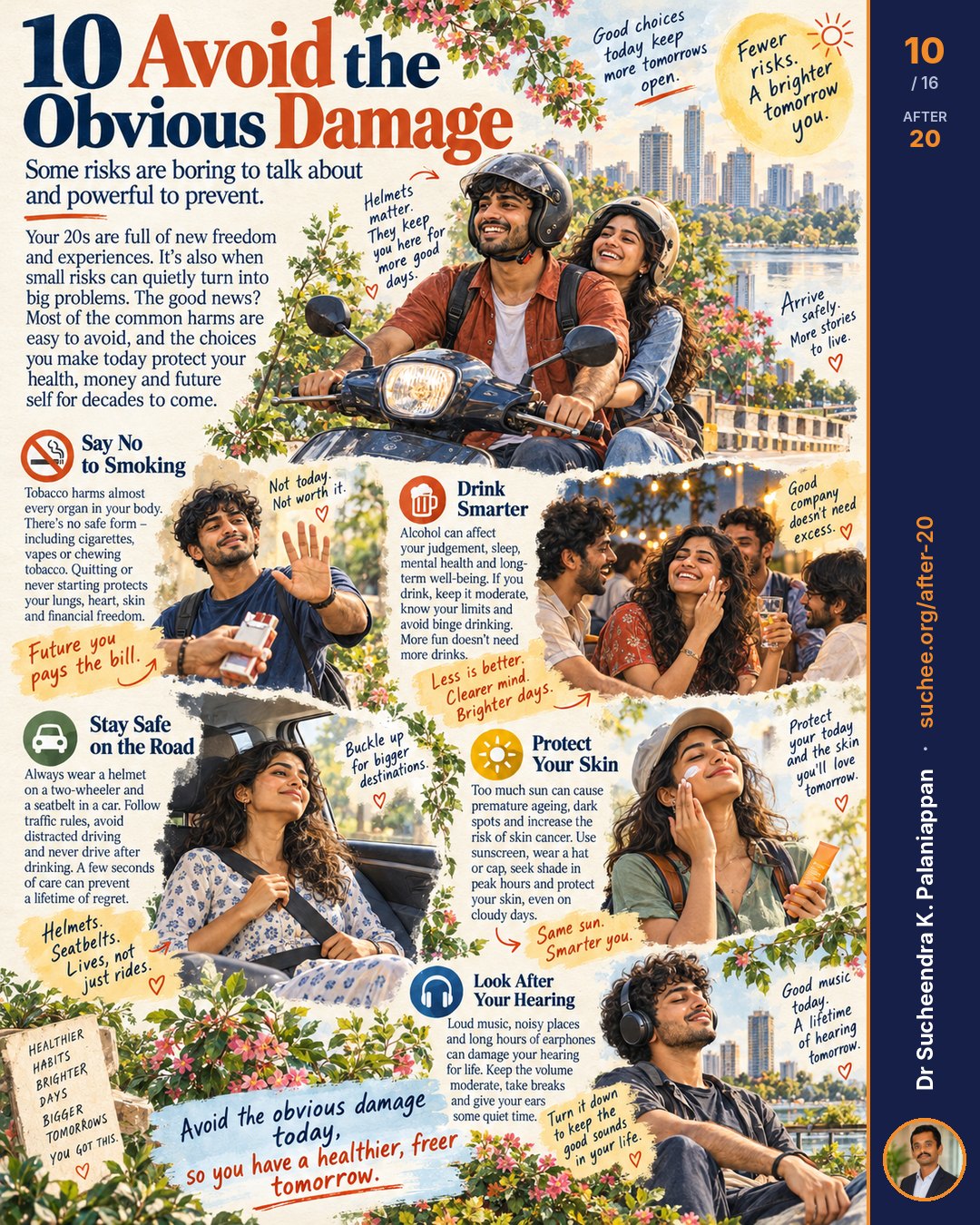
Avoid the obvious damage
Boring to talk about, powerful to prevent.
Read as text
- No form of tobacco is safe, smoked or chewed. E-cigarettes are banned in India. Tobacco in India · E-cigarettes
- If you drink, keep it low and avoid binge drinking. No amount of alcohol is safe for health. Alcohol
- Wear a helmet on a two-wheeler and a seatbelt in a car. Never drive after drinking or while on your phone. Road safety
- Use sunscreen, a hat or shade in strong sun.
- Keep earphone volume moderate and take breaks. Hearing
-
 11 / 16
Know a few useful numbers
A small set of numbers that guides you without making you obsessive.
Read as text
- Blood pressure: below 120/80 is normal. 140/90 or above on repeat checks is high and needs a doctor. Blood pressure
- Get it checked every year or two. US guidance allows every 3 to 5 years at 18 to 39 if it is normal and you have no risk factors. Blood pressure
- Keep your waist to less than half your height. For Indians, waist risk starts at 90 cm for men and 80 cm for women. Waist size for Indians · Waist-to-height ratio
- Get a lipid profile at least once in your 20s, earlier with a family history of heart disease. For most young adults, LDL should be below 100 mg/dL. Cholesterol
- Test glucose or HbA1c if you are overweight, have PCOS or a family history of diabetes. Normal is fasting glucose below 100 mg/dL and HbA1c below 5.7%. Blood sugar · Risk in Indian adults
-
 12 / 16
Vaccines are quiet protection
Prevention is easiest when it happens before exposure.
Read as text
- Check your vaccine record once and catch up on anything you missed. Adult vaccines
- HPV vaccine: it protects against cervical and several other cancers, and catching up in your 20s still helps. Ask your doctor. HPV vaccine
- A tetanus and diphtheria booster every 10 years. Adult vaccines
- A flu vaccine every year. Adult vaccines
- Hepatitis B vaccine if you were never vaccinated. Adult vaccines
- Typhoid and hepatitis A spread through contaminated food and water and are common in India, not only abroad. Ask your doctor whether you need them. Adult vaccines
-
 13 / 16
Do the ordinary maintenance
Most health care in your 20s is boring, and that is why it works.
Read as text
- Brush twice a day, clean between your teeth and see a dentist regularly.
- Get your eyes checked for blurry vision, frequent headaches or screen strain, and your hearing if you notice difficulty.
- Get new or changing moles checked by a doctor.
- Do not ignore pain, injuries or symptoms that keep coming back.
- Have a yearly check-in with a doctor: sleep, mood, sexual health, smoking and drinking, and family history.
- From 30, India’s national NCD programme screens every adult for blood pressure, diabetes and common cancers, free at government health centres. Get checked
-
 14 / 16
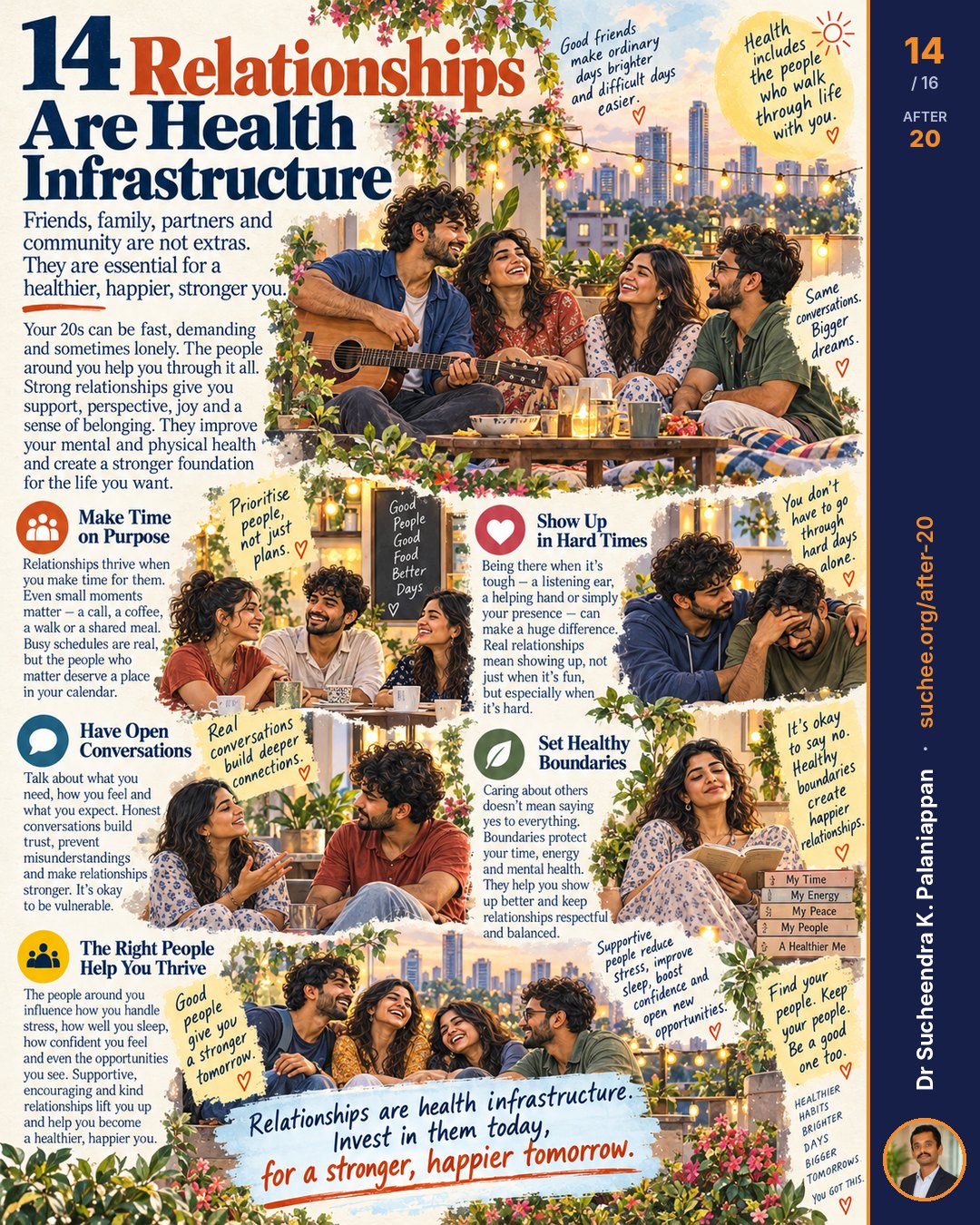
Relationships are health infrastructure
Friends, family, partners and community are not extras.
Read as text
- People with strong social ties live longer, an effect comparable to well-known risks such as smoking. Staying connected
- Make time on purpose: a call, a coffee, a walk or a shared meal.
- Show up when things are hard, not just when they are fun.
- Talk openly about what you need and what you expect.
- Healthy boundaries protect your time, energy and mental health. It is okay to say no.
-
 15 / 16
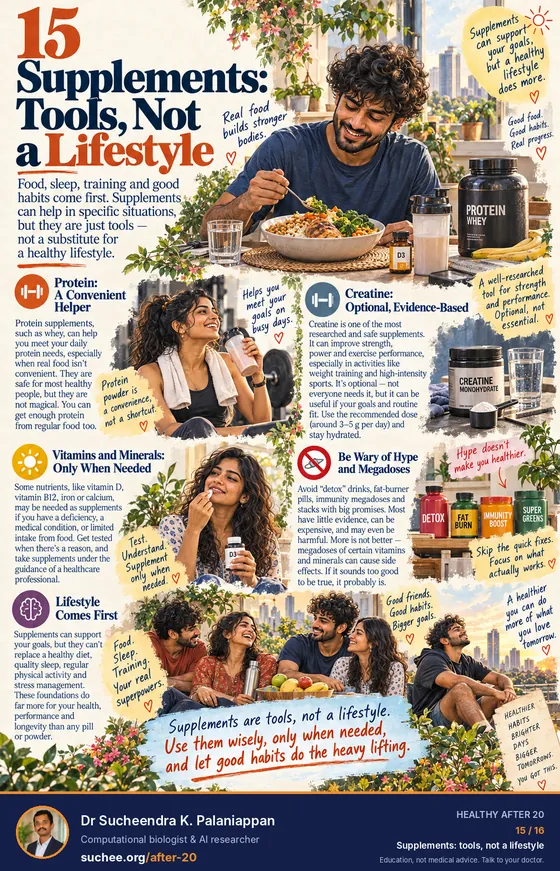
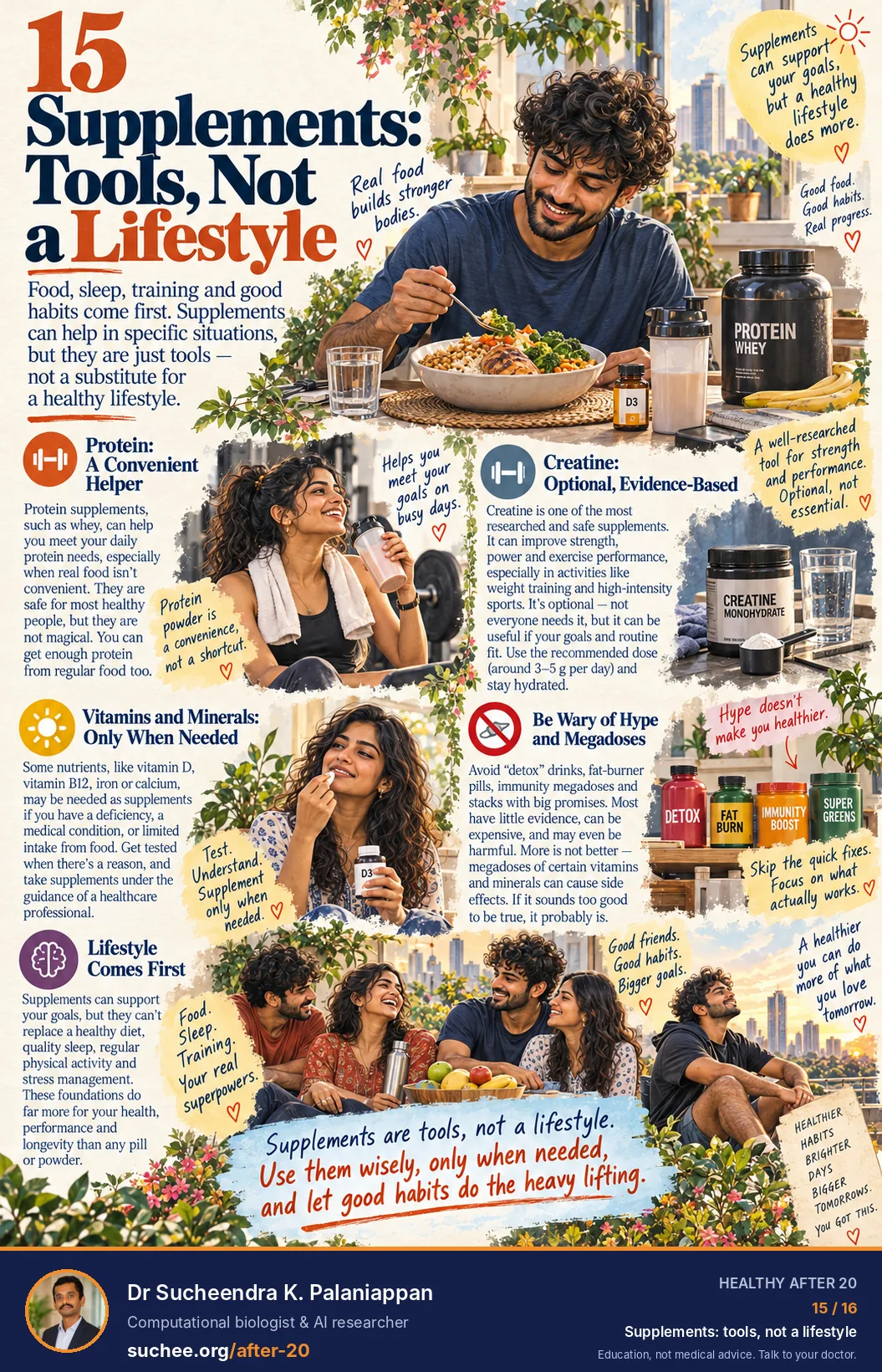
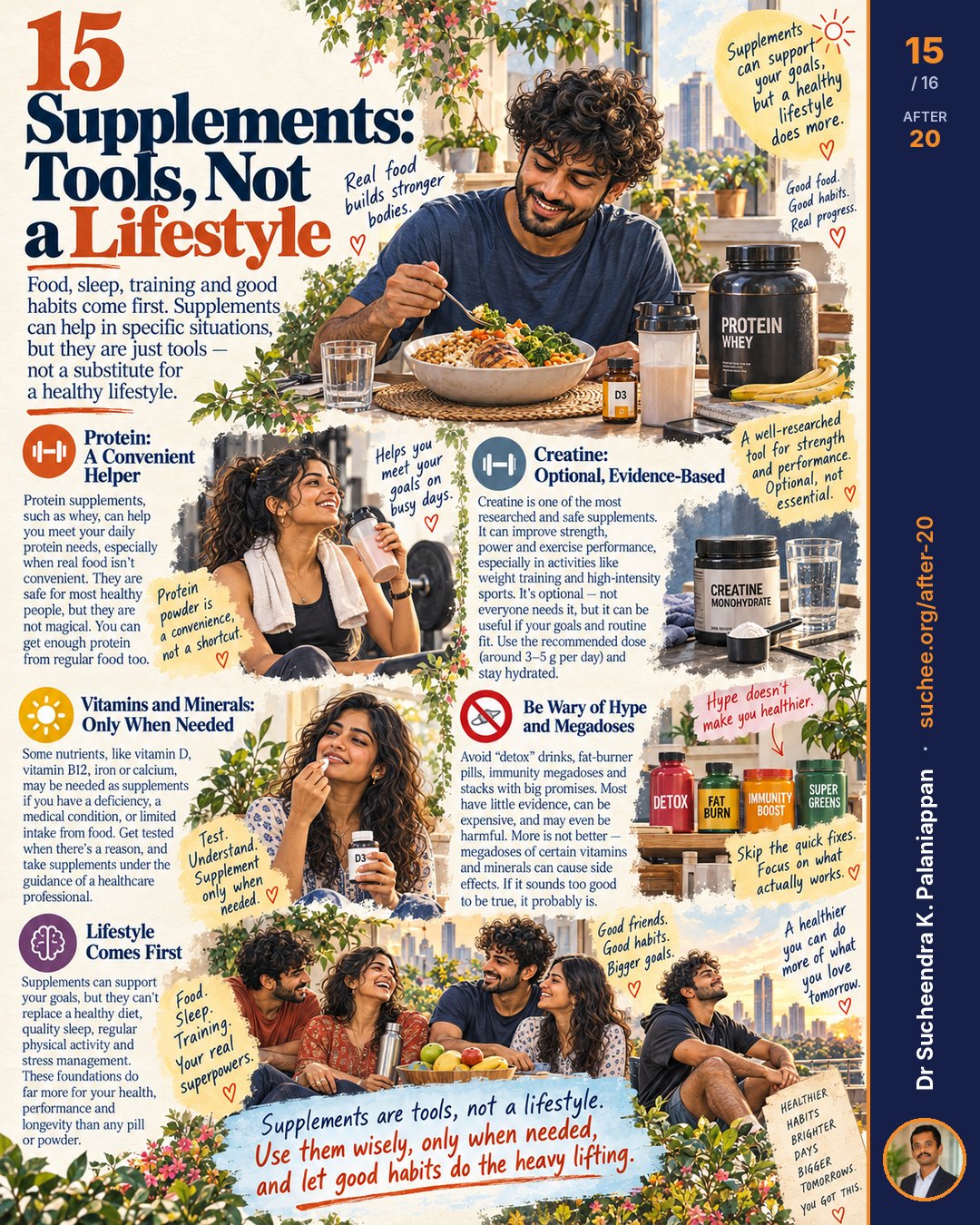
Supplements: tools, not a lifestyle
Food, sleep and training first. Pills only for a reason.
Read as text
- Food, sleep, training and good habits come first.
- Protein powder is a convenience, not a need. India’s dietary guidelines advise getting protein from food rather than supplements. The Indian plate
- Creatine monohydrate, usually 3 to 5 g a day, is well studied and helps strength training. It is optional. Creatine
- Take vitamin D, B12, iron or calcium only for a shown need, ideally after a test. Supplements
- Skip detox drinks, fat burners, immunity megadoses and stacks with big promises. More is not better. Supplements
-
 16 / 16
A stronger, brighter you
Your 20s are a foundation for everything that comes next.
Read as text
- Move most days and lift twice a week. How much to move
- Eat real food, built around an Indian plate. The Indian plate
- Protect 7 to 9 hours of sleep. Sleep
- Look after your mind, and ask for help early. Help for your mind
- Invest in people. Staying connected
- Do not spend your 20s trying to stay young. Use them to become strong.
















What each guide stands on
Most health advice on WhatsApp has no source. Each claim here links to one, with the kind of evidence it is, so you can check it or show your doctor.
- Risk in Indian adultsAmong Indian adults aged 20 and over, 35.5% have high blood pressure, 11.4% have diabetes and 15.3% have prediabetes, and 39.5% carry excess fat around the waist. Most of it causes no symptoms.Anjana et al., ICMR-INDIAB-17, Lancet Diabetes & Endocrinology 2023 National survey · 113,043 adults, 31 states and UTs
- How much to move150 to 300 minutes of moderate activity a week, or 75 to 150 minutes of vigorous activity, plus muscle strengthening of all major muscle groups on 2 or more days. Replace sitting with any movement: some activity is better than none.
- Peak bone massBone mass peaks between the late teens and the late 20s, and a higher peak means stronger bones later in life. The strongest evidence for building it is for physical activity and calcium intake, then vitamin D.Weaver et al., NOF position statement on peak bone mass, Osteoporosis International 2016 Systematic review No Indian guideline covers this.
- The Indian plateFill about half the plate with vegetables and fruit, add whole grains or millets, pulses, eggs, fish or meat, and milk or curd. Limit foods high in fat, sugar and salt, keep added salt to 5 g a day at most, and get protein from food rather than protein supplements.ICMR-NIN, Dietary Guidelines for Indians, 2024 National guideline
- Sleep7 to 9 hours a night for adults aged 18 to 64.Hirshkowitz et al., National Sleep Foundation recommendations, Sleep Health 2015 Expert panel No Indian guideline covers this.
- Screens before bedReading on a light-emitting tablet before bed, rather than a printed book, made people take longer to fall asleep, delayed their body clock and the evening rise in melatonin, and left them less alert the next morning.Chang et al., Evening use of light-emitting eReaders, PNAS 2015 Randomised crossover trial · 12 adults No Indian study covers this.
- Caffeine and sleepA large dose of caffeine (400 mg, about four cups of coffee) taken 6 hours before bed still cut sleep by more than an hour.Drake et al., Caffeine effects on sleep taken 0, 3, or 6 hours before bed, J Clin Sleep Med 2013 Randomised trial · 12 adults No Indian study covers this.
- Help for your mindTele MANAS, India’s national tele mental health helpline, is free and open 24x7 in about 20 languages. Call 14416 or 1-800-891-4416 to reach a trained counsellor, with mental health specialists when needed.MoHFW, Tele MANAS National programme
- Staying connectedAcross 148 studies, people with stronger social ties had about 1.5 times the odds of survival, an effect comparable to well-known risks such as smoking.Holt-Lunstad et al., Social relationships and mortality risk, PLoS Medicine 2010 Meta-analysis · 308,849 people, 148 studies
- Sexually transmitted infectionsMore than 1 million curable sexually transmitted infections are acquired every day worldwide, most without symptoms. In India, government Suraksha clinics at district hospitals and medical colleges offer STI counselling, treatment and free condoms, and the national AIDS helpline is 1097.NACO, STI/RTI services National programme · WHO, Sexually transmitted infections fact sheet Fact sheet
- HPV vaccineAlmost all cervical cancer is caused by HPV. WHO recommends the vaccine mainly for girls aged 9 to 14; one dose is also enough up to age 20, women over 21 should get two, and boys can be vaccinated where feasible.WHO, Updated recommendations on HPV vaccination, 2022 WHO recommendation · WHO, Cervical cancer fact sheet Fact sheet
- Tobacco in India28.6% of Indian adults use tobacco, 42.4% of men and 14.2% of women, most often as smokeless tobacco, the main cause of mouth cancer.MoHFW, Global Adult Tobacco Survey 2 (2016–17) National survey · 74,037 adults
- E-cigarettesSince 2019, making, importing, selling or advertising e-cigarettes, including heat-not-burn products, is banned in India.
- AlcoholWHO states that no amount of alcohol is safe for health. The risk starts with the first drink, and cancer risk rises the more you drink.
- Road safetyIn 2022, 1,68,491 people died in road crashes in India. Two-wheeler riders were 44.5% of those killed, and two-thirds of all victims were aged 18 to 45.MoRTH, Road Accidents in India 2022 National report
- HearingMore than 1 billion people aged 12 to 35 are at risk of hearing loss from loud music through earphones and at loud venues. Lower volume and shorter listening protect hearing.WHO, Making listening safe WHO programme No Indian guideline covers this.
- Blood pressureBelow 120/80 is normal. High blood pressure is diagnosed at 140/90 or above, measured on two different days. US guidance screens adults aged 18 to 39 every 3 to 5 years if blood pressure is normal and there are no risk factors, and every year otherwise.WHO, Hypertension fact sheet Fact sheet · Whelton et al., ACC/AHA blood pressure guideline, Hypertension 2018 US guideline · USPSTF, Hypertension screening in adults, 2021 US guideline
- Waist size for IndiansFor Asian Indians, abdominal obesity starts at a waist of 90 cm in men and 80 cm in women, lower than the Western cut-offs of 102 and 88 cm, because risk rises at a smaller size.Misra et al., Consensus statement for Asian Indians, JAPI 2009 Indian expert consensus
- Waist-to-height ratioKeep your waist to less than half your height. A waist-to-height ratio of 0.5 to 0.59 means increased health risk and 0.6 or more high risk, for adults of all ethnicities with a BMI under 35.NICE, Overweight and obesity management (NG246) UK guideline
- CholesterolIndia’s lipid guideline sets an LDL cholesterol target below 100 mg/dL for people at low or moderate risk, and lower targets at higher risk, because Indians develop heart disease earlier. US guidance measures cholesterol in adults from age 20.Iyengar et al., Lipid Association of India expert consensus, 2016 Indian expert consensus · Grundy et al., AHA/ACC cholesterol guideline, Circulation 2019 US guideline
- Blood sugarFasting glucose below 100 mg/dL and HbA1c below 5.7% are normal. 100 to 125 mg/dL or 5.7 to 6.4% is prediabetes, and 126 mg/dL or 6.5% and above is diabetes.
- Adult vaccinesIndia’s adult immunisation guidance from the Association of Physicians of India covers influenza every year, a tetanus and diphtheria booster every 10 years, and others by age and risk.Review of the API adult immunisation guidelines, IJCMPH 2024 Review of Indian guideline
- Get checkedIndia’s national NCD programme screens every adult over 30 for high blood pressure, diabetes and common cancers of the mouth, breast and cervix, at government health centres. Use it, and keep the numbers.MoHFW, NP-NCD Operational Guidelines National programme
- SupplementsBeta-carotene and vitamin E should not be taken to prevent heart disease or cancer, and for multivitamins the evidence is too thin either way. Supplements are for a known gap, such as low B12 or vitamin D on a test.USPSTF, Vitamin, mineral and multivitamin supplementation, 2022 US guideline No Indian guideline covers this.
- CreatineCreatine monohydrate is the most studied sports supplement and appears safe at usual doses in healthy adults, typically 3 to 5 g a day. It helps most alongside strength training.Kreider et al., ISSN position stand on creatine, JISSN 2017 Expert position stand No Indian guideline covers this.
Guidance changes as evidence grows. When it does, the guides and this list will be updated. Last updated .
How these are made
- Guidelines, not headlines. Every number comes from a guideline, a national survey or a systematic review, linked above. One exciting study does not change a guide.
- Written for young Indians. Indian waist cut-offs, Indian helplines and clinics, dal and curd rather than protein shakes.
- Habits before products. Tests and supplements come after the basics, and only with a reason.
- Nothing to sell. No clinic, no supplements, no product. Free to print and share.
Want the science behind it?
Longevity, Interpreted. is my weekly reading of longevity research: what was shown, at what stage, and what it does not yet support.