Health by age · 40s and 50s
Healthy after 40 build reserve before you need it
At 40 most people feel fine. Blood pressure, sugar, waist and liver fat change quietly for years before anything shows.
What changes the course is not new: aerobic exercise and strength training, protein and fibre from ordinary Indian food, sleep, no tobacco, and a yearly look at a few numbers.
Fourteen one-page guides, meant to be read in order, each with a source for every number.
Sources are listed below: Indian ones where they exist (ICMR-NIN, ICMR-INDIAB, the national NCD programme, the Lipid Association of India), WHO and international guidelines for the rest, labelled as such.
 Sucheendra Kumar PalaniappanComputational biologist
Read them in order
Tap a guide to open it full screen, then swipe through all fourteen. Each one has a text version and its sources.
-
 01 / 14
Start here
Build reserve, know your risks, stay capable. The ten topics on one page.
Read as text
- The aim at 40: build reserve, know your risks, stay capable.
- Cook Indian food, walk more, and lift for strength. How much to move
- Sleep well, keep learning, keep hobbies. Sleep
- Preventive care keeps you ahead: a yearly look at a few numbers. Get checked
-
 02 / 14
Why 40 matters
The next decade is when preventable risk quietly adds up.
Read as text
- Muscle keeps you active, prevents frailty later and protects bones. Build it before problems appear. How much to move
- Blood pressure risk grows quietly. Keeping it in range protects heart, brain and kidneys. Risk in India by 40
- A healthy waist lowers the risk of diabetes, heart disease and fatty liver. Waist size for Indians
- Better sleep helps memory, mood and heart health. Less chronic stress helps too. Sleep
- Movement, sleep, food and stress all compound. Prevention works best before disease is obvious.
-
 03 / 14
A connected system
Sleep, muscle, liver, gut, vessels and brain act on one another.
Read as text
- Better sleep improves appetite, mood and blood pressure. Sleep apnoea
- Exercise helps several systems at once. How much to move
- The liver responds to alcohol, weight and diet. Fatty liver in India
- The brain is shaped by sleep, stress, movement and connection. Staying connected
- Think in systems, not isolated numbers.
-
 04 / 14
Move, lift, stretch
150 minutes a week, strength twice a week, and less sitting.
Read as text
- At least 150 minutes of moderate activity a week, or 75 minutes of vigorous activity. How much to move
- Lift weights or use resistance at least twice a week: legs, hips, back, chest, shoulders and arms. How much to move
- Protect muscle now to protect ageing later: strength helps balance and lowers the risk of falls.
- Stretching and mobility help posture and stiffness. Breathing and yoga help stress, but do not replace strength and cardio.
- Sit less. Stand, stretch or walk for a few minutes every 30 to 60 minutes. How much to move
-
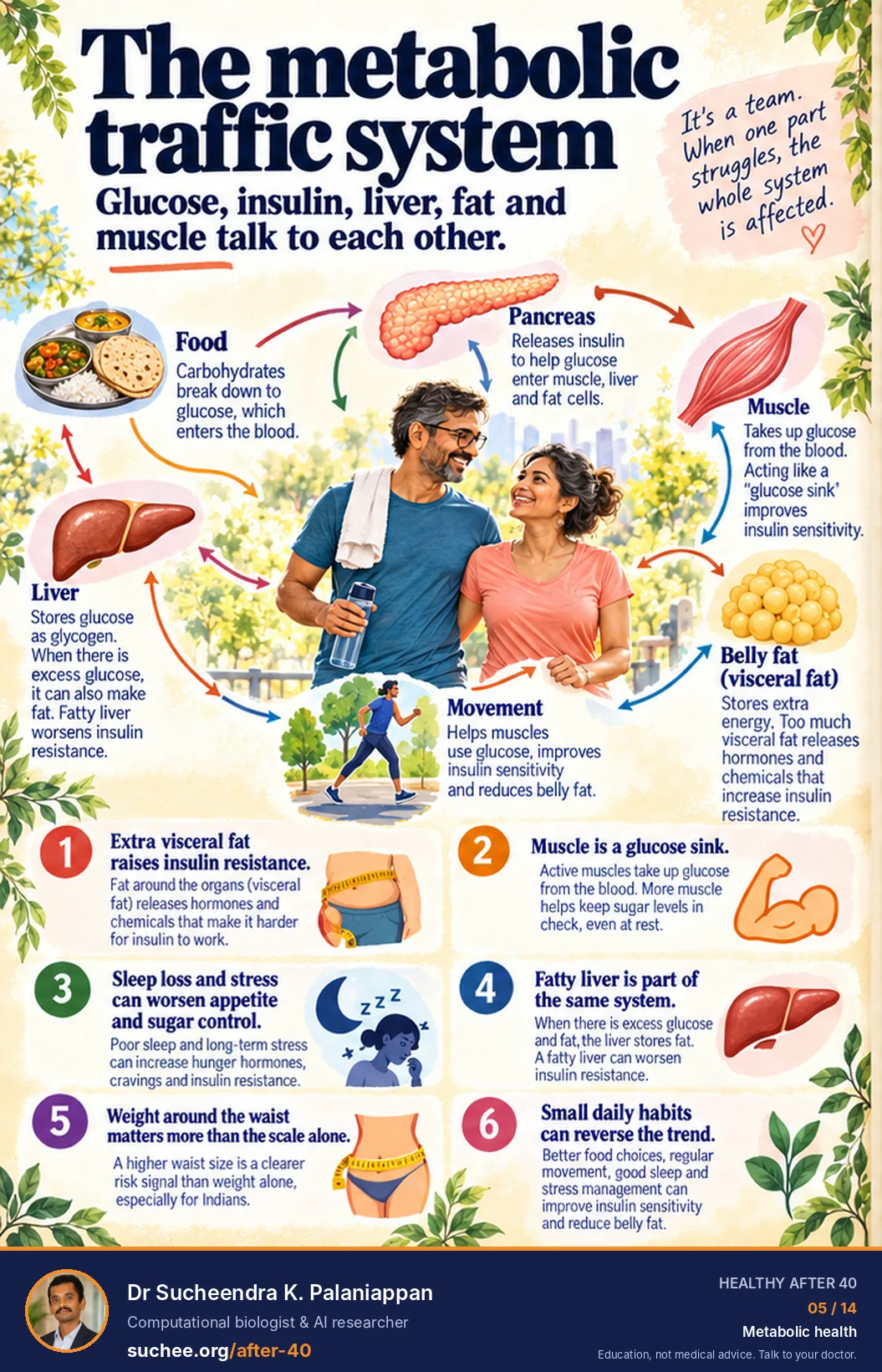
 05 / 14
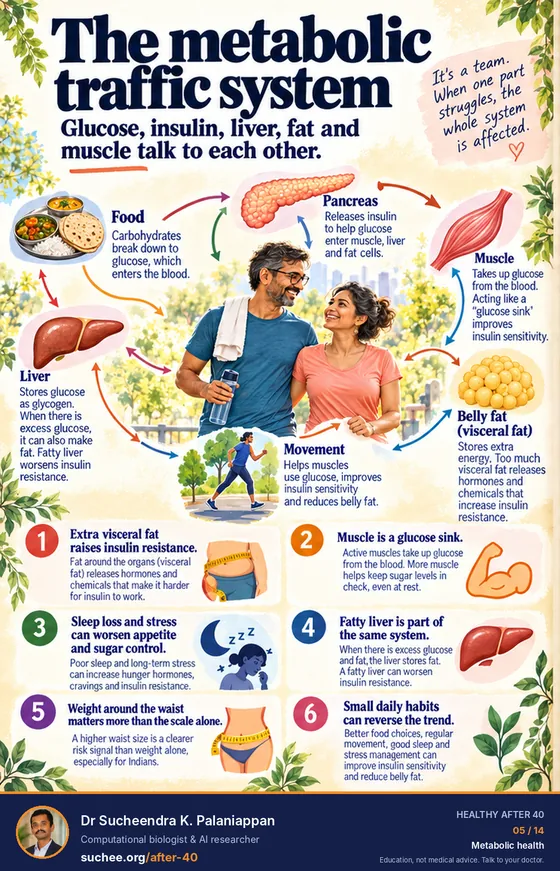
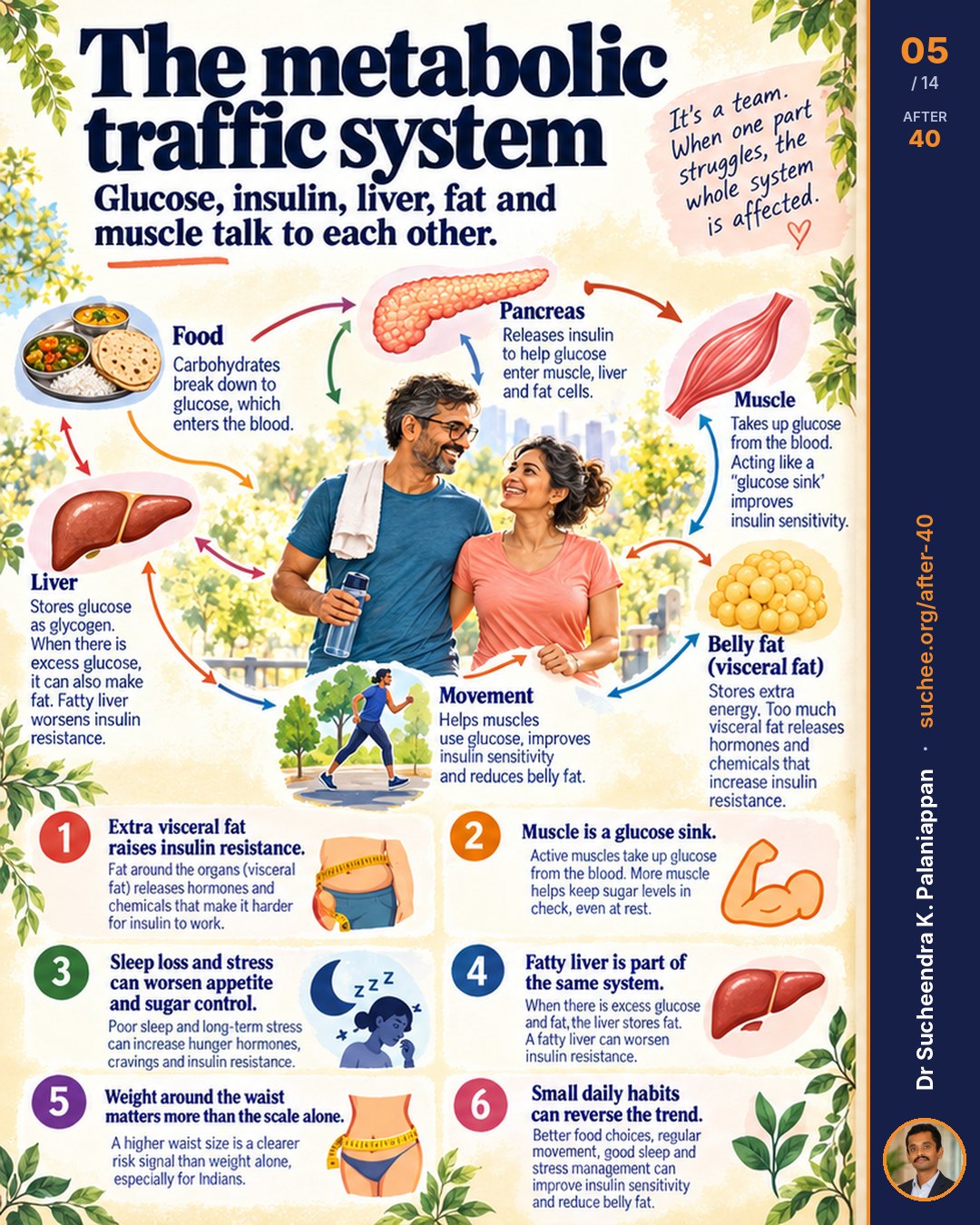
Metabolic health
How glucose, insulin, liver, belly fat and muscle talk to each other.
Read as text
- Fat around the organs makes it harder for insulin to work. Risk in India by 40
- Muscle is a glucose sink. More muscle helps keep sugar in check, even at rest. How much to move
- Poor sleep and long-term stress can raise hunger, cravings and insulin resistance.
- Fatty liver is part of the same system, and can worsen insulin resistance. Fatty liver in India
- For Indians, waist size is a clearer risk signal than weight alone. Waist size for Indians
- Better food, regular movement, good sleep and less stress can reverse the trend.
-
 06 / 14
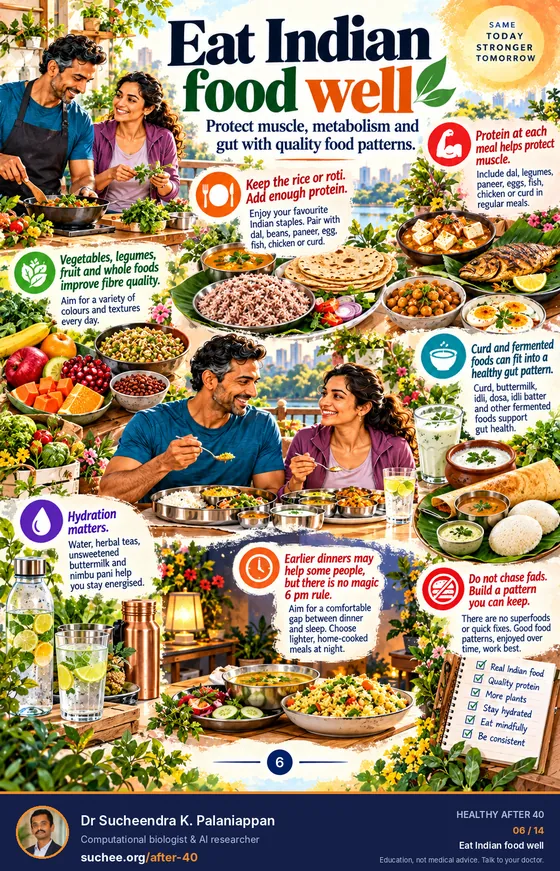
Eat Indian food well
Keep the rice or roti. Add protein at every meal, more plants, fewer fads.
Read as text
- Keep the rice or roti. Pair it with dal, beans, paneer, egg, fish, chicken or curd. The Indian plate
- Vegetables, legumes, fruit and whole foods, in many colours, every day. The Indian plate
- Curd, buttermilk, idli and dosa can fit a healthy gut pattern.
- Drink water, unsweetened buttermilk or nimbu pani.
- Earlier, lighter dinners may help some people, but there is no magic 6 pm rule.
- There are no superfoods. A pattern you can keep works best. The Indian plate
-
 07 / 14
Gut health
Feed the microbiome, do not worship it. Fibre, curd, chewing, and red flags.
Read as text
- Fibre from vegetables, fruit, dal, beans and whole grains helps the gut. The Indian plate
- Curd, idli, dosa, kanji and other traditional fermented foods can support gut health.
- Constipation usually improves with more fibre, water and movement.
- Antibiotics and overuse of acid medicines can affect gut bacteria.
- See a doctor for bleeding, weight loss, severe pain or a change in bowel habit. Colorectal screening
- Expensive probiotics and gut cleanses are not needed for most people.
-
 08 / 14
Sleep, stress, connection
Protect sleep like diet and exercise. Have people who expect to see you.
Read as text
- Protect sleep as seriously as diet and exercise. Sleep
- Snoring, gasping or daytime sleepiness may mean sleep apnoea. Get it checked. Sleep apnoea
- Chronic stress raises risk through behaviour and biology.
- Music, reading, gardening and hobbies are good for mood and attention.
- Have people who expect to see you. Purpose and relationships protect long-term health. Staying connected
-
 09 / 14
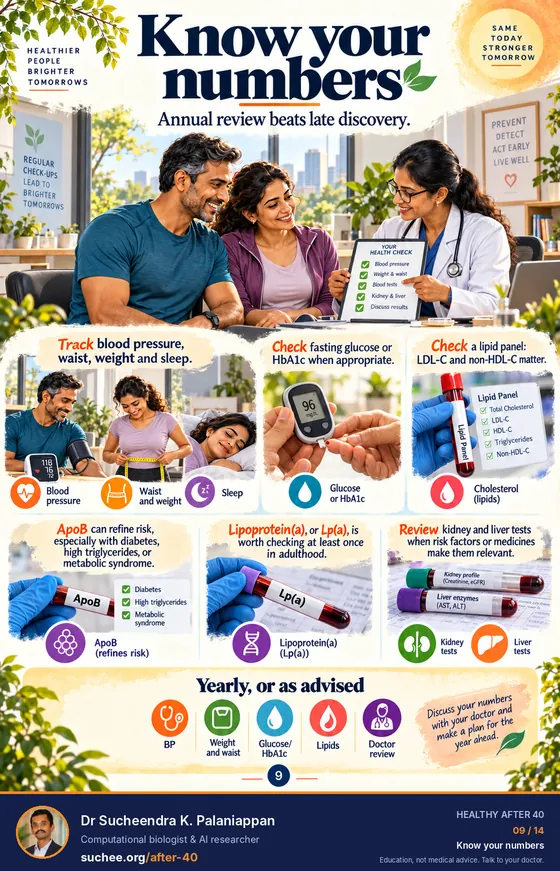
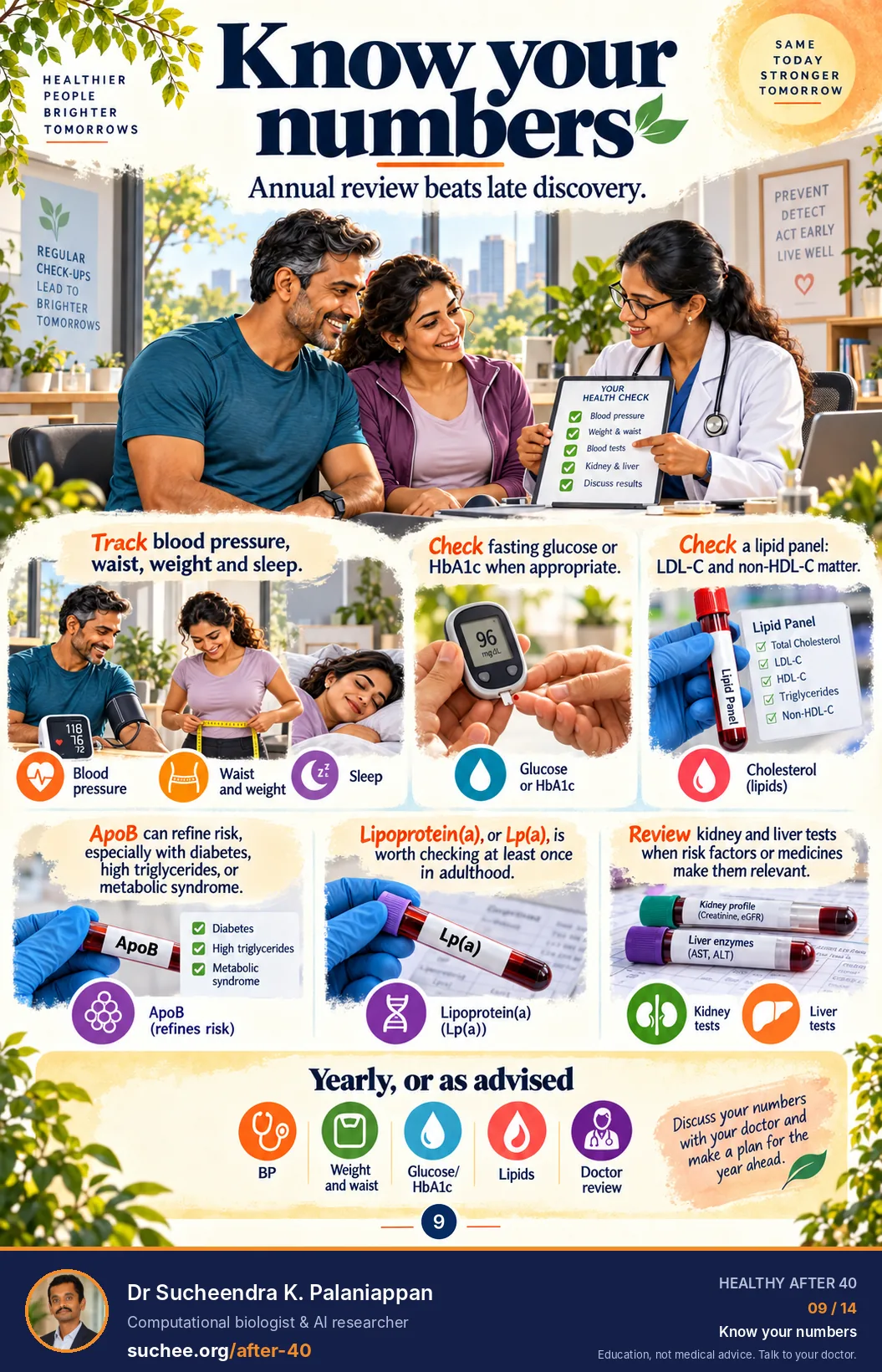
Know your numbers
A yearly review beats late discovery: blood pressure, waist, sugar and lipids.
Read as text
- Track blood pressure, waist, weight and sleep. Get checked · Waist size for Indians
- Check fasting glucose or HbA1c when appropriate. Get checked
- Check a lipid panel. LDL and non-HDL cholesterol matter. Cholesterol targets
- ApoB can refine risk, especially with diabetes, high triglycerides or metabolic syndrome. Cholesterol targets
- Check Lp(a) at least once in adulthood. Lipoprotein(a)
- Kidney and liver tests when risk factors or medicines make them relevant. Review with your doctor every year.
-
 10 / 14
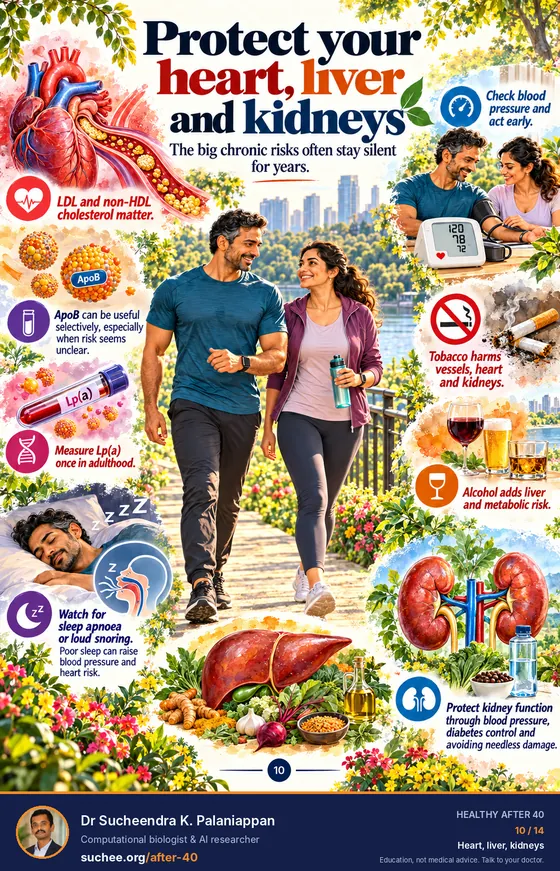
Heart, liver, kidneys
The big chronic risks stay silent for years. Catch them early.
Read as text
- LDL and non-HDL cholesterol matter. ApoB is useful when risk is unclear. Cholesterol targets
- Measure Lp(a) once in adulthood. Lipoprotein(a)
- Check blood pressure and act early. Risk in India by 40
- Tobacco harms vessels, heart and kidneys. Alcohol adds liver and metabolic risk. Tobacco in India · Fatty liver in India
- Loud snoring or sleep apnoea can raise blood pressure and heart risk. Sleep apnoea
- Protect kidneys by controlling blood pressure and diabetes and avoiding needless painkillers.
-
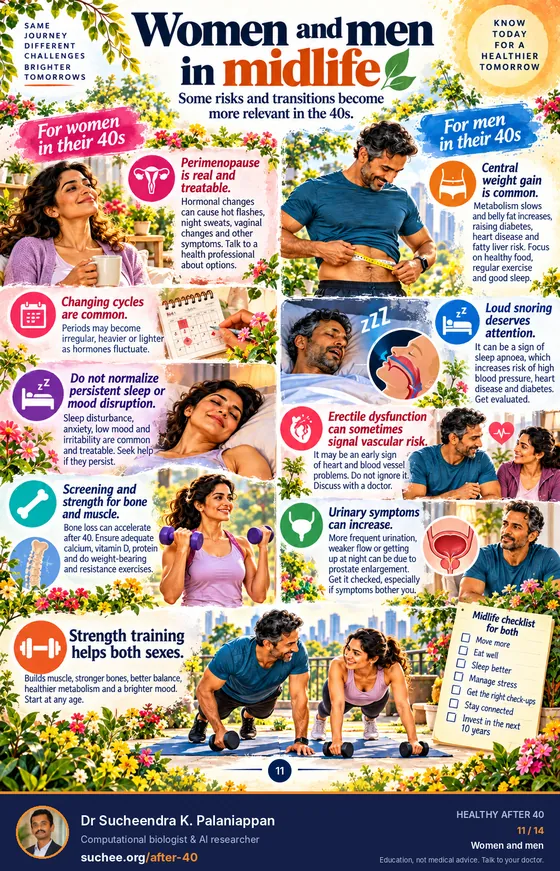 11 / 14
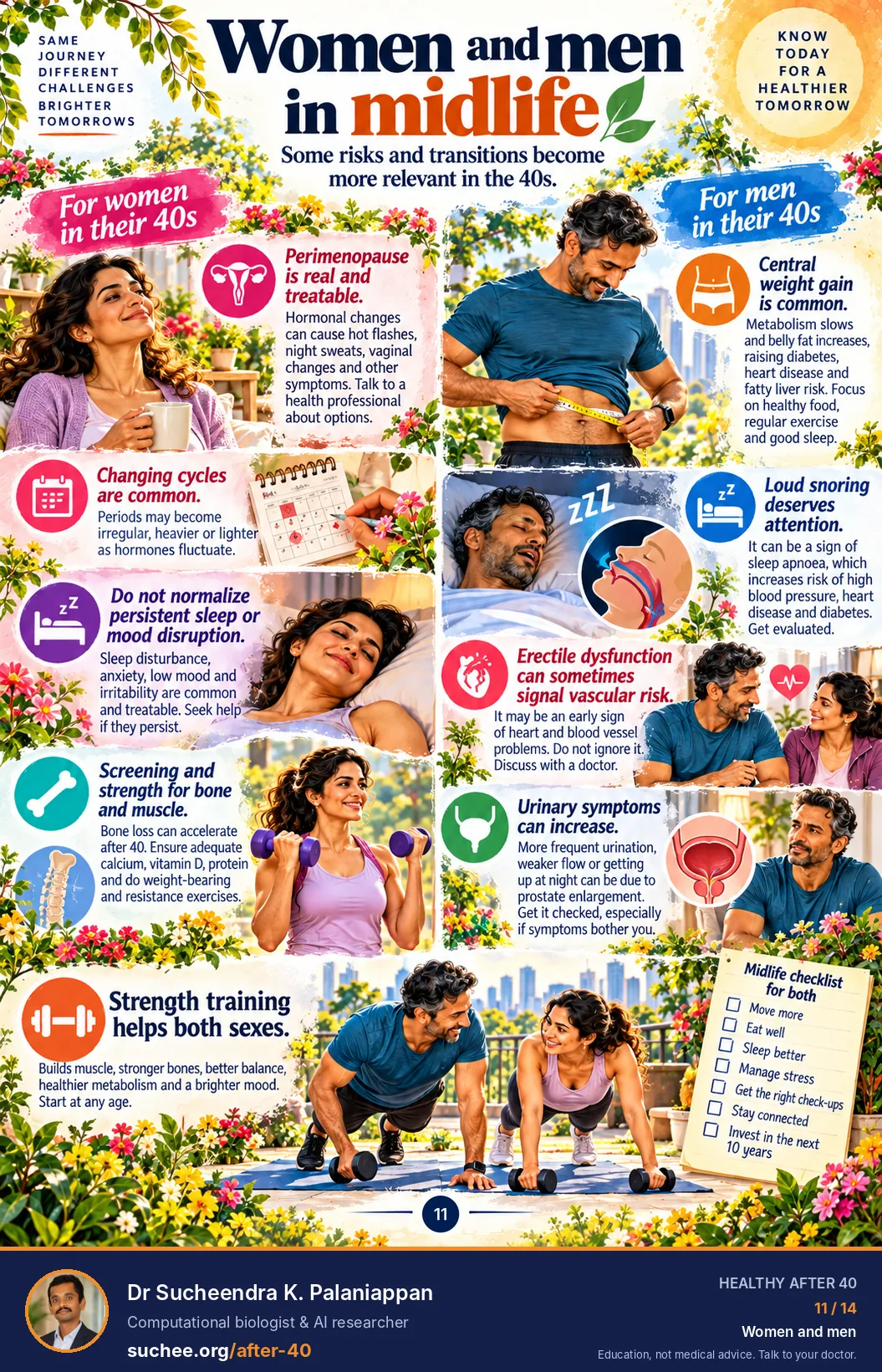
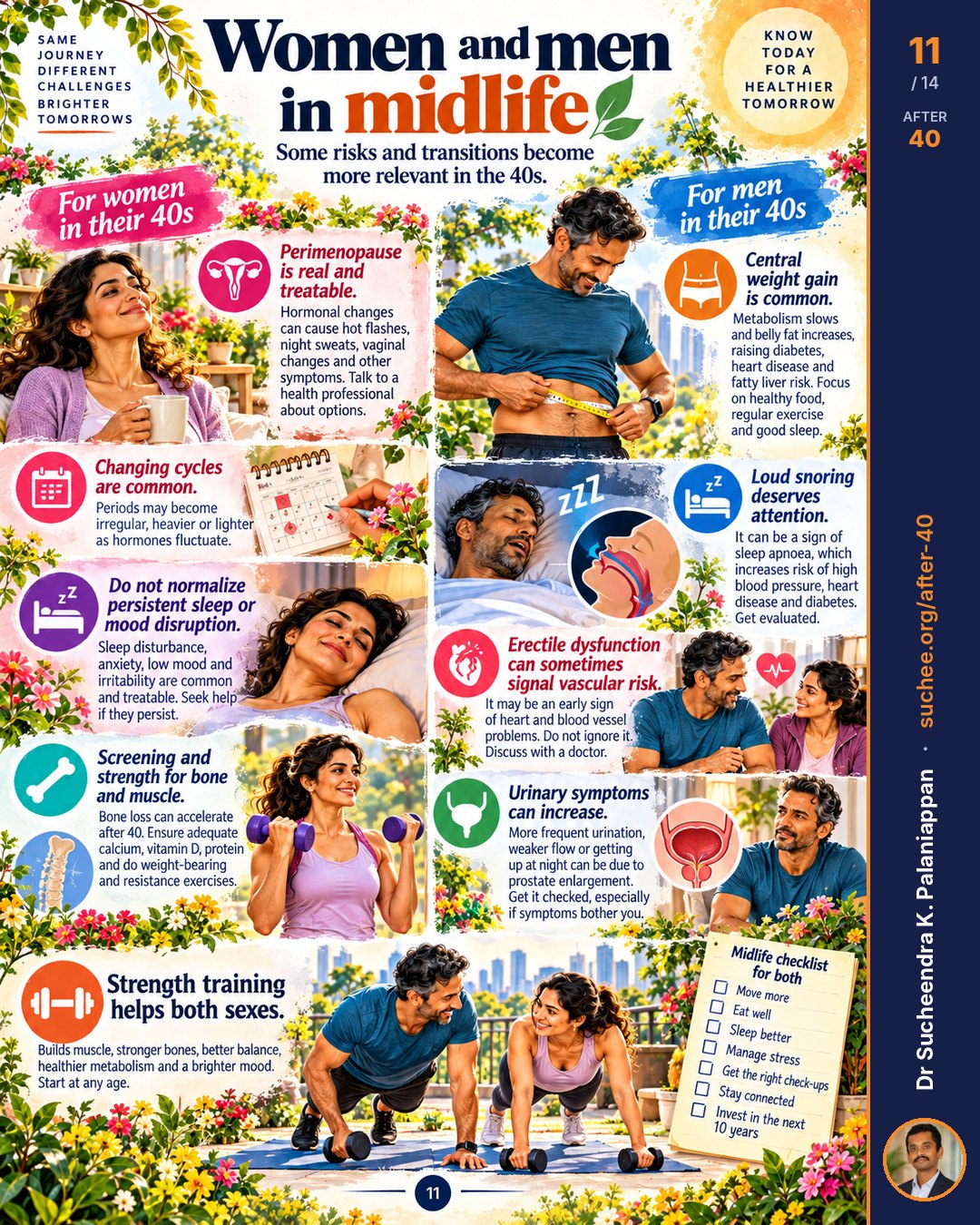
Women and men
Perimenopause, bone, snoring, prostate: what changes in the 40s.
Read as text
- Women: perimenopause is real and treatable. Changing cycles, hot flushes and night sweats are common. Talk to a doctor about options. Perimenopause
- Women: do not normalise persistent poor sleep or low mood. Bone loss can speed up after 40, so get enough calcium, vitamin D and protein, and do weight-bearing exercise. Perimenopause
- Men: belly fat raises the risk of diabetes, heart disease and fatty liver. Waist size for Indians
- Men: loud snoring deserves an evaluation for sleep apnoea. Sleep apnoea
- Men: erectile dysfunction can be an early sign of heart and blood vessel problems. Do not ignore it. Erectile dysfunction and the heart
- Men: more frequent urination or getting up at night can be prostate enlargement. Get it checked.
- Both: strength training builds muscle, bone, balance and mood. Start at any age. How much to move
-
 12 / 14
Screening and vaccines
Ask what fits your age, family history and risk. Prevention is personal.
Read as text
- Ask what screening fits your age, family history and risk. Get checked
- Colorectal screening usually starts around 45 in US guidance. Ask your doctor. Colorectal screening
- Keep up cervical and breast screening as advised. Get checked
- Oral cancer matters, especially if you use tobacco. Tobacco in India
- Check teeth, gums, vision and hearing.
- Stay up to date on vaccines: flu, COVID, tetanus or Tdap, and others when advised. Adult vaccines
-
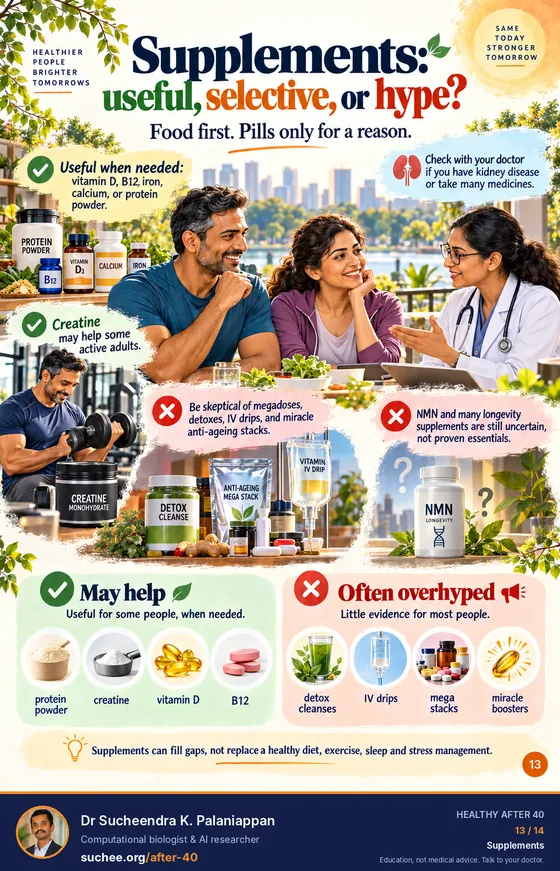 13 / 14
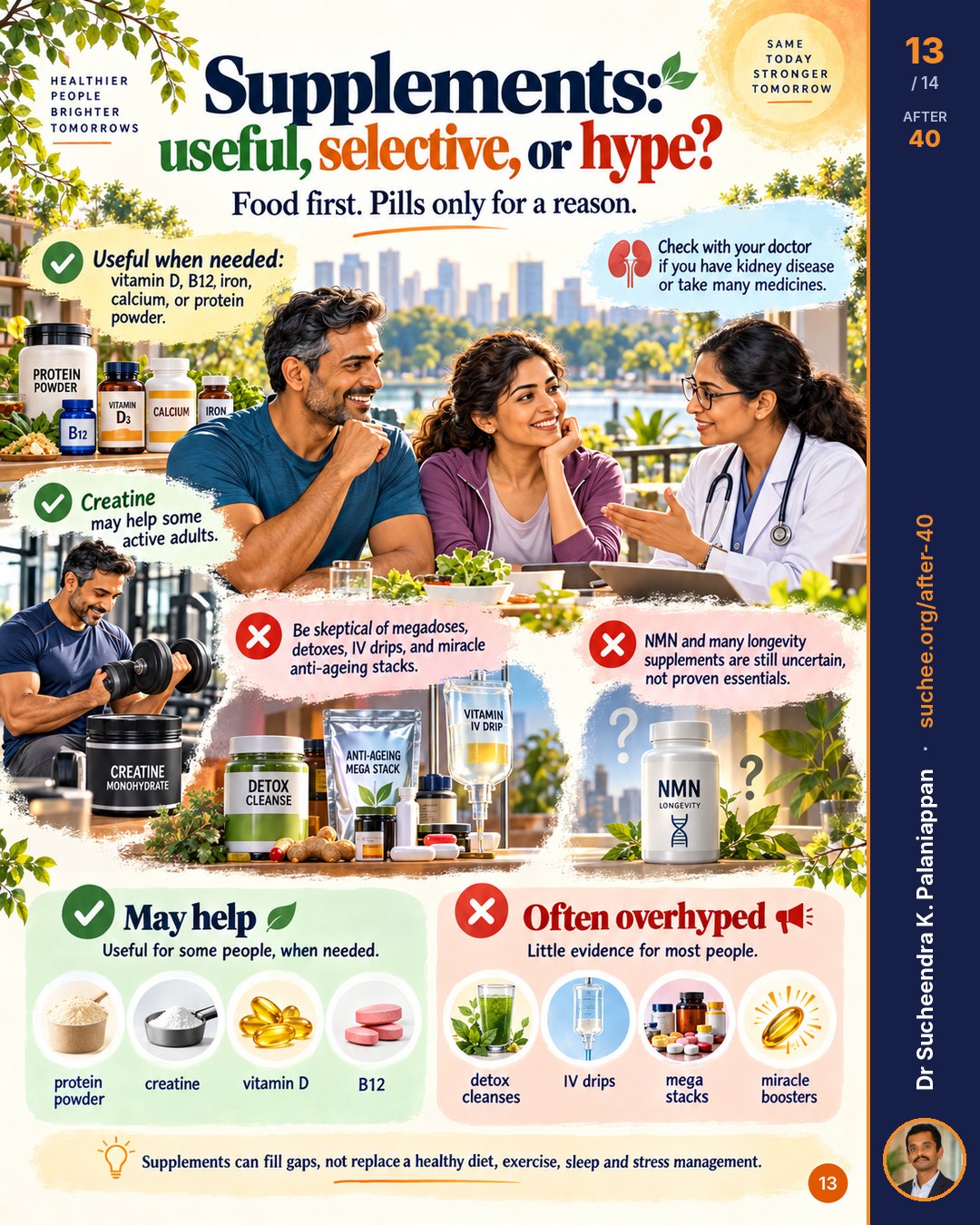
Supplements
Useful, selective or hype? Food first, pills only for a reason.
Read as text
- Useful when a need is shown: vitamin D, B12, iron, calcium, or protein powder. Supplements · The Indian plate
- Creatine may help some active adults, alongside strength training. Creatine
- Be sceptical of megadoses, detoxes, IV drips and anti-ageing stacks. Supplements
- NMN and many longevity supplements are still uncertain, not proven essentials.
- Check with your doctor if you have kidney disease or take many medicines.
-
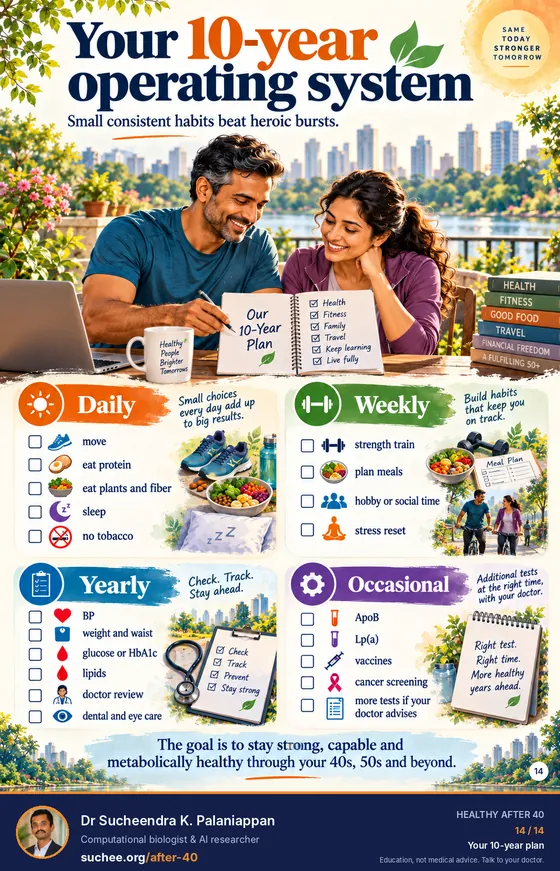 14 / 14
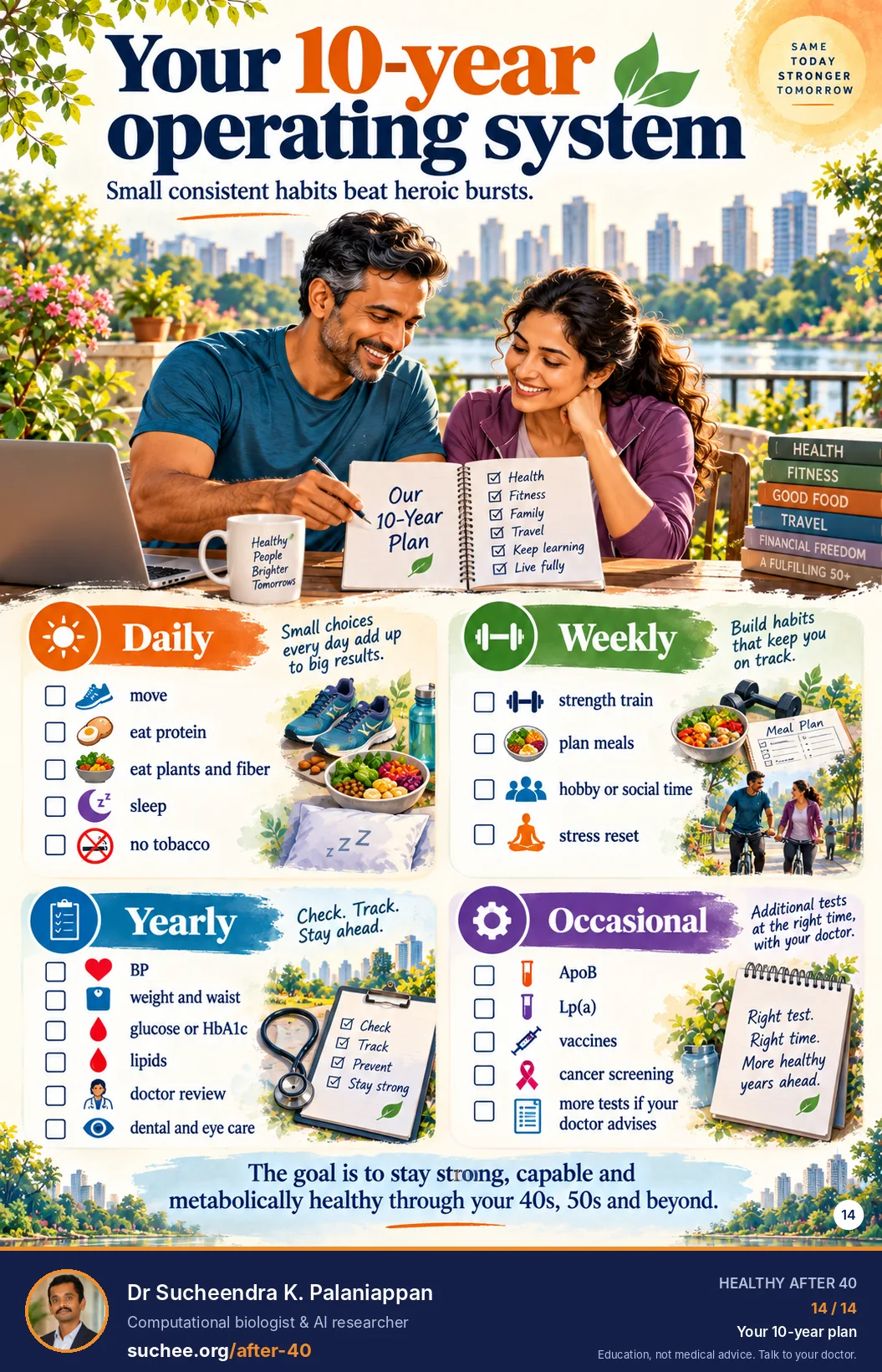
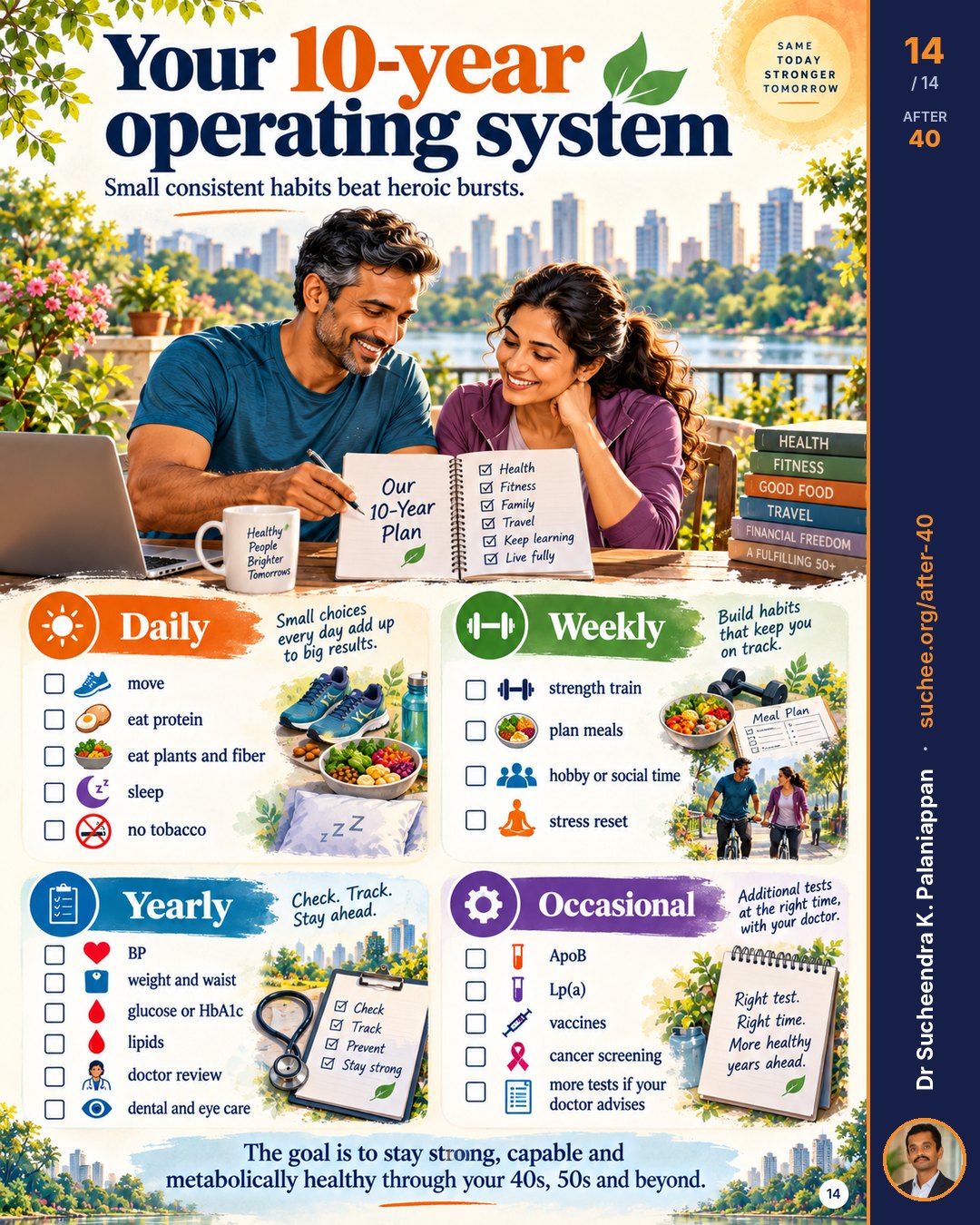
Your 10-year plan
Daily, weekly, yearly and occasional: the whole guide as one checklist.
Read as text
- Daily: move, eat protein, eat plants and fibre, sleep, no tobacco. How much to move · Tobacco in India
- Weekly: strength training, plan meals, a hobby or social time, a stress reset. How much to move
- Yearly: blood pressure, weight and waist, glucose or HbA1c, lipids, a doctor review, dental and eye care. Get checked
- Occasionally: ApoB, Lp(a), vaccines, cancer screening, and other tests your doctor advises. Lipoprotein(a) · Adult vaccines
- The goal: stay strong, capable and metabolically healthy through your 40s, 50s and beyond.




















What each guide stands on
Most health advice on WhatsApp has no source. Each claim here links to one, with the kind of evidence it is, so you can check it or show your doctor.
- Risk in India by 40Among Indian adults, 35.5% have high blood pressure, 11.4% have diabetes and 15.3% have prediabetes. 39.5% carry excess fat around the waist and 81.2% have at least one abnormal cholesterol value. Most of this is silent.Anjana et al., ICMR-INDIAB-17, Lancet Diabetes & Endocrinology 2023 National survey · 113,043 adults, 31 states and UTs
- How much to move150 to 300 minutes of moderate activity a week, or 75 to 150 minutes of vigorous activity, plus muscle strengthening of all major muscle groups on 2 or more days. Replace sitting with any movement.
- Waist size for IndiansFor Asian Indians, abdominal obesity starts at a waist of 90 cm in men and 80 cm in women, lower than the Western cut-offs of 102 and 88 cm, because risk rises at a smaller size.Misra et al., Consensus statement for Asian Indians, JAPI 2009 Indian expert consensus
- Fatty liver in IndiaPooled across Indian studies, about 38.6% of adults have fatty liver not caused by alcohol, and more than half of people with obesity or diabetes.Elhence et al., NAFLD in India, J Clin Exp Hepatol 2022 Meta-analysis · 50 studies
- The Indian plateGet good-quality protein from food combinations such as dal with rice or roti, eat a wide variety of foods with more vegetables and pulses, and keep added salt to 5 g a day at most. ICMR-NIN advises against protein powders for most people.ICMR-NIN, Dietary Guidelines for Indians, 2024 National guideline
- Cholesterol targetsIndia’s lipid guideline sets targets for both LDL cholesterol and non-HDL cholesterol, lower than Western ones, because Indians develop heart disease earlier. ApoB adds information when triglycerides are high or with diabetes, obesity or metabolic syndrome.Iyengar et al., Lipid Association of India expert consensus, 2016 Indian expert consensus · Mach et al., ESC/EAS dyslipidaemia guidelines, Eur Heart J 2020 European guideline
- Lipoprotein(a)Lp(a) is mostly inherited and stays fairly stable through life, so measuring it at least once in adulthood is enough for most people. A high value is a reason to control every other risk more tightly.Kronenberg et al., EAS consensus statement on Lp(a), Eur Heart J 2022 European expert consensus
- Get checkedIndia’s national NCD programme screens every adult over 30 for high blood pressure, diabetes and common cancers of the mouth, breast and cervix, at government health centres. Use it, and keep the numbers.MoHFW, NP-NCD Operational Guidelines National programme
- Colorectal screeningScreening for colorectal cancer from age 45 is a US recommendation. India has no national colorectal screening programme, so ask your doctor, especially with a family history or symptoms.USPSTF, Colorectal cancer screening, 2021 US guideline No Indian guideline covers this.
- Tobacco in India28.6% of Indian adults use tobacco, 42.4% of men and 14.2% of women, most often as smokeless tobacco, the main cause of mouth cancer.MoHFW, Global Adult Tobacco Survey 2 (2016–17) National survey · 74,037 adults
- Sleep7 to 9 hours a night for adults up to 64.Hirshkowitz et al., National Sleep Foundation recommendations, Sleep Health 2015 Expert panel No Indian guideline covers this.
- Sleep apnoeaSnoring, daytime sleepiness, obesity or high blood pressure at a routine check-up are reasons for a sleep evaluation. Untreated sleep apnoea raises blood pressure and heart risk.Sharma et al., INOSA guidelines, Indian J Med Res 2014 National guideline
- PerimenopauseIn the years before periods stop, cycles change and hot flushes, night sweats, poor sleep and low mood are common. Bone loss speeds up around menopause. Symptoms are treatable, with hormonal and non-hormonal options.WHO, Menopause fact sheet Fact sheet
- Erectile dysfunction and the heartIn about 95,000 men, erectile dysfunction went with a higher risk of heart disease, even in men without known heart disease. It is a warning sign worth taking to a doctor, not a cause.Banks et al., Erectile dysfunction severity and cardiovascular risk, PLoS Medicine 2013 Cohort study · 95,038 men No Indian study of this size.
- Adult vaccinesIndia’s adult immunisation guidance from the Association of Physicians of India covers influenza every year, a tetanus and diphtheria booster every 10 years, and others by age and risk.Review of the API adult immunisation guidelines, IJCMPH 2024 Review of Indian guideline
- SupplementsBeta-carotene and vitamin E should not be taken to prevent heart disease or cancer, and for multivitamins the evidence is too thin either way. Supplements are for a known gap, such as low B12 or vitamin D on a test.USPSTF, Vitamin, mineral and multivitamin supplementation, 2022 US guideline No Indian guideline covers this.
- CreatineCreatine monohydrate is the most studied sports supplement and appears safe at usual doses in healthy adults. It helps most alongside strength training.Kreider et al., ISSN position stand on creatine, JISSN 2017 Expert position stand No Indian guideline covers this.
- Staying connectedAcross 148 studies, people with stronger social ties had about 1.5 times the odds of survival, an effect comparable to well-known risks such as smoking.Holt-Lunstad et al., Social relationships and mortality risk, PLoS Medicine 2010 Meta-analysis · 308,849 people, 148 studies
Guidance changes as evidence grows. When it does, the guides and this list will be updated. Last updated .
How these are made
- Guidelines, not headlines. Every number comes from a guideline, a national survey or a systematic review, linked above. One exciting study does not change a guide.
- Written for Indian bodies. Indian waist cut-offs, Indian cholesterol targets, dal and curd rather than kale and quinoa.
- Habits before products. Tests and supplements come after the basics, and only with a reason.
- Nothing to sell. No clinic, no supplements, no product. Free to print and share.
Want the science behind it?
Longevity, Interpreted. is my weekly reading of longevity research: what was shown, at what stage, and what it does not yet support.