Health by age · 100 and over
Healthy after 100 another good day, on your own terms
At 100 the aim is not more rules. It is to make each day safer, more comfortable, more connected and your own.
The guides cover what studies of people who reach 100 do and do not show, keeping your choices, good days, a home that makes life easier, food and swallowing, staying connected, and care built around what matters to you.
Eight one-page guides, written for centenarians and the families who look after them, each with a source for every number.
Sources are listed below. Studies of people aged 100 and over come first, including India's national ageing survey. Where no study of centenarians exists, the source is a guideline or study of older adults in general, and says so. Indian services (112, Elderline, the national programme for older people, living wills) are listed too.
 Sucheendra Kumar PalaniappanComputational biologist
Read them in order
Tap a guide to open it full screen, then swipe through all eight. Each one has a text version and its sources.
-
 01 / 8
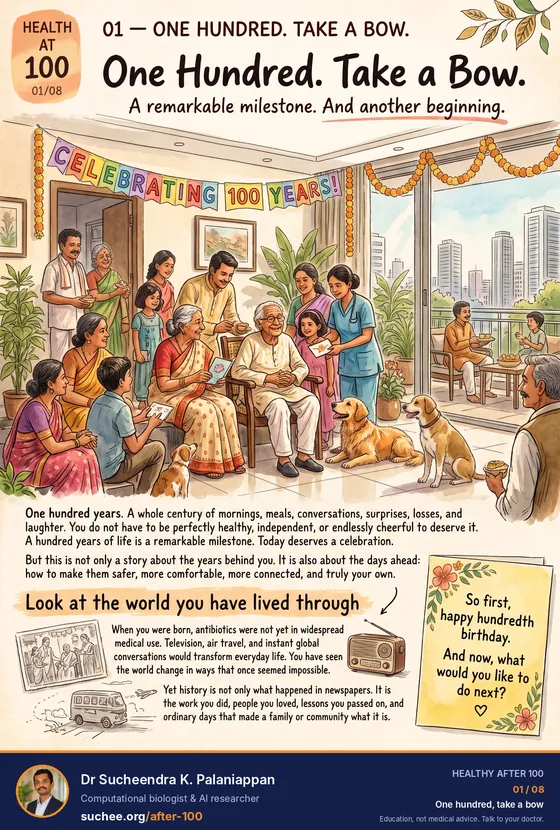
One hundred, take a bow
A remarkable milestone, and another beginning.
Read as text
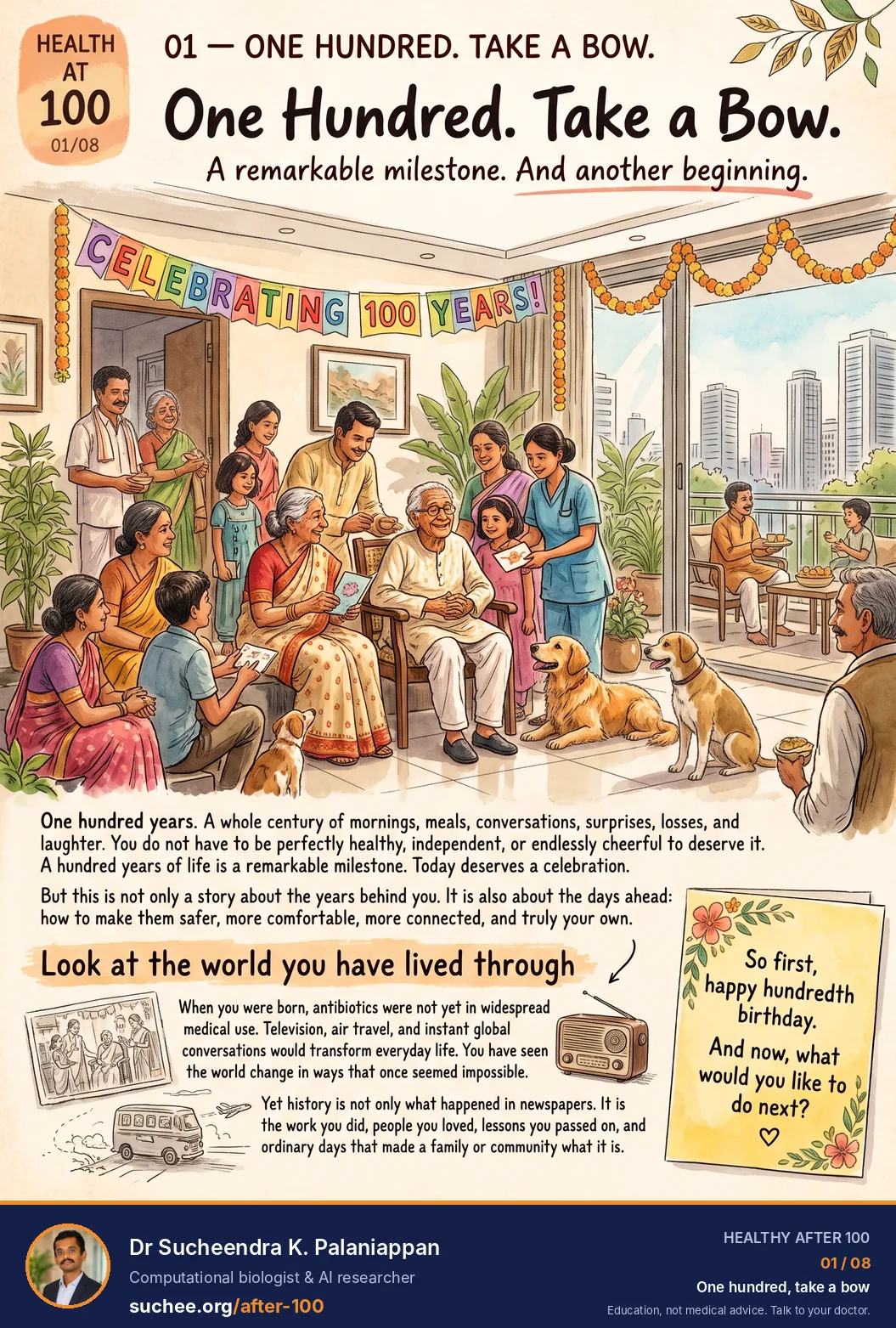
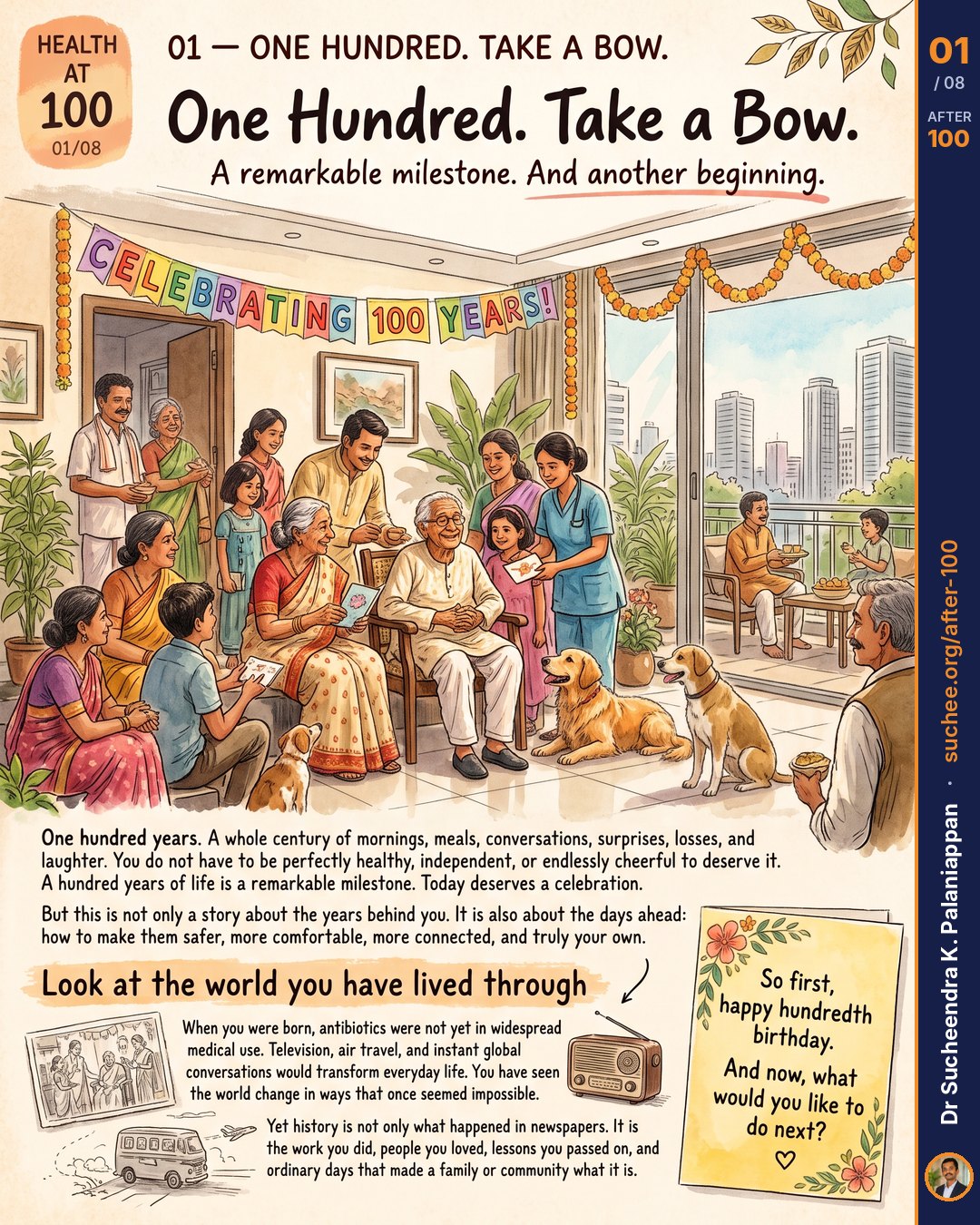
- A hundred years of mornings, meals, conversations, losses and laughter. You do not have to be perfectly healthy, independent or cheerful to deserve the celebration.
- In India's national ageing survey, more than half of people aged 100 and over still walked, ate, bathed and dressed on their own, and about three in four of the oldest rated their lives as fairly good. India's oldest people
- Someone born in the mid-1920s arrived before penicillin was discovered, and it was not made in quantity until the 1940s. Television, air travel and phones that reach across the world came later still. When antibiotics arrived
- These guides are about the days ahead: making them safer, more comfortable, more connected and your own.
- A fall matters more at 100: about half of centenarians who break a hip die within a year. At a celebration, keep the floor clear around the guest of honour, with no pets underfoot or loose rugs. A broken hip at 100 · Pets and falls
- So first, happy hundredth birthday. And then: what would you like to do next?
-
 02 / 8
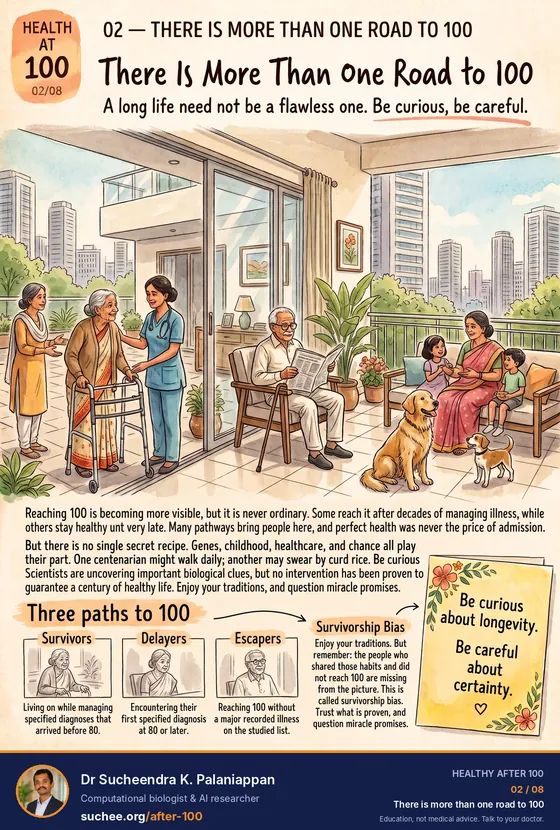
There is more than one road to 100
A long life need not be a flawless one. Be curious, and be careful.
Read as text
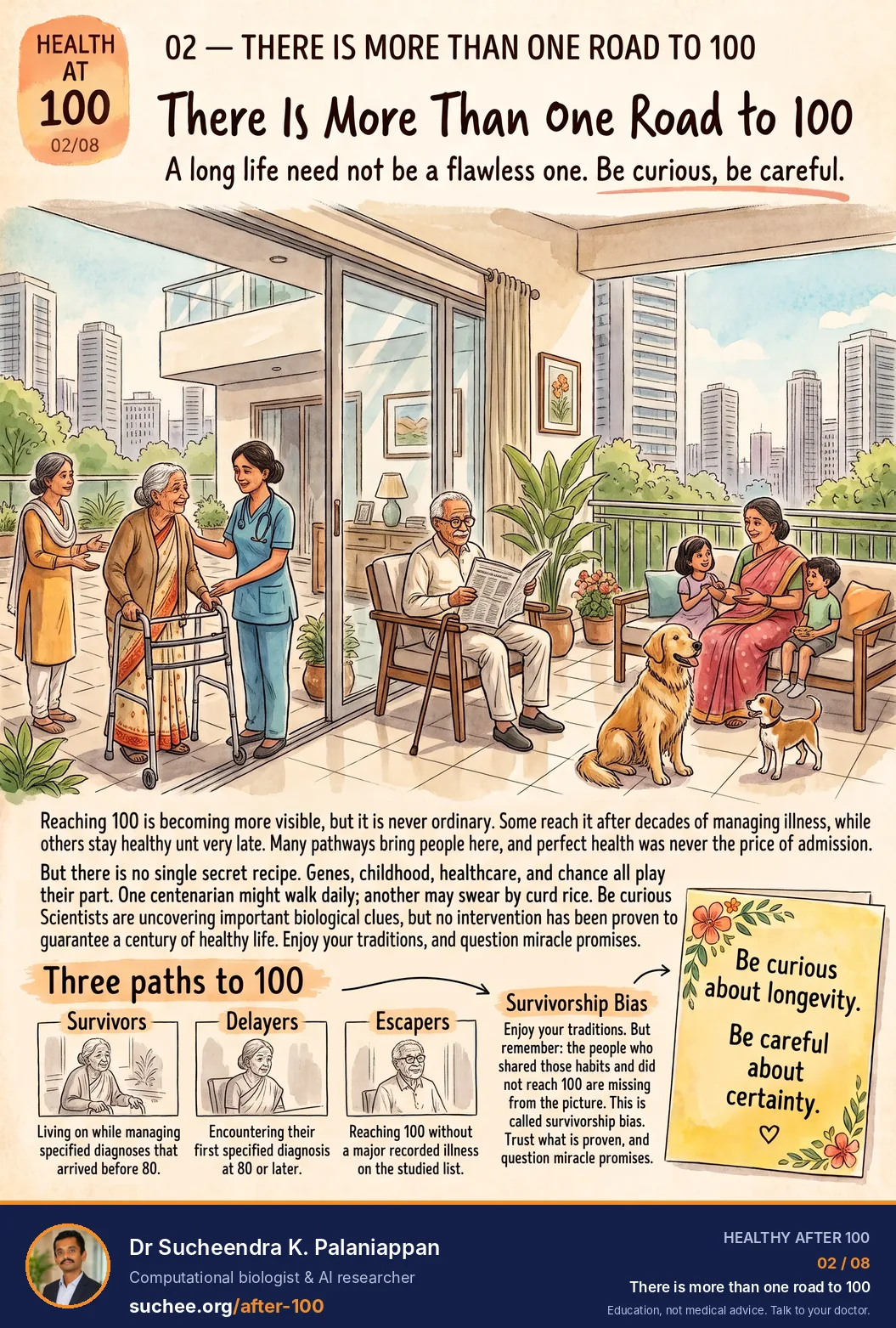
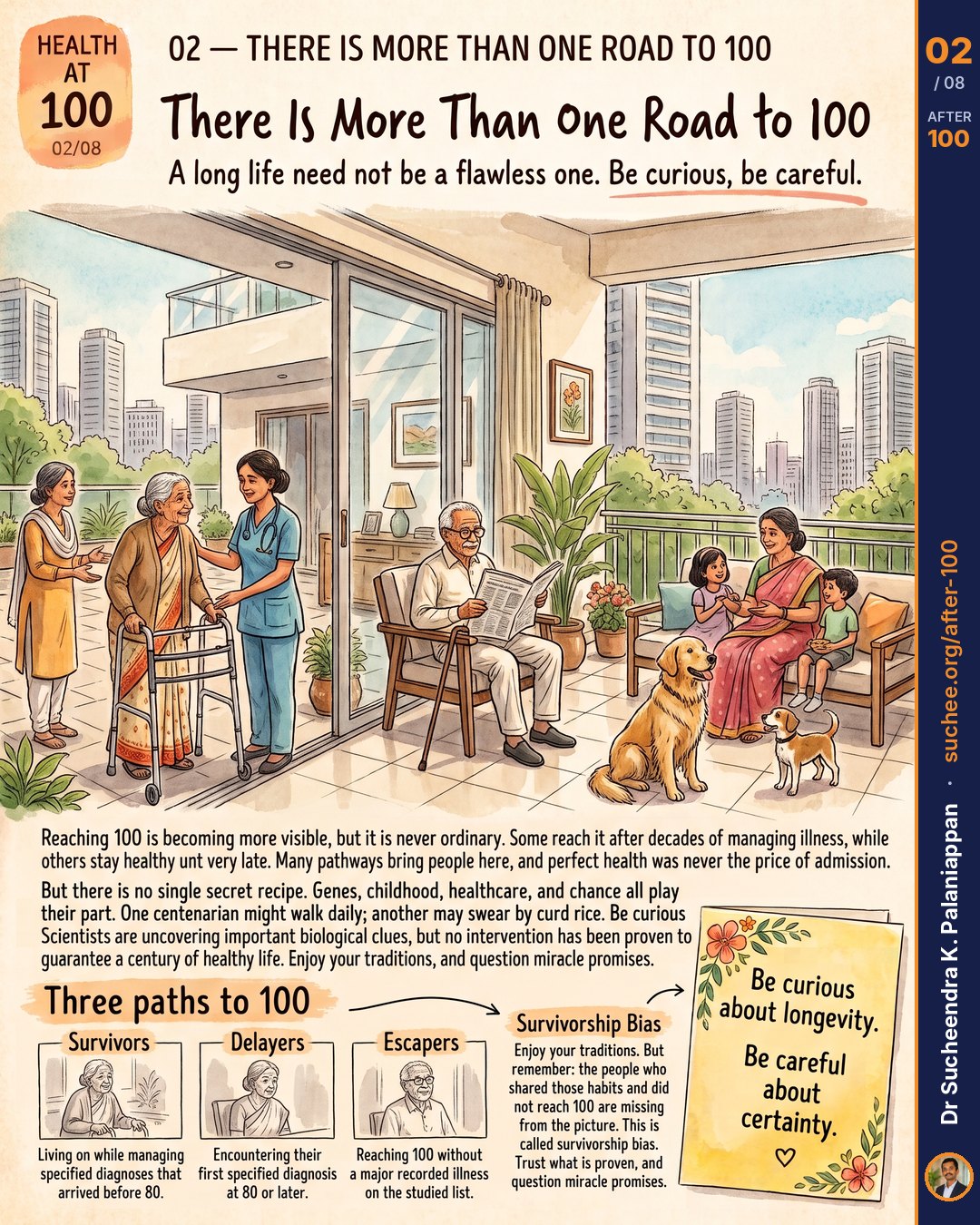
- Some people reach 100 after decades of managing illness; others stay healthy until late. Perfect health was never the price of admission.
- In one study of 424 centenarians, 43% of the women had lived with a major illness since before 80, 42% first got one at 80 or later, and 15% reached 100 without one. Men were more often in the last group. Three paths to 100
- Many were healthier on the way: Danes who went on to reach 100 had spent less time in hospital in their 70s than people born the same year who died in their 80s. Healthier on the way to 100
- Reaching 100 runs in families: brothers of centenarians were at least 17 times, and sisters 8 times, as likely to reach 100. Shared genes explain part of that and shared homes and habits part. Across ordinary lifespans, genes explain much less. Reaching 100 runs in families · Genes across ordinary lifespans
- One centenarian walks daily; another swears by curd rice. The people who shared those habits and did not reach 100 are missing from the picture. This is survivorship bias.
- Scientists are finding biological clues, but no treatment, supplement or diet has been shown to guarantee a long, healthy life. Enjoy your traditions, and question miracle promises.
-
 03 / 8
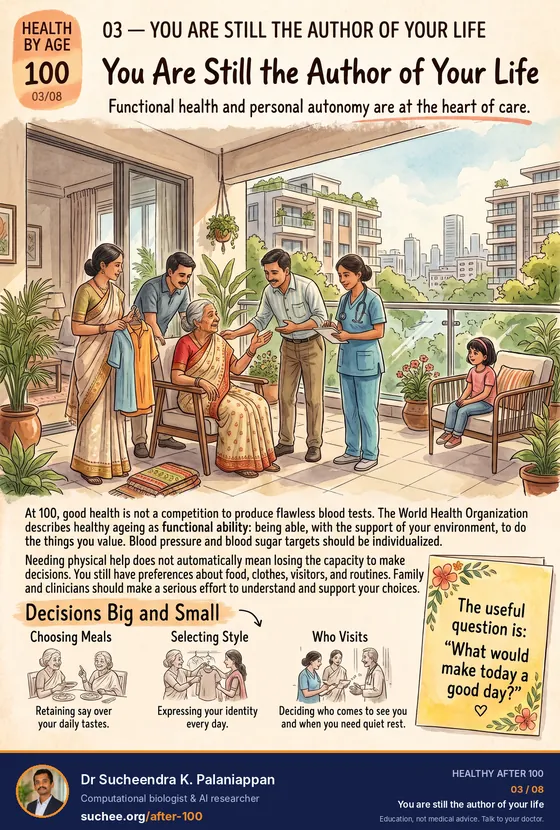
You are still the author of your life
What you can do, and what you want, sit at the heart of care.
Read as text
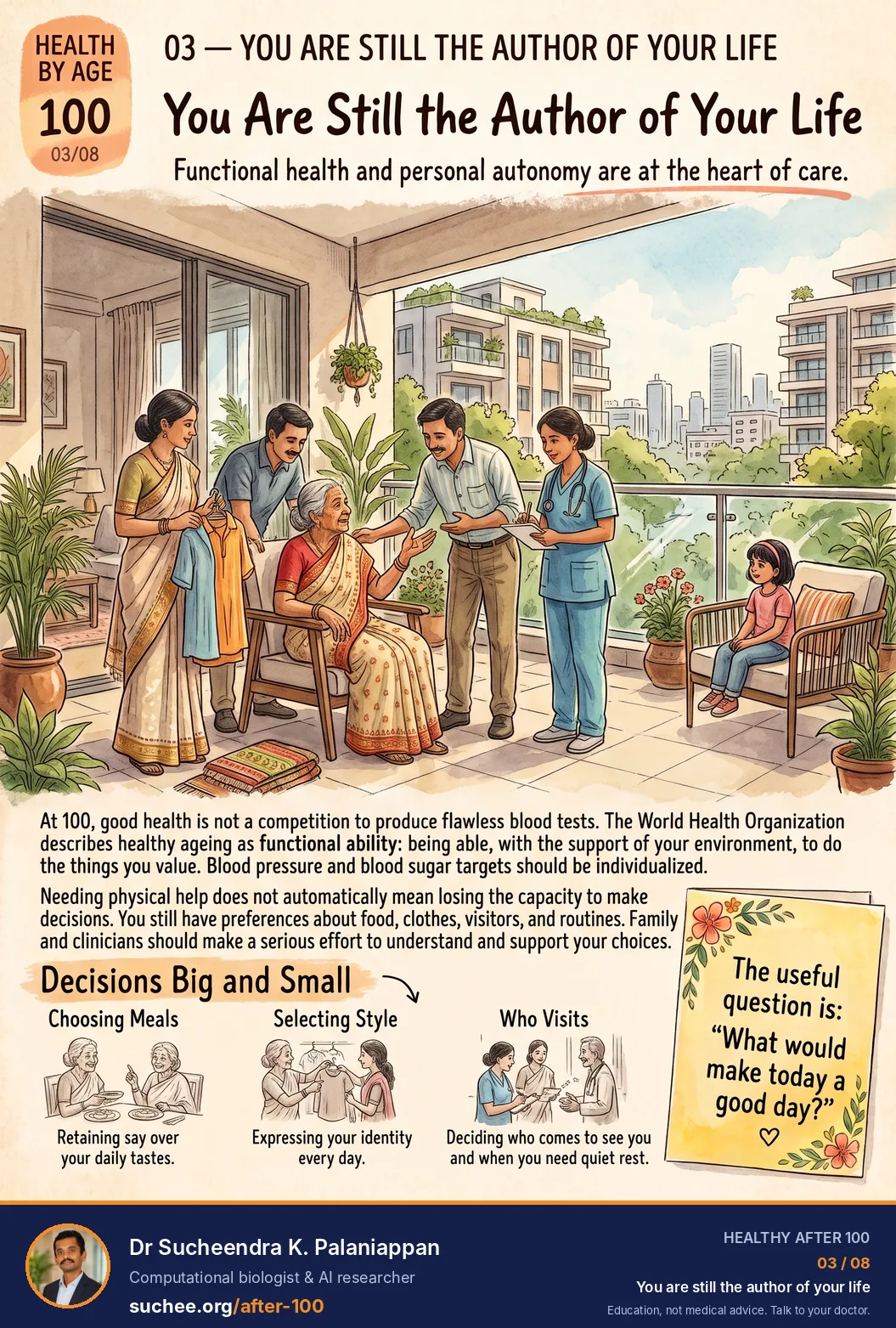
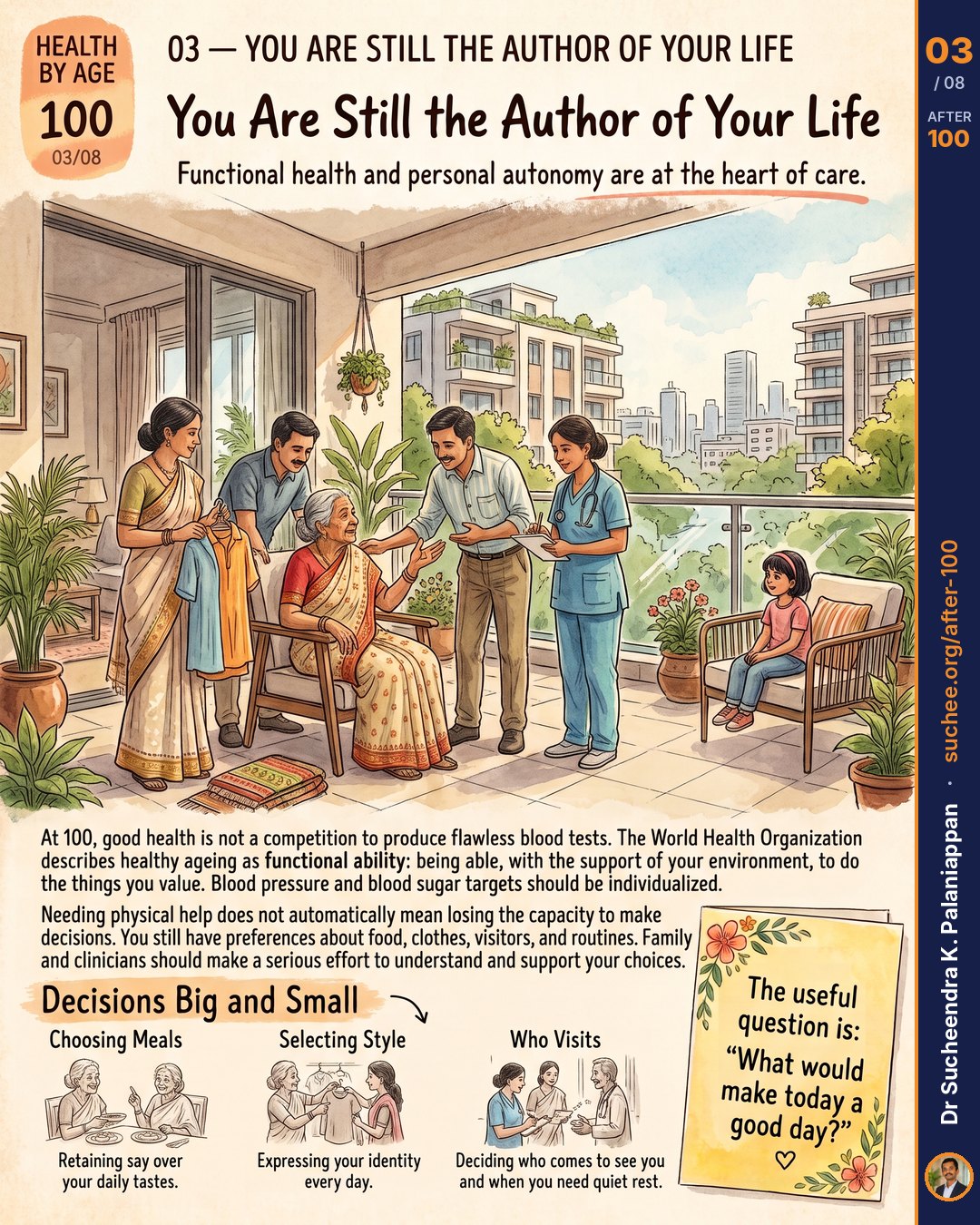
- WHO describes healthy ageing as keeping the ability to do what you value, with the support of the people and places around you. What WHO means by healthy ageing
- At 100, good health is not a contest to produce perfect blood tests. About half of people over 95 still take a blood pressure medicine, and guidelines for the very old allow looser targets. Ask your doctor what makes sense for you, and do not stop a medicine on your own. What the very old eat and take · Targets in very old age
- Needing help with the body is not the same as losing the mind. In a New York study of people aged 95 to 107, many lived in their own homes, and thinking skills were, on average, good. Living at home, thinking clearly
- So start from the assumption that you can decide, with whatever help and time you need. Meals, clothes, visitors, routines and quiet rest stay your choices. Helping people decide
- The useful question each day: what would make today a good day?
-
 04 / 8
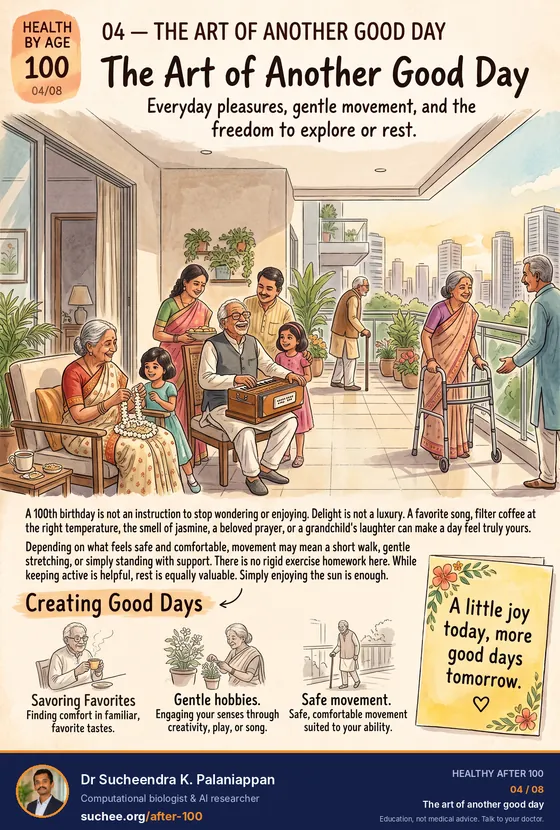
The art of another good day
Everyday pleasures, gentle movement, and the freedom to explore or rest.
Read as text
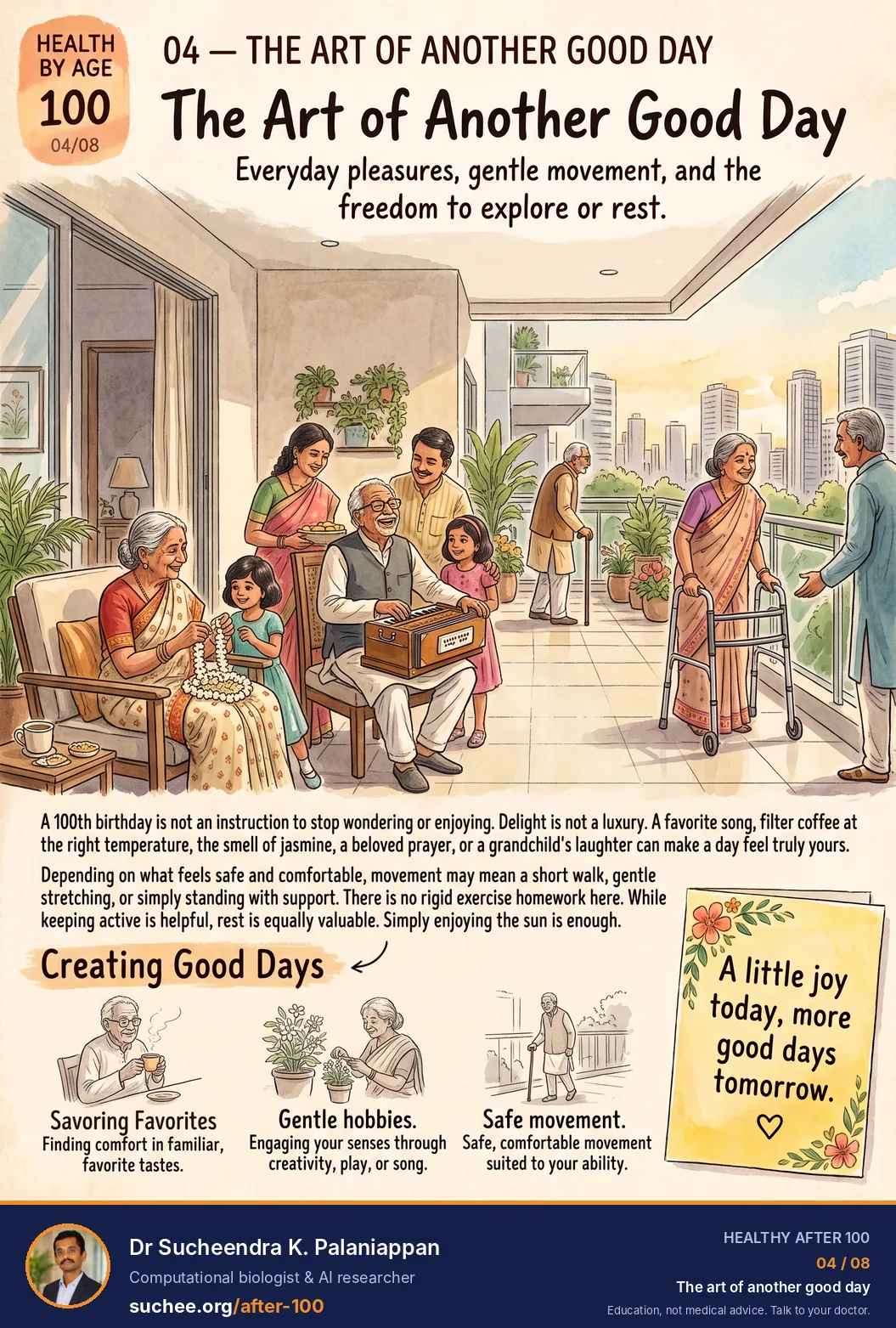
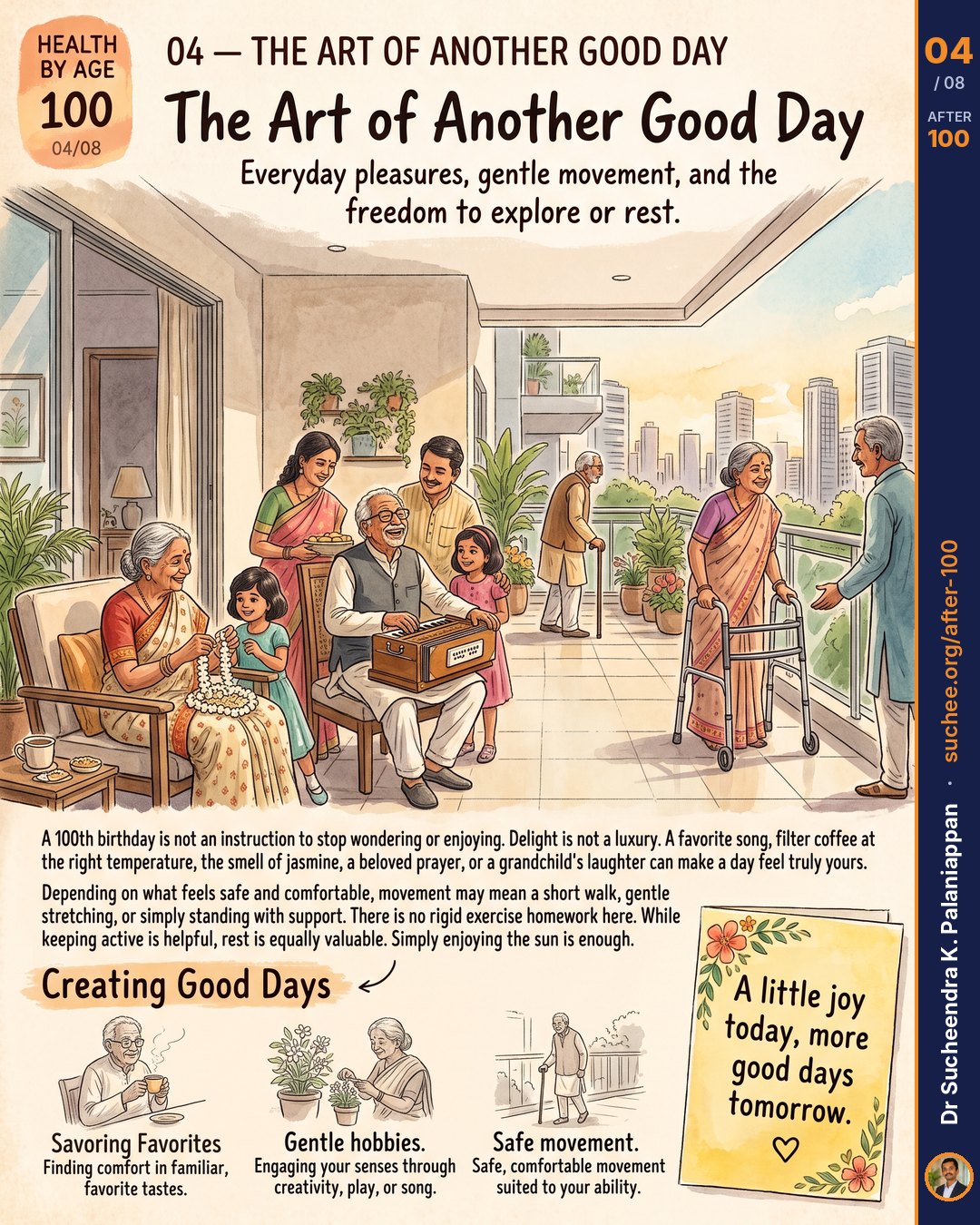
- Delight is not a luxury: a favourite song, filter coffee just right, the smell of jasmine, a prayer, a grandchild's laughter.
- Many centenarians report high happiness despite health limits, and belief in your own abilities and an optimistic outlook matter more than perfect health. Happiness at 100
- Movement can be a short walk, gentle stretching or simply standing with support, whatever feels safe and comfortable. Some activity is better than none. How much to move after 65
- Muscles still respond in the 90s: frail people around 90 more than doubled their strength in eight weeks of supervised training. Ask a physiotherapist what is safe for you. Strength training at 90
- Rest when you need it, but in a chair rather than in bed, and get up through the day, with help if needed. Long stretches in bed cost muscle quickly. Bed rest and muscle
- Use the stick or walker you have been given, and keep pets out from under your feet. Pets and falls
- Enjoy the sun in the cooler morning hours, with water to hand, and stay out of the midday heat.
-
 05 / 8
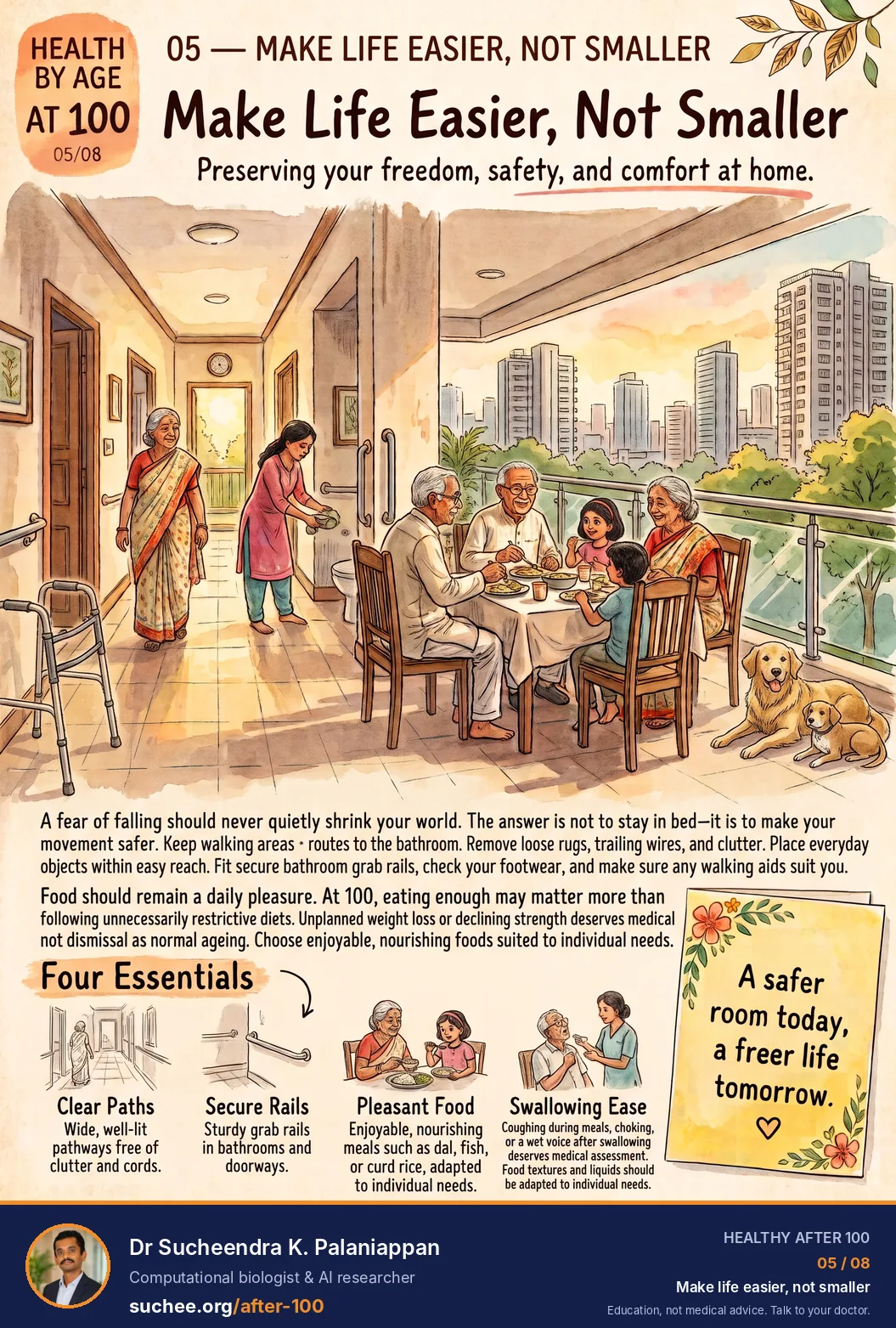
Make life easier, not smaller
Freedom, safety and comfort at home.
Read as text
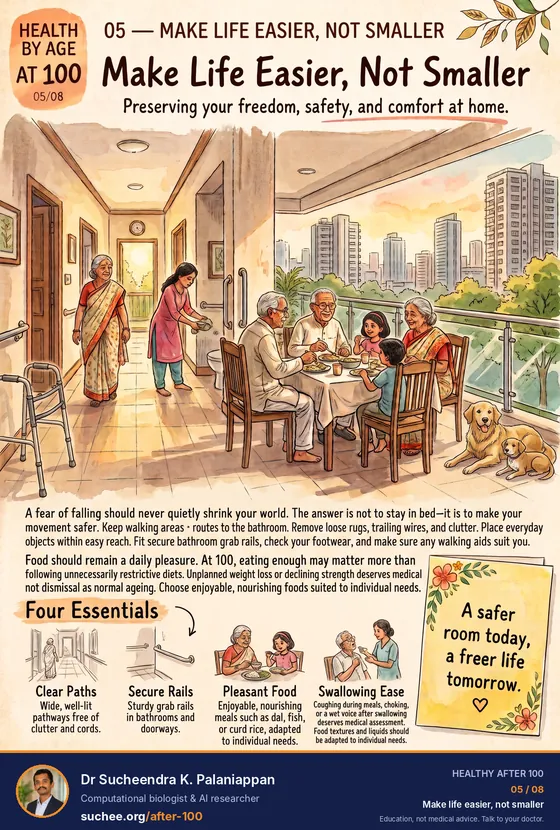
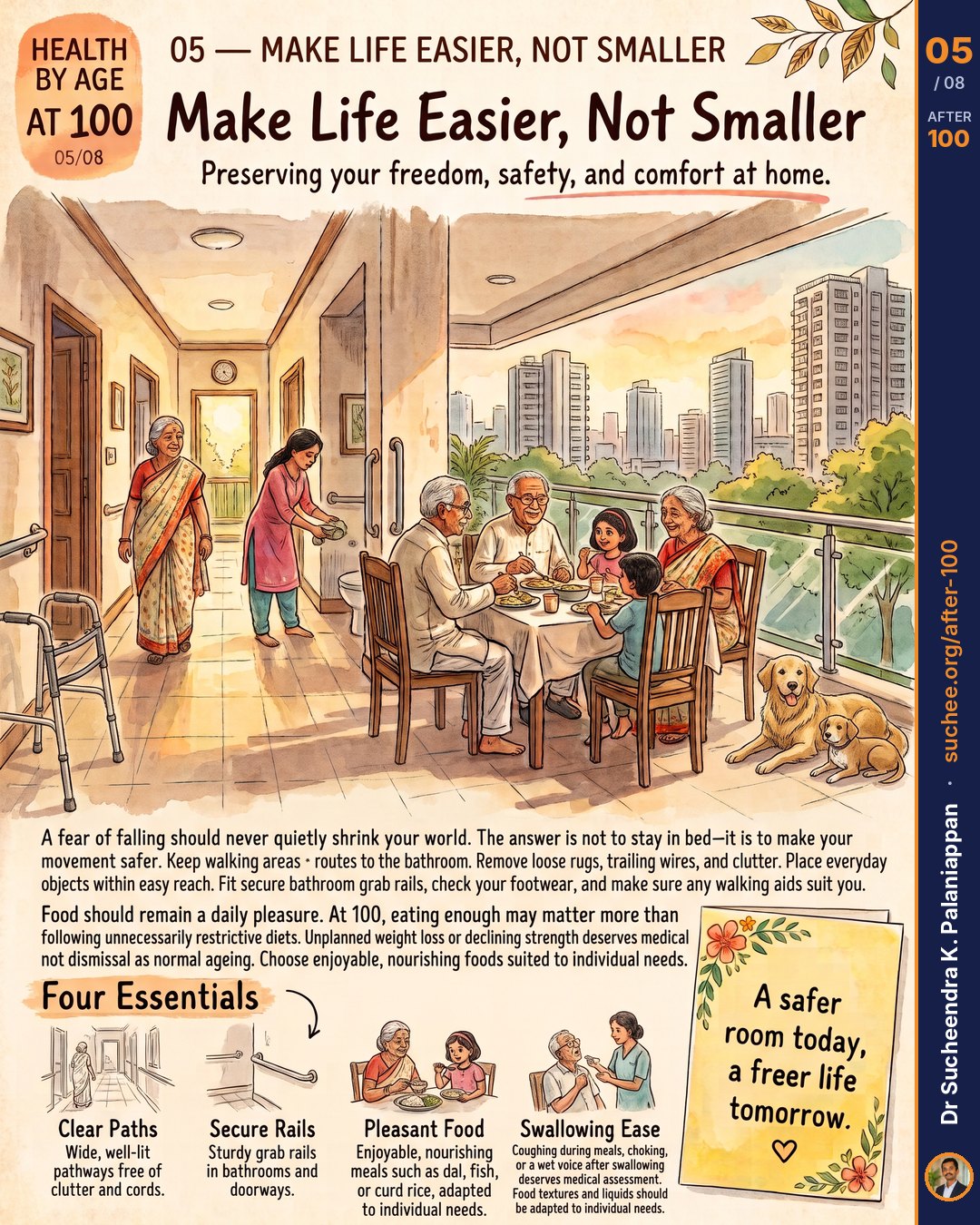
- A fear of falling should not quietly shrink your world. A broken hip is serious at 100, so the answer is to make moving about safer, not to stay in bed. A broken hip at 100 · Bed rest and muscle
- Light the way, with night lights from bed to bathroom. Clear loose rugs, wires and clutter, and keep floors dry. A safer home
- Fit grab rails firmly in the bathroom, wear well-fitting footwear with a good grip and a closed back, and check that walking aids suit you. A safer home
- Keep everyday things, and a phone, within easy reach.
- People who reach 95 and beyond mostly eat a varied diet of staples such as rice and wheat, with vegetables, fruit and protein from dal, fish or poultry, and little salty food. What the very old eat and take
- At 100, eating enough matters more than strict diets. Make food easy to chew, and with diabetes or kidney disease ask your doctor what still applies. Food at a great age
- Losing weight without trying, or growing weaker, needs a doctor's look, not dismissal as old age. Weight loss
- Coughing or choking at meals, or a wet voice after swallowing, needs assessment. If someone cannot breathe, speak or cough, call 112. Swallowing problems · Emergency numbers
-
 06 / 8
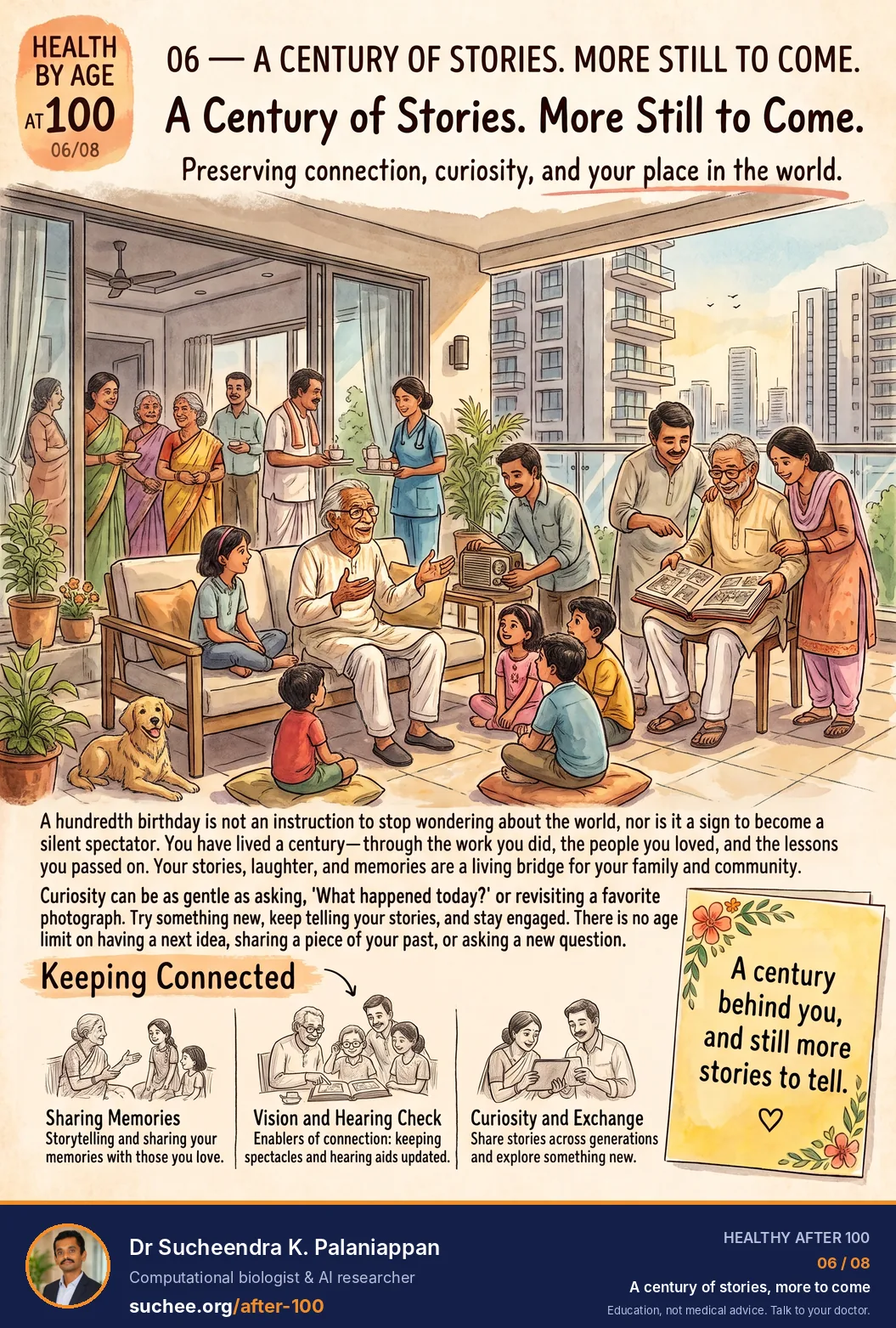
A century of stories, more to come
Connection, curiosity, and your place in the world.
Read as text
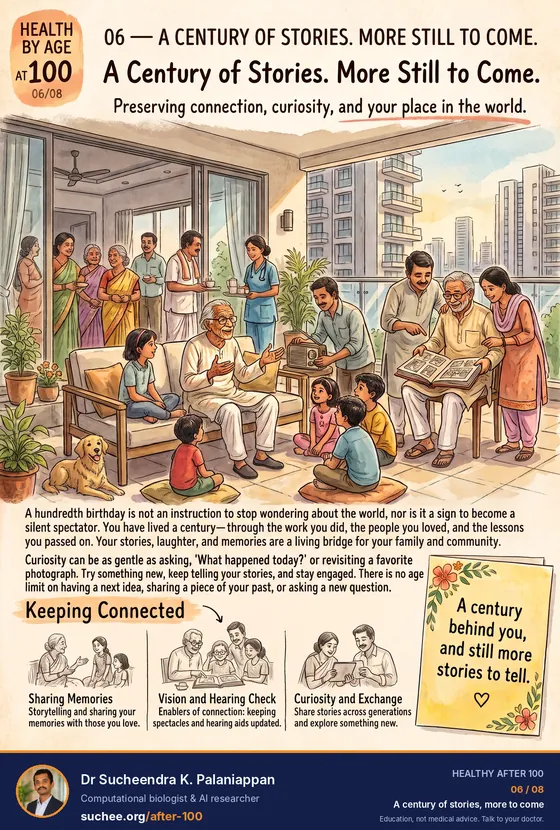
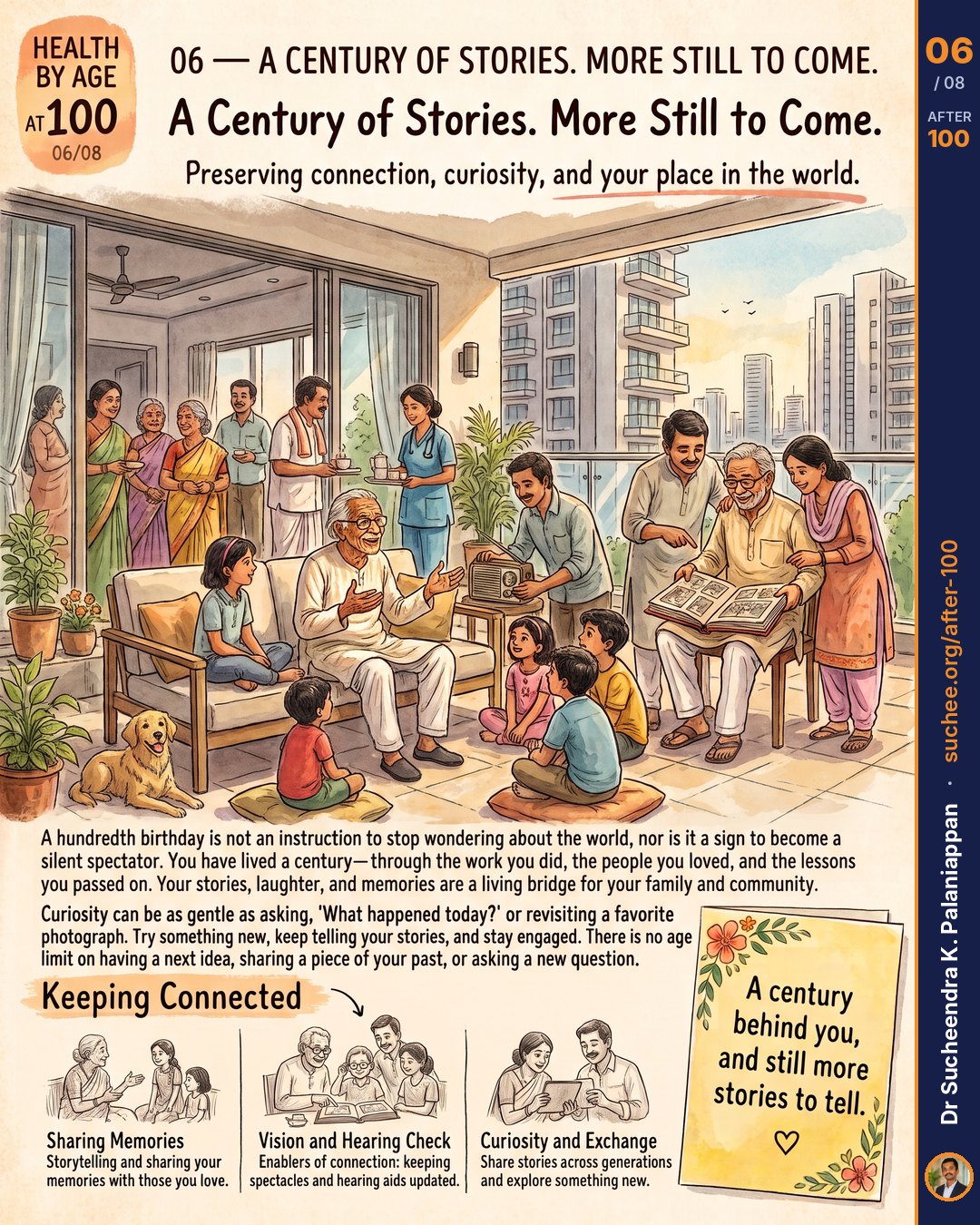
- A hundredth birthday is no reason to become a silent spectator. Your stories, laughter and memories are a living bridge for your family and community.
- Curiosity can be as gentle as asking what happened today, or looking at an old photograph together.
- Sight and hearing problems are almost universal at 100, and poor sight is the strongest link to difficulty with daily tasks. Keep spectacles and hearing aids up to date, and have them checked. Health at 100 · Sight, hearing and daily life
- Treating poor hearing and sight also keeps conversation possible, which is good for memory. Hearing, sight and memory
- Strong social ties go with longer lives. Staying connected
- Try something new, keep telling your stories, and let someone record them: a recipe, a song, a family history.
- Give the storyteller a firm chair with armrests, and keep floor cushions and sleeping pets out of the way. Pets and falls
-
 07 / 8
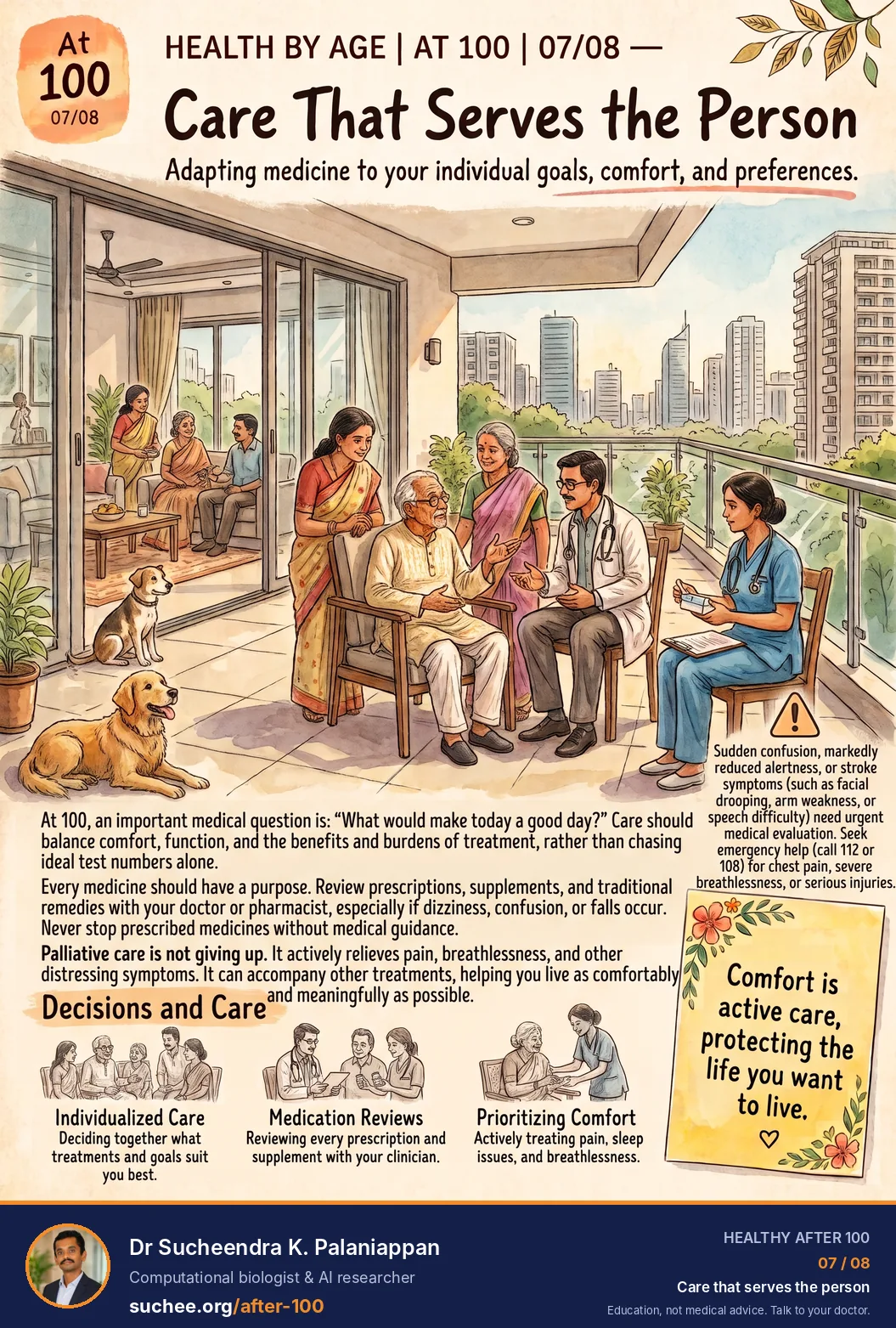
Care that serves the person
Medicine adapted to your goals, comfort and preferences.
Read as text
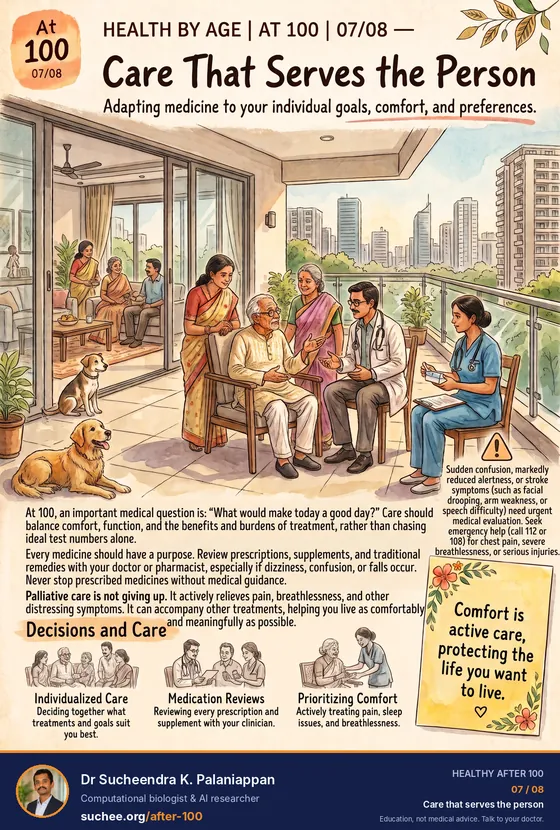
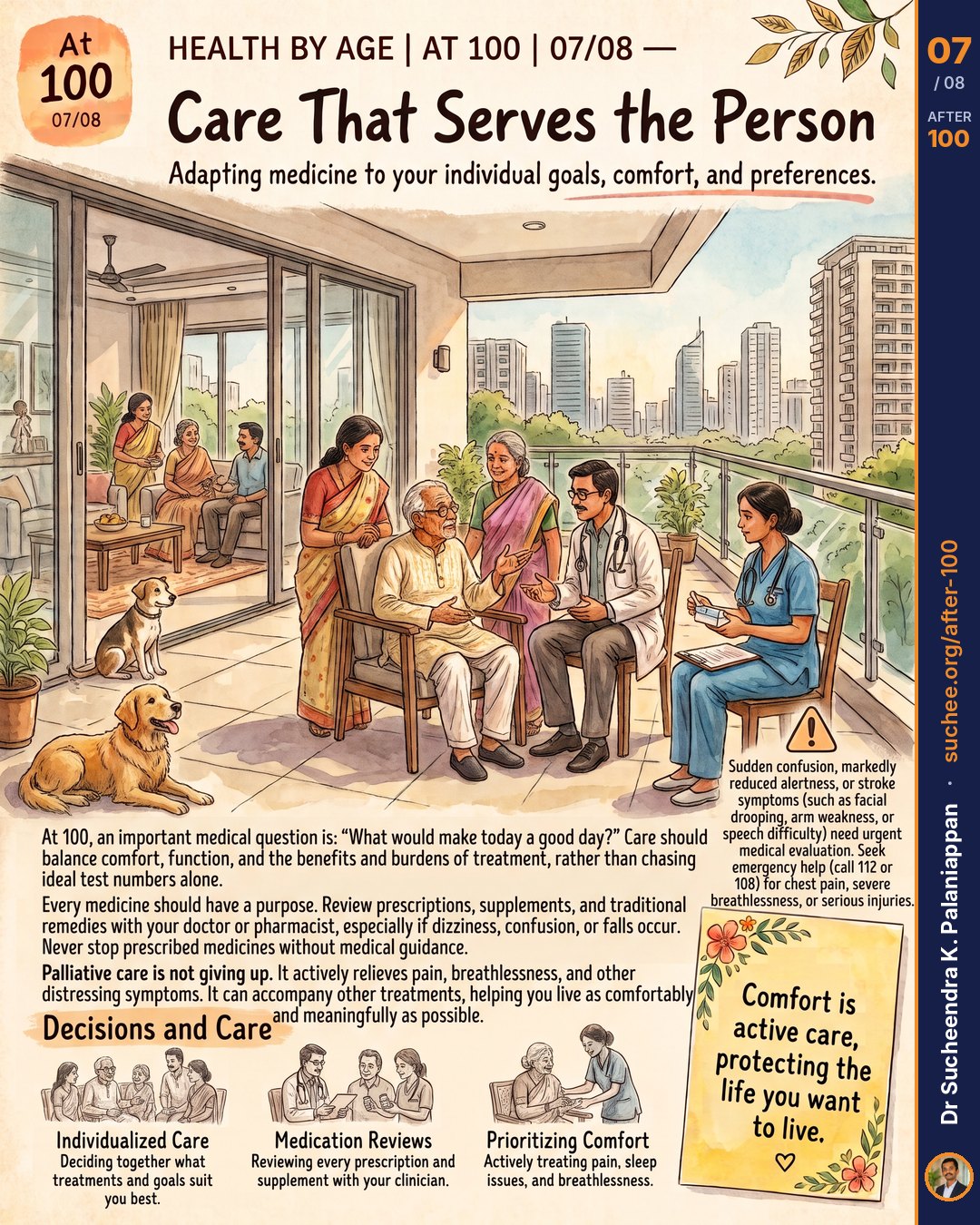
- Good care balances comfort, function, and the benefits and burdens of treatment, rather than chasing ideal test numbers. Targets in very old age
- People over 95 take four to five medicines on average. Go through prescriptions, supplements and traditional remedies with your doctor or pharmacist at least once a year, and sooner after dizziness, confusion or a fall. Never stop one on your own. What the very old eat and take · Medicines to review after 65
- Pain is common at 100 and often under-treated: nearly a third of German centenarians had frequent pain. Ask for it to be treated. Health at 100
- At 100, pneumonia and frailty are commoner causes of death than cancer or heart disease. A new cough, fever or fast breathing needs a doctor the same day, and sudden confusion or unusual sleepiness urgently. How centenarians die · Delirium
- Call 112 for chest pain, severe breathlessness, a serious injury, or signs of stroke such as a drooping face, a weak arm or slurred speech. Emergency numbers
- Palliative care is not giving up. It relieves pain, breathlessness and distress, and can start early, alongside other treatment. Palliative care
- Plan ahead, so a sudden illness does not mean an unwanted hospital stay. Say what you would and would not want, and who should decide if you cannot. A living will puts this in writing. How centenarians die · Living wills in India
-
 08 / 8
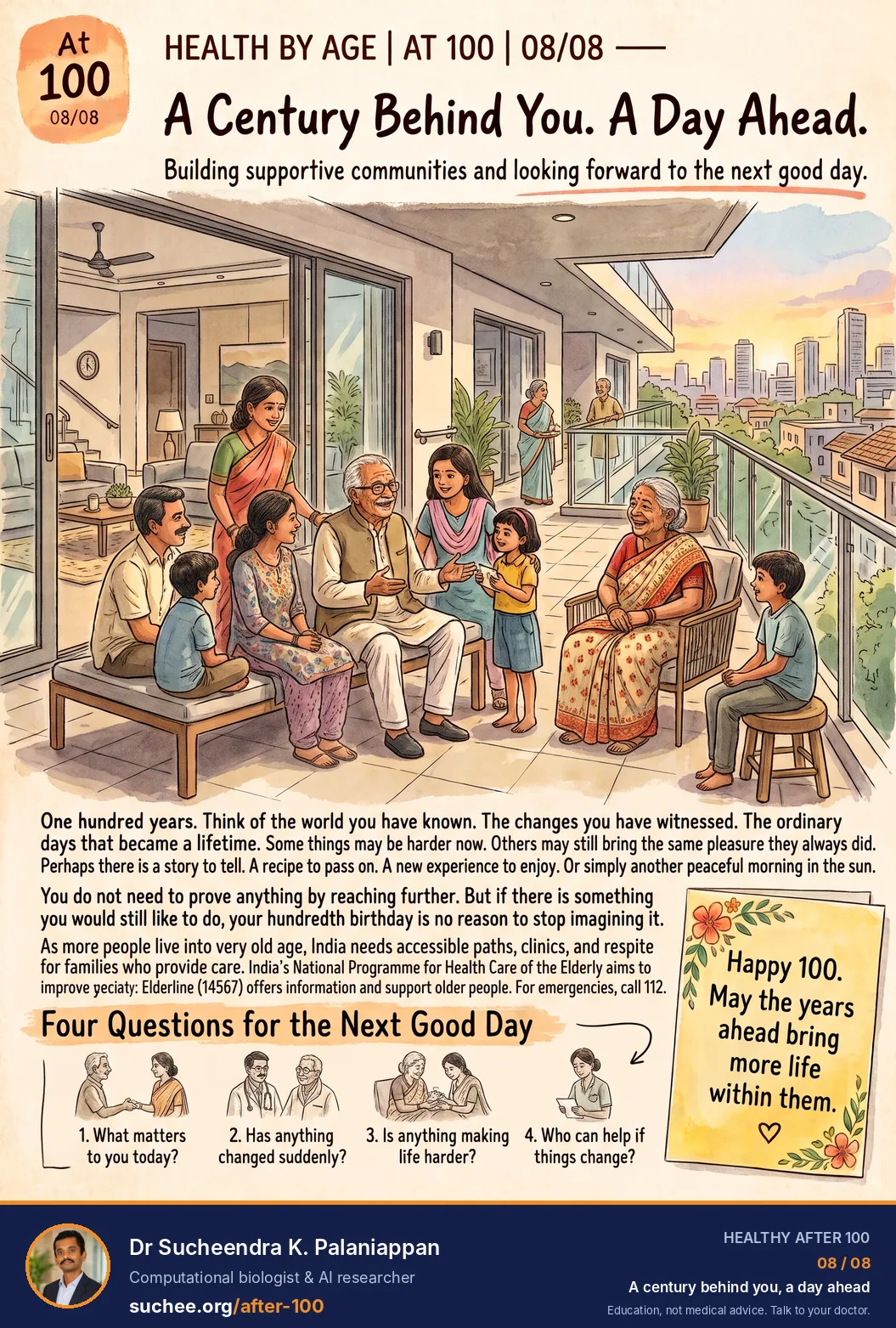
A century behind you, a day ahead
Supportive communities, and the next good day.
Read as text
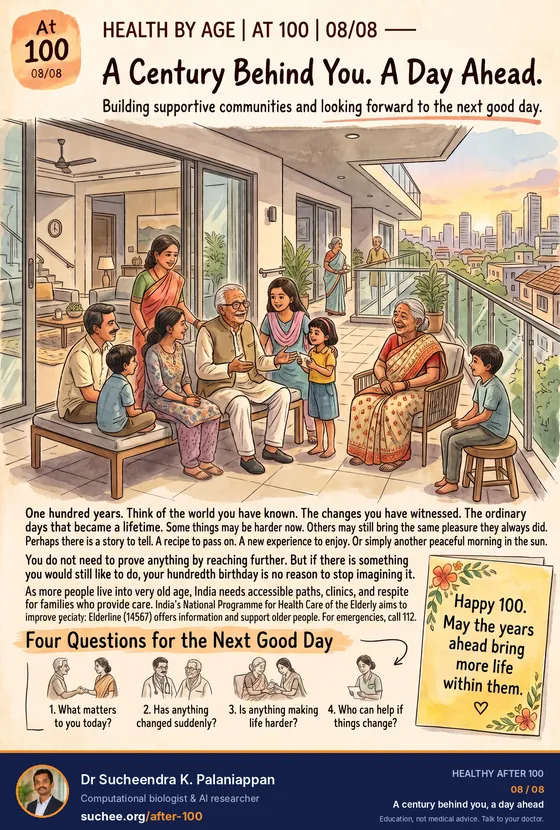
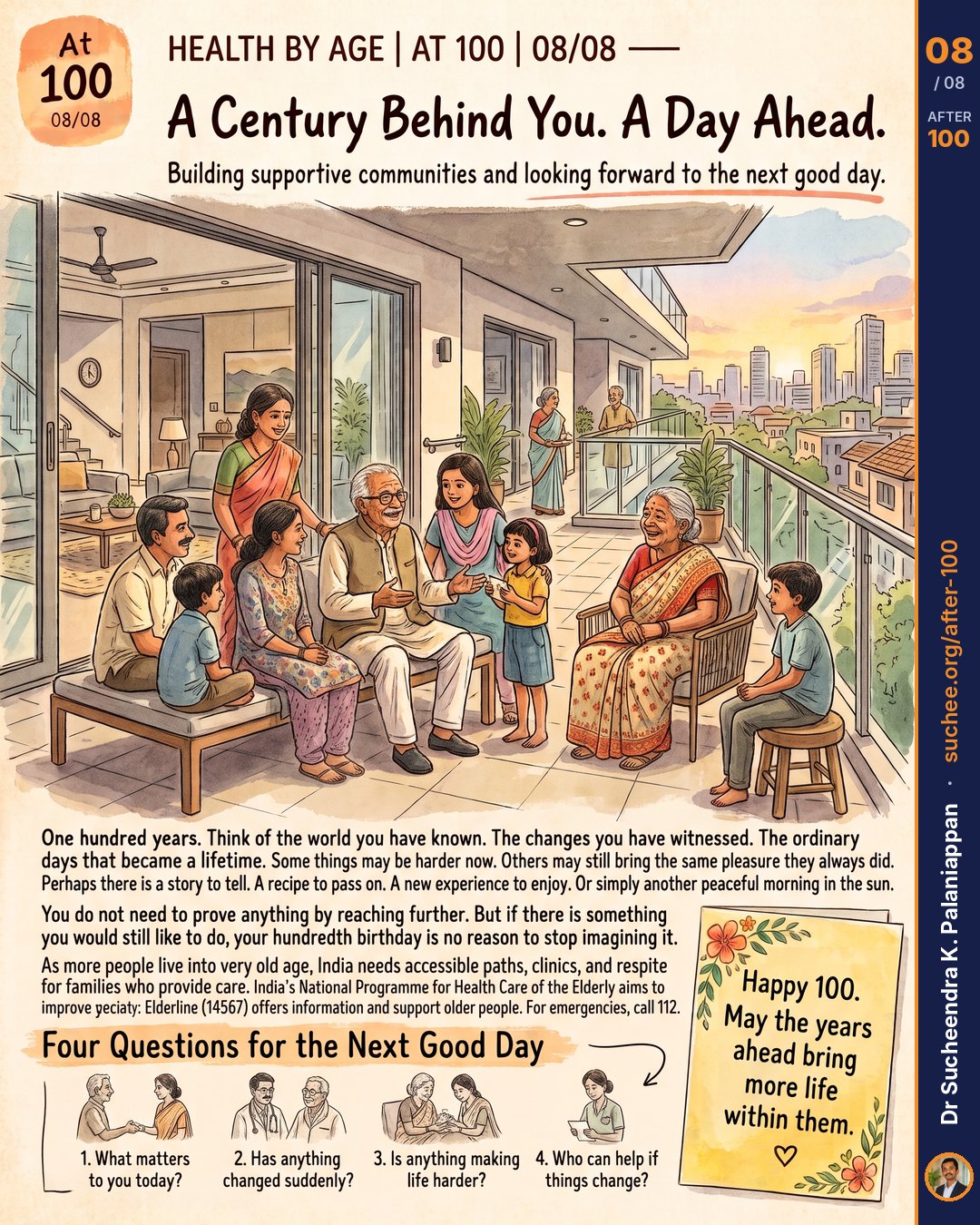
- Some things may be harder now; others still bring the same pleasure they always did. Perhaps a story to tell, a recipe to pass on, or another peaceful morning.
- You do not need to prove anything by reaching further. But if there is something you would still like to do, a hundredth birthday is no reason to stop imagining it.
- Four questions for the next good day: What matters to you today? Has anything changed suddenly? Is anything making life harder? Who can help if things change?
- India does not yet know how many centenarians it has, because ages this high are often misreported. Families need accessible paths, clinics and respite, and the national programme for older people aims to bring dedicated care to every level of the health system. India's oldest people · India's programme for older people
- Elderline, 14567, gives older people and their families free information and support. In an emergency, call 112. Elderline · Emergency numbers
What each guide stands on
Most health advice on WhatsApp has no source. Each claim here links to one, with the kind of evidence it is, so you can check it or show your doctor.
- India's oldest peopleIn India's national ageing survey (LASI, 2017–19), most people aged 90 and over were women and widowed, and few reported heart disease, diabetes or high blood pressure. More than half of those aged 100 and over could walk, eat, bathe and dress on their own, and about three in four of the oldest rated their lives as fairly good. Ages this high are often misreported in India, so the country has no reliable count of its centenarians.Rajpal et al., Centenarians and near-centenarians in India: empirical insights on health and well-being characteristics, GeroScience 2025 National survey · people aged 90 and over
- India's programme for older peopleLaunched in 2010–11, the National Programme for Health Care of the Elderly aims to give people over 60 dedicated health care at primary, secondary and tertiary levels, including regional geriatric centres.
- Emergency numbers112 is India's single emergency number. It brings together the older numbers, including 100 for police, 101 for fire and 108 for an ambulance.Ministry of Home Affairs, Emergency Response Support System 112 National service
- ElderlineElderline, 14567, is the national toll-free helpline for senior citizens, open 8 am to 8 pm every day. It gives information on care and services, guidance on pensions and legal matters, emotional support, and field help in cases of abuse or neglect.
- Living wills in IndiaSince 2018 Indians can make an advance medical directive, or living will, saying which treatments they would not want if they cannot decide, and naming who should decide for them. In 2023 the Supreme Court simplified the process: it is signed before two witnesses and attested by a notary or gazetted officer.
- When antibiotics arrivedAlexander Fleming discovered penicillin in 1928. It was not produced in large quantities until the 1940s.
- Three paths to 100In a study of 424 American centenarians, 43% of the women and 24% of the men had been diagnosed with one of the common diseases of old age before 80 (survivors), 42% and 44% were first diagnosed at 80 or later (delayers), and 15% and 32% reached 100 without any (escapers).Evert et al., Morbidity profiles of centenarians: survivors, delayers, and escapers, J Gerontol A 2003 Cohort study · 424 centenarians No Indian study covers this.
- Healthier on the way to 100Among nearly 40,000 Danes born in 1905, those who went on to reach 100 had spent less time in hospital in the decades before. At ages 71 to 74, 80.5% of the future centenarians had no hospital stay, against 68.4% of those who died in their early 80s.Engberg et al., Centenarians: a useful model for healthy aging? A 29-year follow-up of hospitalizations among 40,000 Danes born in 1905, Aging Cell 2009 Cohort study · 39,945 people No Indian study covers this.
- Reaching 100 runs in familiesIn 444 American centenarian families, brothers of centenarians were at least 17 times, and sisters at least 8 times, as likely to reach 100 as others born around 1900. Siblings share genes and also upbringing, so the study cannot separate the two.Perls et al., Life-long sustained mortality advantage of siblings of centenarians, PNAS 2002 Family study · 2,092 siblings No Indian study covers this.
- Living at home, thinking clearlyIn a population-based study of 119 people aged 95 to 107 in New York City, an unexpectedly large share lived in the community rather than in care, and thinking skills were, on average, good.Jopp et al., Physical, cognitive, social and mental health in near-centenarians and centenarians living in New York City, BMC Geriatrics 2016 Population study · 119 people aged 95–107 No Indian study covers this.
- Happiness at 100In the Heidelberg Centenarian Study, many centenarians reported high levels of happiness despite health limits. Much of the effect of health and social ties on happiness ran through belief in one's own abilities and an optimistic outlook.Jopp and Rott, Adaptation in very old age: exploring the role of resources, beliefs, and attitudes for centenarians' happiness, Psychology and Aging 2006 Population study · centenarians No Indian study covers this.
- Strength training at 90Ten frail nursing-home residents aged about 90, the oldest 96, did eight weeks of supervised strength training. The nine who finished more than doubled their strength (an average gain of 174%) and walked faster. A small study without a comparison group.Fiatarone et al., High-intensity strength training in nonagenarians, JAMA 1990 Small trial · 10 people aged 86–96 No study of people aged 100, and none from India, covers this.
- Health at 100Among 112 German centenarians, people had on average five health conditions. Vision or hearing problems were the most common (94%), followed by mobility problems (72%). About 30% had frequent pain, and more than a third of those said it was more than they could bear.Jopp, Boerner and Rott, Health and disease at age 100: findings from the second Heidelberg Centenarian Study, Deutsches Ärzteblatt International 2016 Population study · 112 centenarians No Indian study covers this.
- Sight, hearing and daily lifeAmong 119 people averaging 99 years, 38% reported both poor sight and poor hearing, 17% poor sight only and 18% poor hearing only. Poor sight, alone or with poor hearing, was the strongest predictor of difficulty with daily tasks.Cimarolli and Jopp, Sensory impairments and their associations with functional disability in a sample of the oldest-old, Quality of Life Research 2014 Population study · 119 people aged 95–107 No Indian study covers this.
- What the very old eat and takeAcross 34 studies of people aged 95 and over living at home, most ate a varied diet built on staples such as rice and wheat, with vegetables, fruit, and protein from legumes, fish or poultry; fewer than 20% preferred salty food. About half were a normal weight. They took on average 4.6 medicines, and about half took one for blood pressure.Dai et al., A systematic review of diet and medication use among centenarians and near-centenarians worldwide, GeroScience 2024 Systematic review · 34 studies Observational studies, none from India.
- A broken hip at 100Across 23 studies of 6,970 centenarians who broke a hip, about half (53.8%) died within a year, and about half had a complication after treatment.Abelleyra Lastoria et al., Outcomes of hip fracture in centenarians: a systematic review and meta-analysis, European Geriatric Medicine 2023 Systematic review · 6,970 centenarians No Indian study covers this.
- How centenarians dieOf 35,867 people who died at 100 or over in England between 2001 and 2010, 28% had old age or frailty recorded as the cause and 18% pneumonia, both far more often than people dying at 80 to 84; cancer and heart disease were less common. 61% died in a care home and 27% in hospital. The authors call for care planned ahead, so that people can stay where they live.Evans et al., Place and cause of death in centenarians: a population-based observational study in England, 2001 to 2010, PLoS Medicine 2014 Population study · 35,867 centenarians No Indian study covers this.
- What WHO means by healthy ageingWHO defines healthy ageing as the process of developing and maintaining the functional ability that enables wellbeing in older age: what a person can do, together with the support of the people and places around them.WHO, World report on ageing and health, 2015 WHO report
- Genes across ordinary lifespansUsing very large family trees, the heritability of lifespan across the whole population came out well below 10%, much lower than earlier estimates.Ruby et al., Estimates of the heritability of human longevity are substantially inflated due to assortative mating, Genetics 2018 Genetic study · family trees The whole population, not centenarians. No Indian study covers this.
- Targets in very old ageFor people aged 80 and over, NICE advises a clinic blood pressure below 150/90, with clinical judgement for frailty and multiple conditions. Diabetes guidance relaxes sugar goals for older adults in poor health and puts avoiding low sugar first.NICE, Hypertension in adults: diagnosis and management (NG136) Guideline · American Diabetes Association, Older adults: Standards of Care in Diabetes, Diabetes Care 2025 Guideline Guidelines for people over 80 or in poor health, not tested at 100. No Indian guideline sets targets for this age.
- Helping people decideStart from the assumption that a person can make their own decisions, and give them the support and time they need to do so. Needing physical help is not a reason to decide for someone.NICE, Decision-making and mental capacity (NG108), 2018 Guideline A guideline for adults of every age. No Indian guideline covers everyday decisions.
- How much to move after 65150 to 300 minutes of moderate activity a week, muscle strengthening on 2 or more days, and varied activity that trains balance and strength on 3 or more days, to improve function and prevent falls. Those who cannot do this much should be as active as their abilities allow.WHO guidelines on physical activity and sedentary behaviour, 2020 Guideline A guideline for adults over 65, not tested at 100.
- Bed rest and muscleTen days of bed rest made healthy older adults, average age 67, lose about 1 kg of muscle from their legs.Kortebein et al., Effect of 10 days of bed rest on skeletal muscle in healthy older adults, JAMA 2007 Experimental study · 12 adults Studied in adults around 67, not centenarians. No Indian study covers this.
- Pets and fallsIn the United States about 86,600 people a year were treated in emergency departments for falls involving a dog or cat, 88% of them involving dogs, often from tripping over the animal or being pulled while walking it.CDC, Nonfatal fall-related injuries associated with dogs and cats, United States, 2001–2006, MMWR 2009 National surveillance People of every age, not centenarians. No Indian study covers this.
- A safer homeHome safety assessment and changes reduced falls, most clearly in people at higher risk of falling and when an occupational therapist did the assessment.Gillespie et al., Interventions for preventing falls in older people living in the community, Cochrane 2012 Systematic review · 159 trials Studied in adults over 60, not centenarians. No Indian review covers this.
- Food at a great ageDiet restrictions that may limit how much an older person eats are potentially harmful and should be avoided; food should be tasty, varied and adapted to the person's needs.Volkert et al., ESPEN practical guideline: clinical nutrition and hydration in geriatrics, Clinical Nutrition 2022 Guideline A guideline for older adults in general. No Indian guideline covers this.
- Weight lossIn adults over 65, losing 5% or more of body weight over 6 to 12 months without trying needs a doctor's assessment. Causes include cancer, depression, medicines, mouth and swallowing problems, and loneliness or low income. Sometimes no cause is found.Gaddey and Holder, Unintentional weight loss in older adults, American Family Physician 2021 Clinical review Advice for adults over 65, not specific to centenarians. No Indian guideline covers this.
- Swallowing problemsOlder people with signs of a swallowing problem should be screened and assessed, and food and drink textures should be adapted to what they can swallow safely.Volkert et al., ESPEN practical guideline: clinical nutrition and hydration in geriatrics, Clinical Nutrition 2022 Guideline A guideline for older adults in general. No Indian guideline covers this.
- Hearing, sight and memoryHearing loss and untreated vision loss are two of 14 changeable risk factors that together account for nearly half of dementia worldwide.Livingston et al., Dementia prevention, intervention, and care: 2024 report of the Lancet standing Commission, The Lancet 2024 Expert commission Adults of every age, not centenarians. No Indian study covers this.
- Staying connectedAcross 148 studies, people with stronger social ties had about 1.5 times the odds of survival, an effect comparable to well-known risks such as smoking.Holt-Lunstad et al., Social relationships and mortality risk, PLoS Medicine 2010 Meta-analysis · 308,849 people, 148 studies Mostly younger adults, not centenarians.
- Medicines to review after 65An expert list of medicines older adults should usually avoid or use with care. It includes benzodiazepine and ‘Z-drug’ sleeping pills, which raise the risk of confusion, falls and fractures, and medicines that need a lower dose when the kidneys work less well.American Geriatrics Society, 2023 Updated Beers Criteria, J Am Geriatr Soc 2023 Expert criteria A list for adults over 65. No Indian list covers this; brand names differ in India.
- DeliriumDelirium is a change in thinking and behaviour that starts over hours or days and can come and go. Some people become agitated; others become quiet, sleepy and withdrawn, which is easily missed. Age over 65 and dementia raise the risk, and 20 to 30% of people on medical wards have it.NICE, Delirium: prevention, diagnosis and management (CG103), updated 2023 Guideline A guideline for adults of every age. No Indian guideline covers this.
- Palliative carePalliative care relieves physical, psychosocial and spiritual suffering for people with serious illness and their families. It works best started early, and can be given alongside treatments meant to prolong life.WHO, Palliative care fact sheet Fact sheet
Guidance changes as evidence grows. When it does, the guides and this list will be updated. Last updated .
How these are made
- Studies of centenarians first. Where a claim rests on people over 65 or 80 rather than people of 100, the source says so.
- Written for Indian families. Filter coffee and curd rice, jasmine and the harmonium, 112 and Elderline, and the families who do most of the caring.
- The person before the numbers. What makes a good day matters as much as a test result. Targets and medicines stay with the doctor who knows them.
- Nothing to sell. No clinic, no supplements, no product. Free to print and share.
Want the science behind it?
Longevity, Interpreted. is my weekly reading of longevity research: what was shown, at what stage, and what it does not yet support.