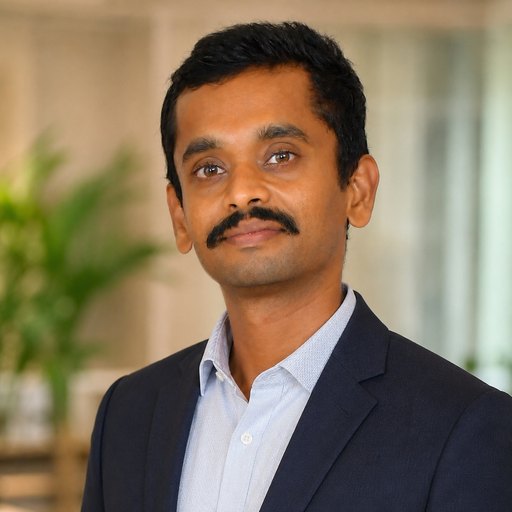
Sucheendra Kumar Palaniappan
Clear judgement on complex systems.
I trained as a scientist, graduated with a University Gold Medal, earned a PhD in computer science, and have spent twenty years applying that foundation to build software and AI systems in biomedicine and healthcare. The space where computing meets the complexity of living systems is where I do my best work.
My PhD was under P.S. Thiagarajan at NUS — a pioneer of concurrency theory and formal methods, whose own work later turned toward modeling biological pathways. Working at that intersection of mathematical rigor and biological complexity was formative. After that, my first postdoc was at RIKEN in Japan under Hiroaki Kitano — who gave the world both the foundations of computational systems biology and the AIBO robot, and who embodies better than anyone I know that research and building are the same impulse. I then went to Inria in France, before returning to Japan, where I work with him again. That arc set the pace for everything that followed, and it shaped how I think: start from first principles, question assumptions before accepting them, find the simplest true thing and build from there.
Today I lead a global data science and engineering team of 20+ across Japan, India, and Canada, scaled from a small team to what it is today. I set technology strategy, research direction, and product roadmaps. We build AI platforms that run in production at pharmaceutical companies and hospitals, across drug safety, clinical operations, biomedical NLP, and healthcare automation. I also hold a parallel appointment as Senior Research Scientist, where my work focuses on AI-driven autonomous scientific discovery.
Most people in AI are either researchers or builders. I have always been both, a systems thinker and a builder. Systems thinking taught me something that sounds obvious but is easy to forget: complex problems rarely need complex solutions. They need the right decomposition. Find the simple subproblems hiding inside the hard one, solve those well, and the larger thing often resolves itself.
What drives me is fairly simple. I am fascinated by how little we understand about the systems we live inside: our bodies, our biology, our society, the fragile yet robust, evolutionarily optimized machinery that keeps us going. Curiosity is what pulls me forward. Impact is how I measure whether it mattered. And I have always believed in giving more than I take — in knowledge, in mentorship, in the communities I am part of. Being a husband and a father teaches me every day how much I still have to learn.
Six patents. Nearly fifty publications, many alongside leading AI research labs and top pharmaceutical companies across the US, Europe, and Japan. I care about healthspan, not just lifespan, shaped by seeing up close what happens when complex systems start to fail. I consult on technology strategy and research leadership, advise and invest in deep-tech startups, and mentor at every level. I also run Lyrical Delights, a platform I started fifteen years ago translating Tamil songs and poetry into English.
Health by age
Plain guides for Indian families on what the evidence supports at each stage of life. Indian sources first, every claim sourced, and every guide free to save and share.
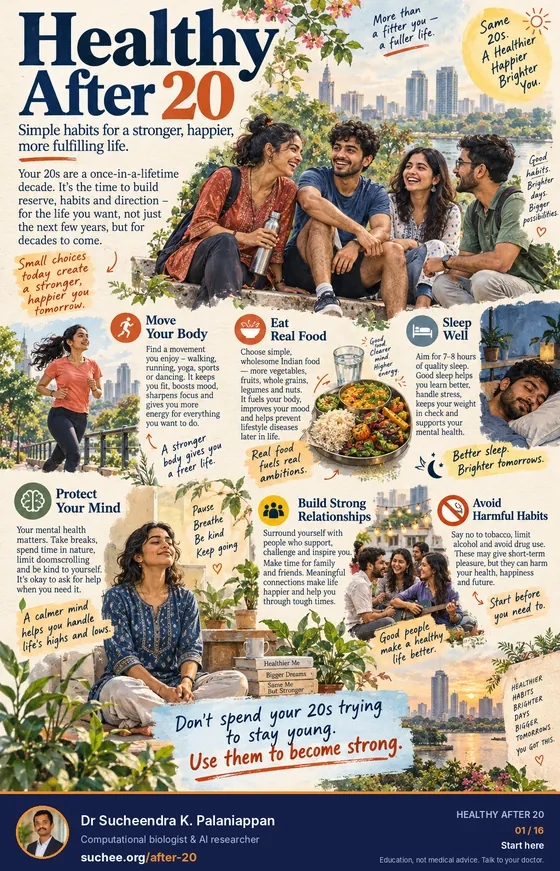
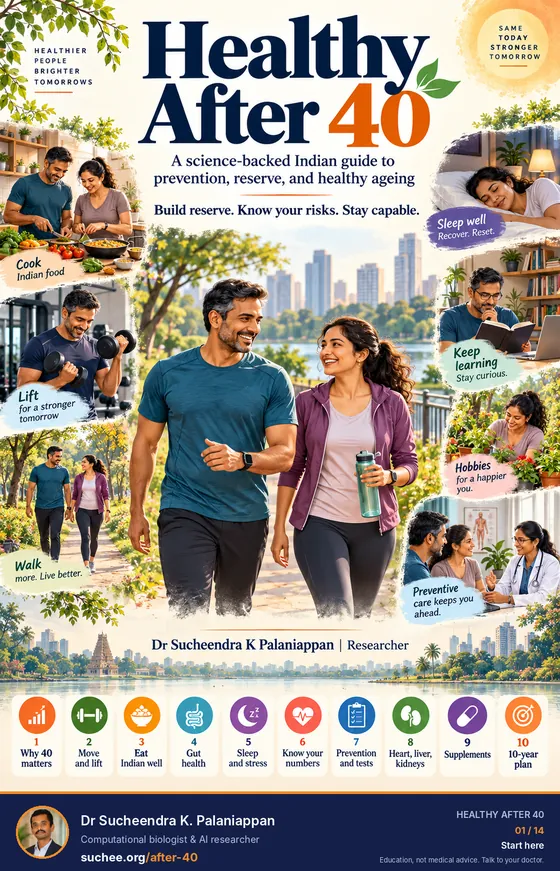
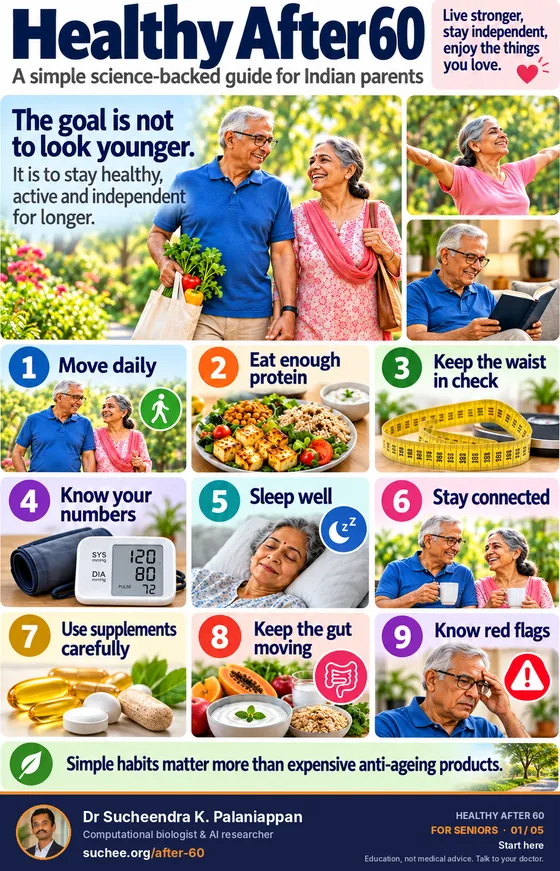
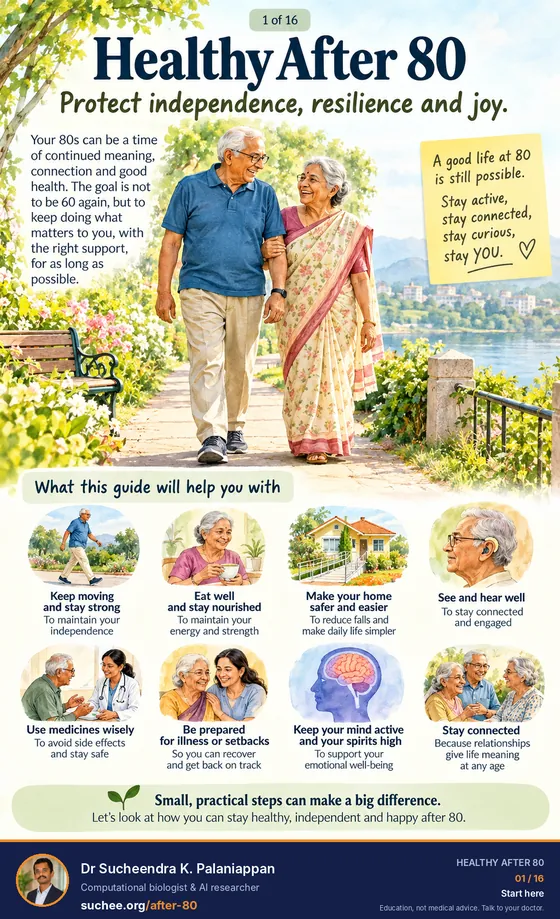
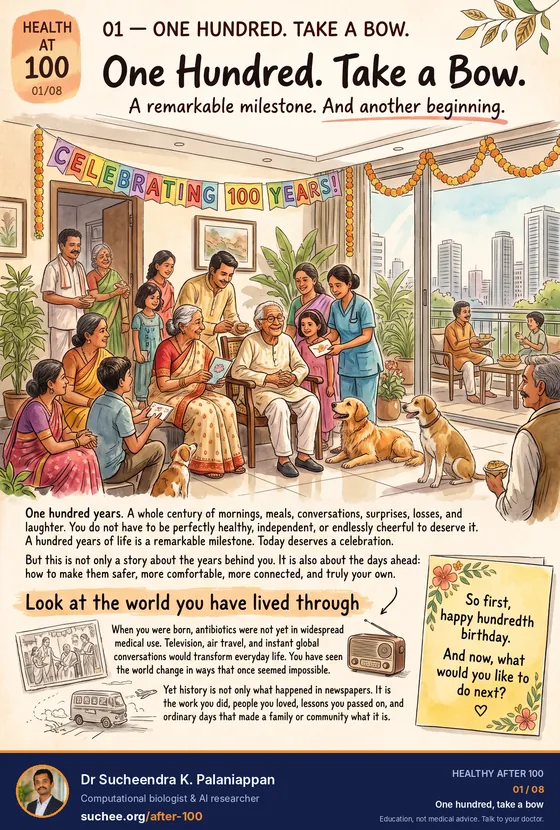
The whole series, from birth to 100
Engagements
Areas of expertise
Artificial Intelligence
Multi-agent systems, LLMs, NLP, computer vision, knowledge graphs, edge AI, autonomous discovery
Machine Learning
Deep learning, graph neural networks, recommendation systems, model compression, production ML infrastructure
Biomedicine & Health
Drug safety, clinical operations, genomics, pathway modeling, immunoprofiling, digital therapeutics, healthspan
Robotics & Edge Systems
On-device inference, agent orchestration on hardware, hybrid architectures, IoT health systems, rehabilitation technology
What I've built
I have architected and shipped half a dozen production AI platforms spanning drug safety evaluation, biomedical text mining, clinical document intelligence, hospital workflow automation, LLM-based protocol extraction, and ML infrastructure. These systems run in production at pharmaceutical companies and hospitals globally.
Most recently, a multi-agent AI system for hospital operations: modular agents for discharge summaries, clinical document parsing, and workflow orchestration on on-prem hybrid infrastructure. Three patents filed around the core architecture in the US and India.
The products rest on over a decade of published research in computational methods for understanding biological systems. My work has introduced new approaches to modeling how cellular pathways behave under uncertainty, how to abstract and verify complex biological dynamics at scale, and how to generate scientific hypotheses automatically from biomedical literature. Published across AAAI, IEEE TKDE, Bioinformatics, Cell Systems, Science Signaling, and CMSB. The research and the engineering are not separate tracks. They feed each other.
Publications
Also at Google Scholar
Patents
Talks & presentations
Get in touch
If something here resonates, I would welcome a conversation.