5–11 October 2026
What moved in longevity science this week, what it changes for what you take, move, eat and measure, and what is being sold far ahead of its evidence. Global signal, India lens.
This week in 30 seconds
| Not yet | Muscle-sparing add-ons to GLP-1 drugs reported muscle mass and nothing about function. If you take a GLP-1 drug, ask your doctor whether anyone is tracking your strength and physical function, which these products haven't shown they protect.Take |
| No | Fitness and grip strength predicted who died, in two very large groups of adults. Keep doing what makes you fitter and stronger: these studies show fitness predicts your risk, not what training itself changes.Move |
| Not yet | Longevity panels went on sale at $5,500 to $45,000 a year, with no report of what buyers gained. If you've wondered about a longevity panel or a calcium score, ask a doctor what either result would change before paying for one.Measure |
| Not yet | Brain waste clearance was measured directly in people for the first time, and overlaps with amyloid buildup. Researchers can now see this process in a living brain, but nothing here says what to do about it.Measure |
Changes what you do: 0 yes · 3 not yet · 1 no
What this issue rests on · 19 sources
| ON THE LADDER |
| Lab and animals · 2 |
| People, watched · 4 |
| People, tested on a stand-in · 5 |
| BESIDE IT |
| Reviews · 3 |
| Not a study · 5 |
◆◆◆◇◇ Every study sits on a five-step ladder, from lab to a person’s actual outcome. How to read it
Take◆◆◆◆◇ People, tested on a stand-in
Muscle-sparing add-ons to GLP-1 drugs reported muscle mass and nothing about function
Does this change what you should do?
Not yetIf you take a GLP-1 drug, ask your doctor whether anyone is tracking your strength and physical function, which these products haven't shown they protect.
| Who | Adults taking GLP-1 drugs; the ATR-258 study enrolled overweight or obese subjects |
|---|---|
| How many | 13 in the ATR-258 study; not stated for trevogrumab |
| How long | 8 weeks for ATR-258; not stated for trevogrumab |
| Design | Clinical trial of trevogrumab added to GLP-1 therapy, randomisation not disclosed; ATR-258 open-label, single-arm, dose-escalation. Both people, tested on a stand-in. |
| Measured | Muscle loss and body composition, STAND-INSTAND-IN |
| 13ATR-258 participants |
◆ Funding is not validationBoth results were released by the companies developing these investigational drugs, and neither has been published. The ATR-258 study is reported as investigator-initiated.
If you are taking a GLP-1 drug, you have probably wondered whether you are losing muscle along with the fat. Companies are building add-on drugs for that worry, and one reported results this week.
The trevogrumab report says muscle loss fell during GLP-1 treatment and regain improved afterwards. How patients were assigned to treatment was not disclosed, so the finding cannot be weighed. A second drug, oral ATR-258, was given to 13 people for eight weeks with no comparison group, which can show tolerability and not benefit.
In India, FSSAI has issued notices to Dr Reddy's Laboratories and Nestlé Health Science over claims that Celevida GLP+ supports lean muscle during GLP-1 and GIP therapy. No clinical outcome data accompanies that claim in the available reporting. 1–3
HARMSNone reported. The trevogrumab report carries no adverse-event data, which is an absence of reporting rather than a clean safety record.
WHAT WOULD MOVE THISA randomised trial in people on GLP-1 drugs showing measured strength holding up, or fewer falls, rather than a better body-composition scan.
1 clinical trial of trevogrumab added to GLP-1 therapy · 2 Longevity.Technology · open-label, single-arm, dose-escalation (3 doses), investigator-initiated · n = 13 · 3 ET HealthWorld · Not a study
Move◆◆◆◇◇ People, watched
Fitness and grip strength predicted who died, in two very large groups of adults
Does this change what you should do?
NoKeep doing what makes you fitter and stronger: these studies show fitness predicts your risk, not what training itself changes.
| Who | Adults in a clinical exercise-testing registry, and UK Biobank adults tested before any cancer diagnosis |
|---|---|
| How many | 562,234 and 10,462 |
| How long | Ten-year mortality prediction; median 12.5 years of follow-up |
| Design | Observational cohorts, both people-watched studies: watched, not tested |
| Measured | Death from any cause, OUTCOME |
| 562,234 adultsexercise-test cohort | 10,462 adultsUK Biobank cohort |
A fitness number carries real prognostic information, which is the argument for measuring it routinely. Nothing in this week's record shows that clinicians have started to. Two large studies this week say that number carries real information.
Among 562,234 adults in a clinical exercise-testing registry, peak fitness, meaning the hardest work the body can sustain, improved ten-year death-risk prediction beyond the standard cardiovascular risk factors. These were people already referred for testing, not a general population sample. Among 10,462 UK Biobank adults tested before any cancer diagnosis, fitness and grip strength tracked with death from any cause and with survival fifteen years after diagnosis. 4,5
HARMSNot measured. Neither study tested an exercise programme, so neither reports injuries or anything else training can cause.
WHAT WOULD MOVE THISA randomised trial in which people assigned to raise their fitness then lived longer, or stayed independent longer, than those who were not.
4 Medicine & Science in Sports & Exercise · observational cohort, clinical exercise-testing registry · n = 562,234 · 5 Mayo Clinic Proceedings · prospective cohort study (UK Biobank) · n = 10,462
Measure Not a study
Longevity panels went on sale at $5,500 to $45,000 a year, with no report of what buyers gained
Does this change what you should do?
Not yetIf you've wondered about a longevity panel or a calcium score, ask a doctor what either result would change before paying for one.
| Who | People buying preventive testing out of pocket |
|---|---|
| How many | No study population; these are commercial services |
| How long | No follow-up reported |
| Design | Stage not assignable: news reports of commercial services, no study design |
| Measured | Test results sold to buyers, with no outcomes reported, STAND-IN |
| $5,500 to $45,000 a yearhospital longevity packages | $249direct-to-consumer calcium scan |
◆ Biomarkers are not outcomesThe hospital packages and the $249 calcium scan sell measurements, and neither has been shown to change what happens to the person measured.
A longevity assessment is now something a nonprofit hospital system will sell you for $5,500 to $45,000 a year, and a coronary artery calcium scan can be bought directly for $249 with no referral. The question is whether a number you pay for changes anything.
None of these services reports what happened to the people who bought them. The reporting on the $249 scan does explain the limits of a zero calcium score, which is the right caveat and a rare one here. A third company is building software to turn test data into continuing care, which is a plan, not a result. 6–8
HARMSNot measured. Testing people without symptoms turns up incidental findings, and those lead to further scans and procedures. Neither the hospital packages nor the calcium scan reports how often that happens to buyers.
WHAT WOULD MOVE THISA study that followed buyers of one of these panels. It would need to report what was found, what was done about it, and whether buyers ended up healthier than people who did not buy one.
6 STAT News · Not a study · 7–8 Longevity.Technology · Not a study
Measure◆◆◆◇◇ People, watched
Brain waste clearance was measured directly in people for the first time, and overlaps with amyloid buildup
Does this change what you should do?
Not yetResearchers can now see this process in a living brain, but nothing here says what to do about it.
| Who | 96 adults undergoing standard neuroimaging |
|---|---|
| How many | 96 |
| How long | Cross-sectional: one point in time |
| Design | Human neuroimaging with an injected contrast agent, matched against gene activity; people, watched |
| Measured | Where clearance was weakest versus where amyloid protein was building up |
| 96participants |
◆ Biomarkers are not outcomesA clearance-amyloid overlap is two measurements moving together, not a measured effect on a person.
Researchers injected a contrast agent into the fluid around the brain and tracked, region by region, how well 96 people cleared it, then compared that map to where amyloid protein was building up. The two tracked together: regions clearing waste more slowly also carried more amyloid.
This is the first time this clearance process has been mapped directly in people rather than inferred from animals. Separate mouse work this week showed the channels waste normally drains through can collapse in Alzheimer's-like brains, and a rat study combined imaging with modelling of the same system. All of it points at one mechanism; none of it tests whether helping the brain clear waste changes anything a person experiences. 9–12
HARMSNo harms data is reported for the imaging or contrast procedure in this record.
WHAT WOULD MOVE THISA trial testing whether a treatment that improves glymphatic clearance changes a real outcome, not just the clearance measurement itself.
9 bioRxiv · cross-sectional human neuroimaging (intrathecal gadolinium-based Glymphatic MRI) with transcriptomic correlation · n = 96 · 10 bioRxiv · AD mouse model, imaging/tracer study · 11 bioRxiv · animal study (rats) combining optical tracer imaging with PDE-based mathematical modeling across anesthesia depths · 12 Review
What didn't move
Reprogramming. First human data: three glaucoma patients, one injection each, open-label and company-reported, with no serious adverse events so far. Informal versions given outside trial structures are unpublished, so no safety data on them exist. Nothing to act on. 13–15
Senolytics. A systematic review of human senolytic trials found the trials predominantly report biomarkers rather than clinical outcomes. Whether a senolytic has improved a clinical outcome in people is not settled by that review. 16
Creatine. A review of randomised trials in older adults adds no new trial data. The evidence you were working from in May is the evidence you have now. 17
Hyperbaric oxygen. A systematic review pooled existing studies in adults over 50, with no new trial. It is heavily marketed on a mixed study base, and no harm estimate for this population appears in the available reporting. 18
Sodium. A US cohort found no significant association between reported sodium intake and death after adjustment. An observational null is weak evidence of no effect, and salt's blood-pressure trials stand. 19
Sources
Most longevity news is early. These plain guides cover what is already proven, stage by stage, with Indian sources first.

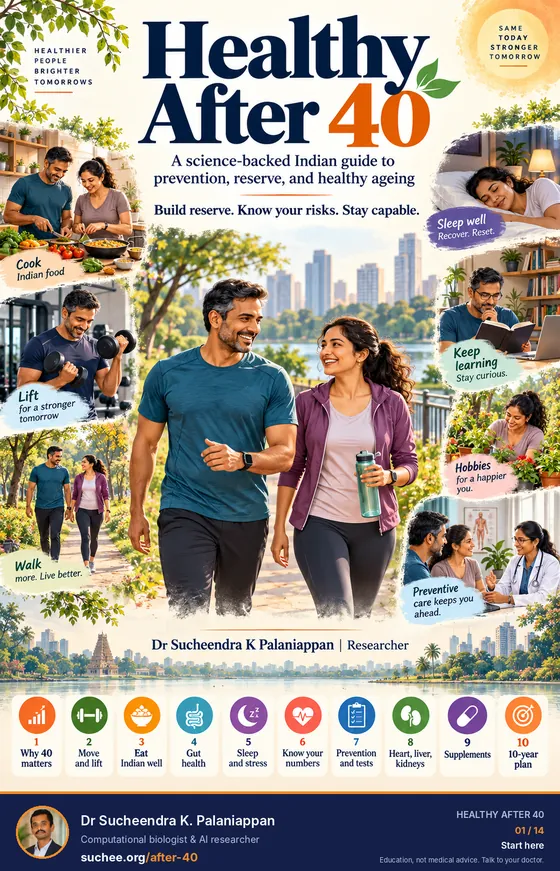
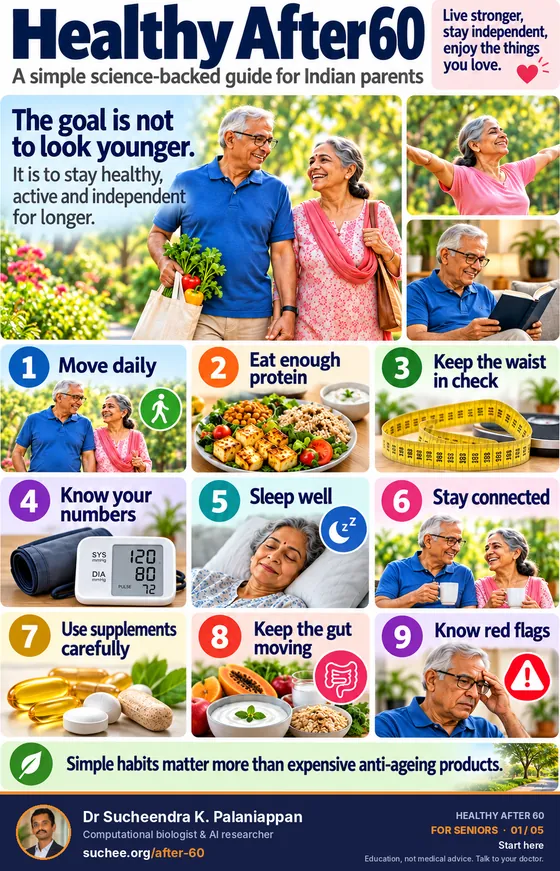
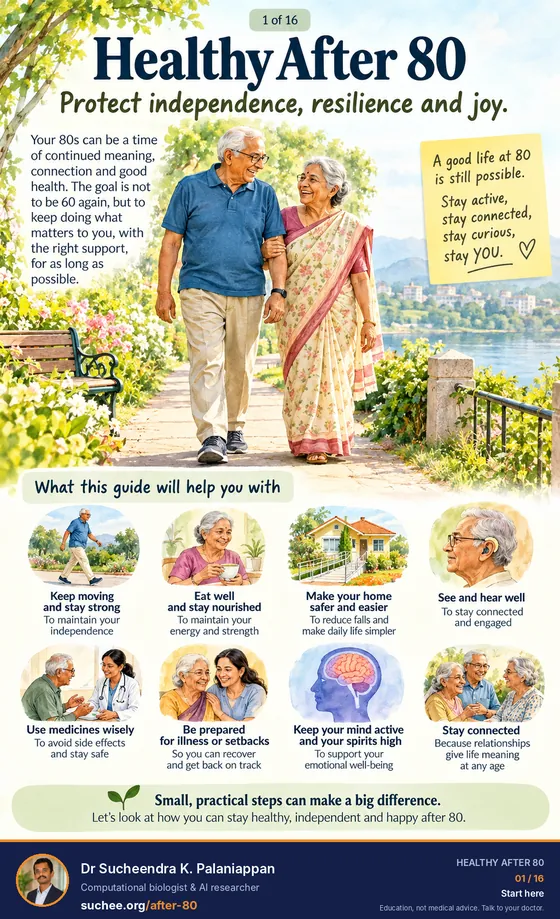


Scientist working at the intersection of computation, biology and medicine. Longevity, Interpreted. exists to understand the evidence, not sell an intervention.
All issues · Subscribe · Health by age · suchee.org · LinkedIn · Scholar