28 September – 4 October 2026
What moved in longevity science this week, what it changes for what you take, move, eat and measure, and what is being sold far ahead of its evidence. Global signal, India lens.
THE SHORT VERSION
Nothing this week changes what you should do. Six new ways to estimate biological age arrived at once, from speech, from an ECG, from blood and from medical records. One was tested against how long people actually lived; the other five were not tested against any outcome at all. Either way, the number is not a plan. If a clinic offers you one, nothing here says the result would change a decision, so declining costs you nothing. You may also have seen weight-loss drugs credited with preventing cancer and dementia; those claims came from reviews of existing studies, not new trials, and are not a reason to start a drug. Nine years of hard cycling did not stop fitness or muscle from falling, and the riders' weight stayed flat while their body fat rose. Keep training, and watch what you can do rather than what the scale says.
MOVE
Keep training, and change what you count
If you exercise to stay independent, track what your body can still do: stairs, shopping bags, getting off the floor unaided. That holds even for people who have trained hard for decades.
Researchers followed 82 of 125 highly active older cyclists for nine years; at follow-up they were 64 to 86 (People, watched)1. This was observational, so it shows patterns rather than causes. Peak fitness fell 19.7% and lean tissue mass 8.1%, and body fat rose from 23.8% to 29.2% while body weight stayed flat.
Two other items this week bear on exercise, and neither tests whether training preserves independence. In 4,477 prefrail and frail older adults, walking-test fitness and grip strength were each independently associated with cognitive impairment at a single timepoint (People, watched)2. The MoTrPAC consortium also reported what 12 weeks of training does inside the body. The parallel-arm trial randomised 206 sedentary adults aged 18 to 74 to endurance training, resistance training or no exercise (People, tested on a stand-in)3. A companion paper profiled acute responses in 175 participants from the same cohort (People, tested on a stand-in)4.
What none of it shows is that training arrests the decline. Harms: no adverse events from the training programme are reported in the MoTrPAC papers (People, tested on a stand-in)3,4.
DOES THIS CHANGE WHAT I SHOULD DO?
No. Keep exercising: standard advice to stay active is unchanged, and nothing this week weakens it. The cyclist cohort was observational and the fitness-cognition link was cross-sectional, so neither tests whether tracking function rather than weight changes any outcome. Weight alone can mislead: in the cyclists it stayed flat while body fat rose.
MEASURE
Six new biological age tests
Six research groups published new ways to estimate biological age this week. If and when a clinic offers one of them, the question is whether that number would change anything a doctor does.
The six estimators:
- speech, in 2,928 people across five Latin American countries, separating healthy controls from mild cognitive impairment and dementia subtypes (People, watched)5
- organ age from blood and tissue gene activity (People, watched)6
- diagnosis codes from 9.5 million Hungarian records (People, watched)7
- ECG patterns, from a database of 399,786 recordings (People, watched)8
- blood methylation modules in 2,050 people (People, watched)9
- death over 16 years in 861 people from the Lothian Birth Cohort 1936, the only one here tested against a hard endpoint (People, watched)10
Which of these measures performed best against that mortality endpoint is unreported. None of the six is reported as validated against a clinical outcome it would be used to predict.
A separate methods paper looked at six established epigenetic clocks (People, watched)11. It quantified how much of their signal comes from blood cell composition, specifically naive and memory T cell proportions, rather than from aging biology. In plain terms, a shift in your immune cell mix can move your age result without necessarily changing anything you would feel.
No longevity-clinic protocol in the available reporting has been linked to a health outcome, at any price point, and none reports adverse-event data (Not a study)12. No clinic is yet reported to offer any of these six measures.
DOES THIS CHANGE WHAT I SHOULD DO?
No. None of these numbers changes a screening interval, a drug or a dose. Declining costs you nothing; if you already have a result, do not act on the gap it reports. This moves when one clock predicts something a clinician acts on, and beats the cheap measures already in use.
Alzheimer's testing is moving to blood and phone-based tools, before the reliability question is settled
If a cheap blood test or a phone app could tell you your Alzheimer's risk, the real question is whether one reading means anything. This week's evidence says: not quite yet.
A Mayo Clinic analysis of 744 patients found a leading blood test for Alzheimer's-related proteins (plasma p-tau217) gave consistent results across different test batches over 18 months (Lab)13. A separate study validated a self-administered cognitive test, taken on a phone or computer, against brain scans and clinical diagnosis in 2,249 people (People, watched)14. Two companies, Amprion and Prema Cognition, are already packaging a digital cognitive test with a blood-based biomarker test into one screening product (Not a study)15.
What complicates this: a smaller study measuring the same blood test and the same cognitive test three times over six months found both varied meaningfully between visits in the same people (Lab)16. Separately, the brain scans used as the reference standard for validating these tests were found to bind proteins they were not designed for (Lab)17. That could affect how the reference standard itself is read.
Harms: none of this evidence reports harm from taking either test. The risk is treating one reading as a diagnosis when the tests themselves are shown to move between visits.
DOES THIS CHANGE WHAT I SHOULD DO?
Not yet. These tests are getting cheaper and easier to access, which is real progress. But the same record that validates them also shows results vary from visit to visit, so a single result is not yet something to act on alone. If you are offered one, ask whether repeat or confirmatory testing is part of the process.
Pollution is becoming a measurable aging input, and one trial is testing whether removing it helps
Most of what is known about pollution and aging says people exposed to more of it do worse, which cannot tell you whether removing the exposure helps. One new trial is testing removal directly, and it includes India. A four-country randomised trial is distributing LPG stoves and fuel to half of 3,200 pregnant-women households in India, Guatemala, Peru and Rwanda (Not a study)18. The other half keep cooking with wood or dung smoke, and children in both groups are followed from birth. No results are reported yet. In India specifically, the policy lever already exists: LPG subsidy and distribution programmes already run, so a positive result would argue for using what exists more, not for building something new.
Why this reaches beyond lung disease: this week also brought evidence that pollution-level exposures can touch aging biology directly. Microplastic exposure triggered cellular senescence in human brain tissue grown in the lab, alongside after-death evidence linking plastic buildup to dementia-affected brains (Lab)19. In 403 children followed from mid-childhood, higher blood levels of PFAS ("forever chemicals") were associated with faster biological aging that persisted into early adolescence (People, watched)20. Against that, more green space near home was associated with less dementia over 16 years in nearly 3,000 older Swedish adults (People, watched)21.
Harms: none of these studies report harm from an intervention, because only the stove trial tests one; the rest are laboratory or observational findings.
DOES THIS CHANGE WHAT I SHOULD DO?
Not yet. The lab and cohort findings make pollution exposure a plausible target, not a proven one; none of it shows that reducing an exposure changes how you age. The stove trial (Not a study)18 is the one result worth watching: it tests the exposure directly, in households like many in India.
TAKE
What the newer shingles vaccine does to T cells
Zoster vaccination is one of the few interventions in this field with an established clinical outcome. This week's study offers a candidate mechanism for the recombinant vaccine's reported advantage. It measured T cell responses, not shingles cases, so it does not test protection.
Researchers put a weakened chickenpox-family virus into the skin of older adults vaccinated five or more years earlier (People, tested on a stand-in)22. Those who had received the recombinant adjuvanted vaccine mounted faster and larger T cell responses at the site than those given the live attenuated vaccine.
That was measured in people rather than inferred from animals. Harms: the study reports immune responses only, with no safety comparison between the two vaccines.
DOES THIS CHANGE WHAT I SHOULD DO?
No. Nothing here changes vaccination advice: the study measured T cell responses, not shingles cases, and it is a preprint. If you are due for zoster vaccination, that decision rests on existing guidance and on which vaccine your programme supplies, neither of which this result alters.
WHAT DIDN'T MOVE
- GLP-1 drugs for cancer or dementia prevention. Reviews widened the claim list to seven obesity-associated cancers (People, watched)23 and pooled cognition data (People, tested on a stand-in)24. Neither added trial data, so neither supports starting one for prevention. Harms: a meta-analysis pooling trials, cohorts, database analyses and pharmacovigilance reports found the evidence on semaglutide and depression risk inconsistent across study types (People, watched)25.
- Stem cell therapy. A randomised, placebo-controlled crossover trial of a single injection into the spinal fluid in progressive multiple sclerosis found no neurological benefit, only immune changes in blood and spinal fluid (People, tested on a stand-in)26. Adverse events are not reported.
- Rapamycin. A commentary restates that it extends mouse lifespan by 10 to 20% while human anti-aging benefit remains unproven (Not a study)27. Two drugs nominated as mTOR inhibitors failed a standardised worm lifespan protocol (Animals)28.
- Beetroot supplements. A systematic review found beetroot extract reliably raised nitrate and nitrite in older adults while pooled blood pressure results stayed inconsistent (People, tested on a stand-in)29. Harms for long-term use are not reported.
- PB125. Its maker announced a randomised trial in 44 people, 24 of them older, where two weeks improved artery dilation (People, tested on a stand-in)30. Artery dilation is a stand-in measure and the window was two weeks; no adverse-event data appear.
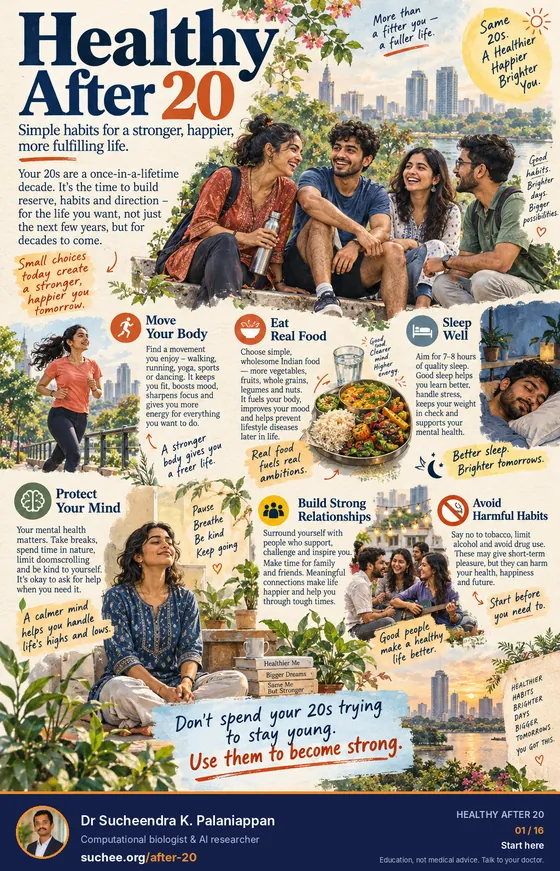
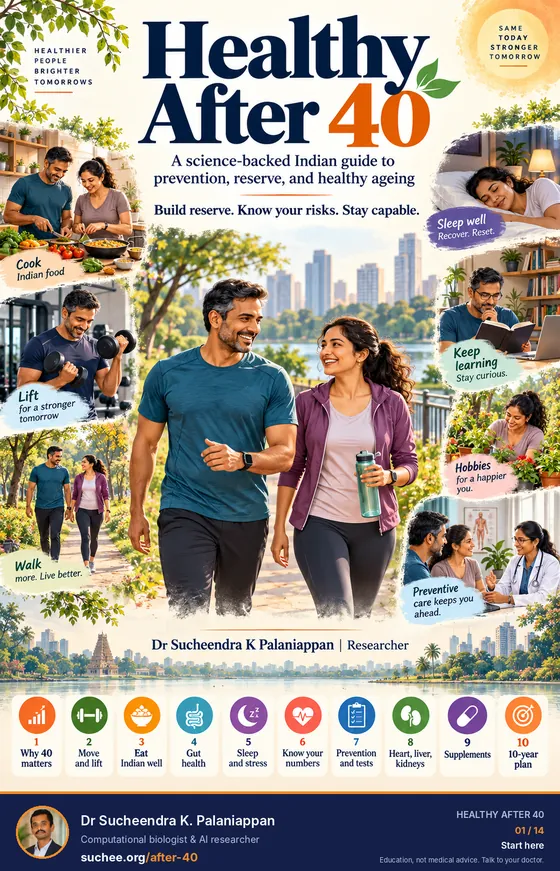
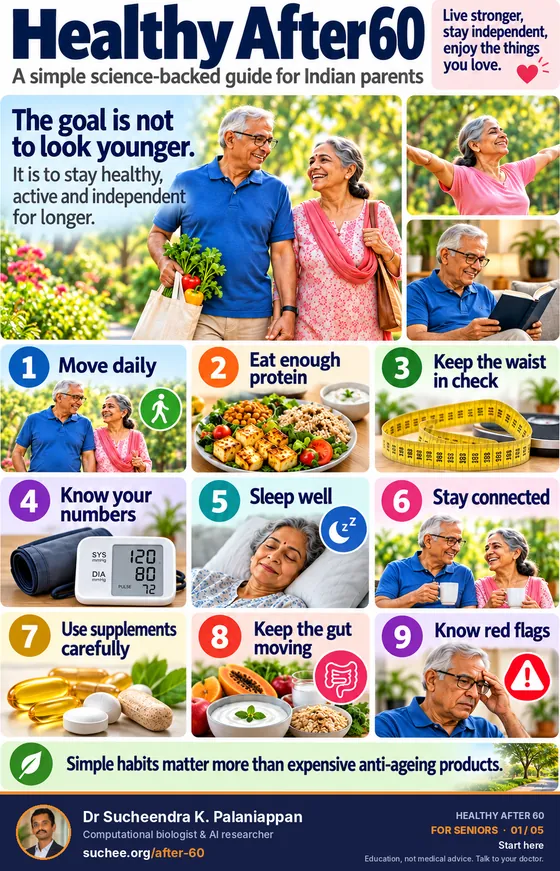
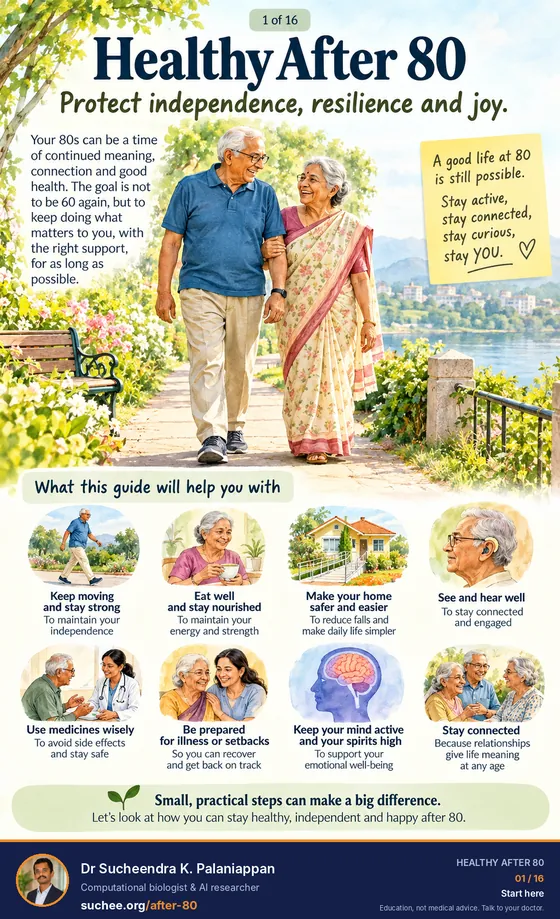
Most longevity news is early. These plain guides cover what is already proven, stage by stage, with Indian sources first.
Sources

Scientist working at the intersection of computation, biology and medicine. Longevity, Interpreted. exists to understand the evidence, not sell an intervention.
All issues · Subscribe · Health by age · suchee.org · LinkedIn · Scholar