28 September – 4 October 2026
What moved in longevity science this week, what it changes for what gets built, funded, approved and priced, and what is being sold far ahead of its evidence. Global signal, India lens.
THIS WEEK'S SIGNAL
- FDA officials said the agency plans to put aging on its regulatory science agenda (Not a study)1.
- Six new biological age measures were published; a methods paper quantified how much of a clock reading reflects blood cell mix (People, watched)2. No product launch or price accompanies any of the six.
- A T-cell-engager senolytic reached non-human primates, with a dose-limiting liver toxicity produced by the same mechanism that kills the senescent cells (Animals)3.
↑ Six new age clocks, and what a clock reading contains
Six new biological age measures appeared this week.
- Speech, from 2,928 people across five Latin American countries (People, watched)4.
- Organ-level transcriptomic clocks from blood and GTEx tissue (People, watched)5.
- ICD-10 codes from a national health registry of 9.5 million Hungarians (People, watched)6.
- An ECG clock trained on 399,786 recordings (People, watched)7.
- Blood methylation modules, developed in 656 people and replicated in 1,394 (People, watched)8.
- A Lothian Birth Cohort analysis benchmarked against 16-year all-cause mortality in 861 people; which measure predicted best is unreported (People, watched)9.
None of the six, including the Lothian mortality analysis above, has been validated against a clinical outcome it would be used to guide. Predicting death in a cohort is not the same as a reading that changes a decision. At the same time, a methods analysis asked what a clock reading actually contains. It quantified how much of six epigenetic clocks' age and age-acceleration signal comes from blood cell composition, specifically naive and memory T cell proportions, rather than intrinsic aging biology (People, watched)2. The size of that share is not stated in the available reporting.
Transplanted hearts shifted epigenetic age toward the recipient's (People, watched)10, and fat transplanted between young and old mice took on the host's aged or youthful state (Animals)11. Both are preprints, one is mouse, and neither reports a functional gain.
Voice, ECG and registry codes need no new sample collection (People, watched)4,6,7. Entry costs fall for consumer and insurer products while validation lags. The confound is quantified in epigenetic clocks, so it bears on the methylation entrant (People, watched)8 and not on the speech, ECG, registry or transcriptomic models. For all six, no clock here is tied to a harm or a benefit, so a buyer gets a number with no decision attached to it.
→ Senolytics changed modality, and the primate data came with a dose-limiting toxicity
After years of small-molecule disappointment, the pipeline moved to immune targeting. A bispecific T-cell engager against uPAR-positive senescent cells produced dose-dependent senolytic effects in mice and non-human primates (Animals)3. The harms sit in the same study: high doses caused T-cell-mediated hepatotoxicity, detectable as raised serum aminotransferase activity. Efficacy and toxicity scale together, because a T cell kills wherever its antigen appears.
A review separately proposes autologous cytokine-induced NK cells as senolytics, listing the obstacles outstanding (Not a study)12. Immune senolysis is further along than the small molecules got, and still short of any human trial. A monitorable liver enzyme gives a first-in-human dose escalation something to titrate against.
CONTRADICTIONS
Is GLP-1 lean-mass loss a problem? A perspective argues the lean mass lost on incretin therapy, roughly a quarter to a third of total weight lost, matches other effective weight-loss methods. It should not be called treatment-induced sarcopenia (Not a study)13. A narrative review treats the same loss as a risk to weigh (People, tested on a stand-in)14. Nobody has shown which reading holds. A registered single-arm trial will measure body composition, bone and physical performance under nine months of weekly tirzepatide in older adults (Not a study)15. With no comparator arm it cannot show whether the lean loss is drug-specific.
Exercise biology and exercise outcomes diverged. The parallel-arm MoTrPAC trial randomised 206 sedentary adults aged 18 to 74 to endurance training, resistance training or no exercise (People, tested on a stand-in)16. A companion paper profiled acute responses in 175 participants from the same cohort (People, tested on a stand-in)17. Against that, 82 of an original 125 highly active older cyclists were followed nine years, with 43 lost to follow-up and no untrained comparison group. They lost 19.7% of VO2peak and 8.1% of lean tissue (People, watched)18. The cohort shows decline continuing under sustained training, not that training leaves its rate unchanged.
BUSINESS SIGNALS
- Senior FDA officials said at a Boston meeting that the agency plans to include aging in its regulatory science agenda. They discussed possible approval pathways, naming no drug, trial or guidance (Not a study)1. This changes what investors fund before it changes what regulators approve.
- SMART-MS, a randomised placebo-controlled crossover trial of one intrathecal mesenchymal stem cell injection in progressive multiple sclerosis, found no neurological benefit alongside immune-compartment changes (People, tested on a stand-in)19. No adverse-event data for the intrathecal injection appear in the available reporting. Clinics selling MSC infusions are selling a modality that just failed a randomised test in progressive multiple sclerosis, by a different route of administration.
- Novartis and Abogen Biosciences signed an mRNA collaboration and licensing deal worth up to $7.8 billion (Not a study)20. Deal values that size are mostly milestones; large pharma is still paying platform prices for the mRNA delivery that in vivo reprogramming needs.
INDIA WATCH
- India's Union Health Minister said 420 million people have been screened for hypertension and diabetes under a central scheme (Not a study)21. What share of those screened entered treatment is unreported.
- Vytalyou raised Rs 9 crore, about $1 million, to expand its longevity clinic network (Not a study)22.
- A Supreme Court bench asked the central government to examine hospitals requiring patients to buy medicines from affiliated pharmacies, citing markups up to ten times on cancer drugs (Not a study)23.
- No clinic protocol outcome or adverse-event data accompany these reports, for Vytalyou or for operators elsewhere (Not a study)22,24.
BRIEFLY
- Arvinas will present Phase 1 biomarker data on ARV-102, a LRRK2 degrader for Parkinson's disease, in Seoul (People, tested on a stand-in)25. A Phase 1 biomarker shows target engagement, not an effect on disease.
- Basecamp Research raised $140 million to train AI models on biological data beyond conventionally studied human genomes (Not a study)26.
- A benchmark of ten general-purpose and three aging-specific single-cell foundation models found a simple highly-variable-gene method beat every model on average (Lab)27.
- Variant Bio expanded its AI target-discovery licence with Boehringer Ingelheim to cardiovascular disease (Not a study)28.
- Junevity will apply its gene-network target-discovery platform to skin aging in Amorepacific skincare products (Not a study)29.
- Prenuvo launched a research network built on its whole-body MRI screening data (Not a study)30. Whole-body screening generates incidental findings, and no overdiagnosis or downstream-procedure data accompany the launch.
- Pathways Bioscience announced a two-week randomised, double-blind, placebo-controlled trial of PB125 in 44 people, 20 younger and 24 older, reporting improved flow-mediated dilation; no adverse-event data accompany it (People, tested on a stand-in)31. Flow-mediated dilation is a surrogate, and two weeks in 24 older adults supports no cardiovascular claim.
- A Phase I open-label trial will give oral mesenchymal stem cell secretome capsules to 20 people aged 60 to 75 with frailty (Not a study)32.
- A trial was registered testing the ExPEC9V vaccine against placebo in adults 60 and over with a recent urinary tract infection (Not a study)33.
- The ELITE trial was registered to test deep biological profiling plus algorithmic polytherapy in healthy ageing (Not a study)34. Giving healthy people several interventions at once carries interaction risk, and the registration record reports no safety data.
- A controlled human infection study in previously vaccinated older adults found faster, greater VZV-specific T cell infiltration after the recombinant adjuvanted zoster vaccine than the live attenuated one (People, tested on a stand-in)35. The endpoint is immune infiltration, and no safety comparison between the two vaccines is reported.
- A Johns Hopkins immune-aging team led by Sean Leng won a $1 million Milestone 2 award in the $101 million XPRIZE Healthspan competition (Not a study)36. It was one of ten teams recognised at this stage. A second awardee the same week was a Tokyo startup working with parsley-derived compounds (Not a study)37.
WATCHING
| TREND | DIR | WHERE IT STANDS |
|---|---|---|
| Age-clock commercialisation | ↑ | Six new modalities, none validated for guiding a decision |
| Biomarker standardisation | ↑ | Cell-composition confound quantified, not an outcome link (People, watched)2 |
| GLP-1 in healthspan medicine | ↑ | Indications widening via reviews; strongest new design a GRADE meta-analysis of oral incretin cardiovascular outcomes in 67,679 people with type 2 diabetes, result not stated (People, tested on what matters)38. Harms: semaglutide and depression evidence inconsistent across study types (People, watched)39 |
| GLP-1 muscle-preservation combos | → | Premise contested; see above |
| Ovarian aging as a target | ↑ | 230 menopause-timing loci, 108 new, brain and pituitary over ovary (People, watched)40 |
| Senolytics | → | Immune-mediated senolysis the live branch, no human trial |
| VO2max as a vital sign | ↑ | MoTrPAC maps public; no study here shows training bends the decline slope |
| India preventive health market | ↑ | Public screening at population scale, private clinics at seed scale |
| Longevity clinics | ↑ | Concierge spend up to $250,000 a year; no protocol outcome data (Not a study)24,41 |
| AI geroprotective discovery | ↑ | Capital in, published benchmark unflattering (Not a study, Lab)26,27 |
| Gut microbiome geroscience | ↑ | Effects conditional on dietary protein in mice (Animals)42, on diabetes status (People, watched)43 and on butyrate producers (People, watched)44 |
| Inflammaging, cGAS-STING | ↑ | ENPP1, the brain's main cGAMP-degrading enzyme, down in aged and EAE mice (Animals)45 |
| Partial reprogramming | → | Animal and molecular only; neither study reports a durable functional gain after dosing stops (Animals)46,47 |
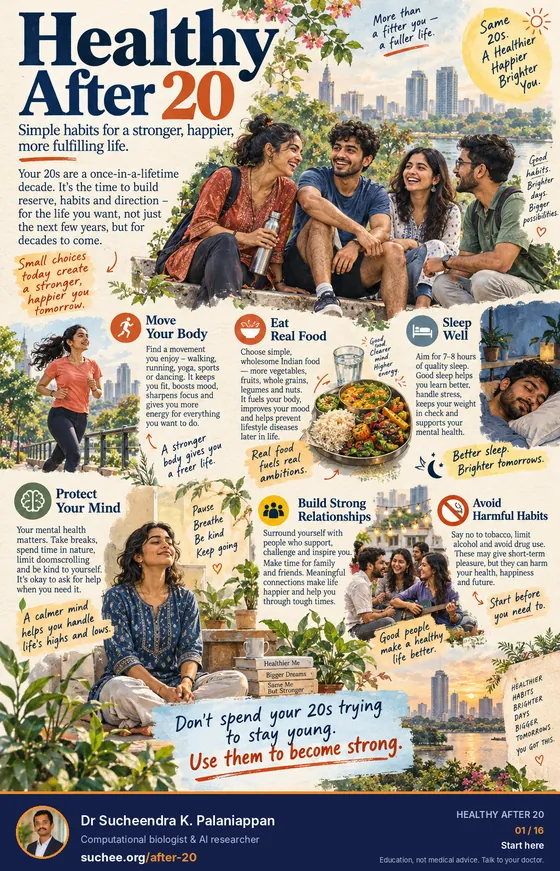
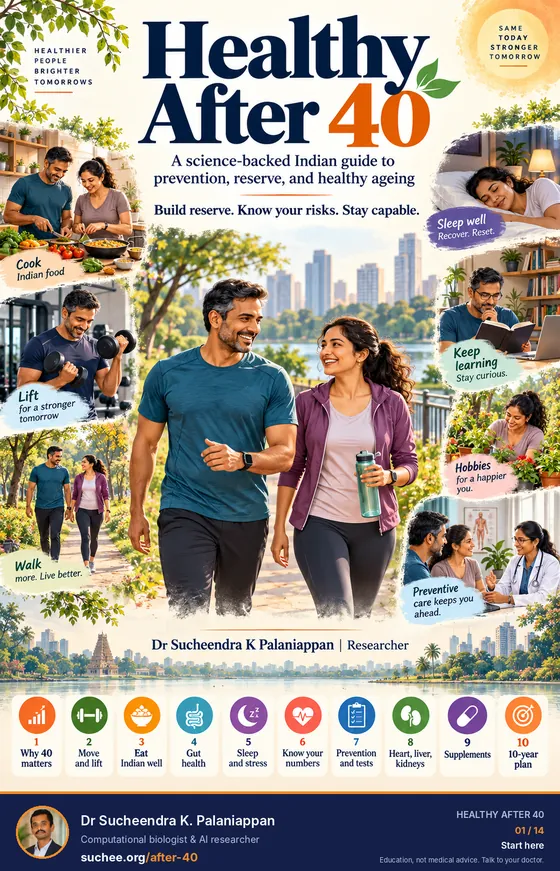
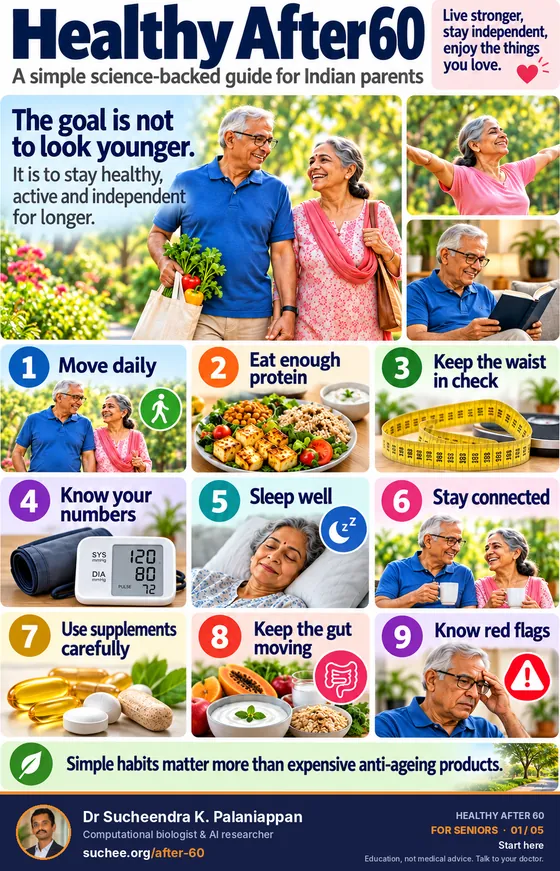
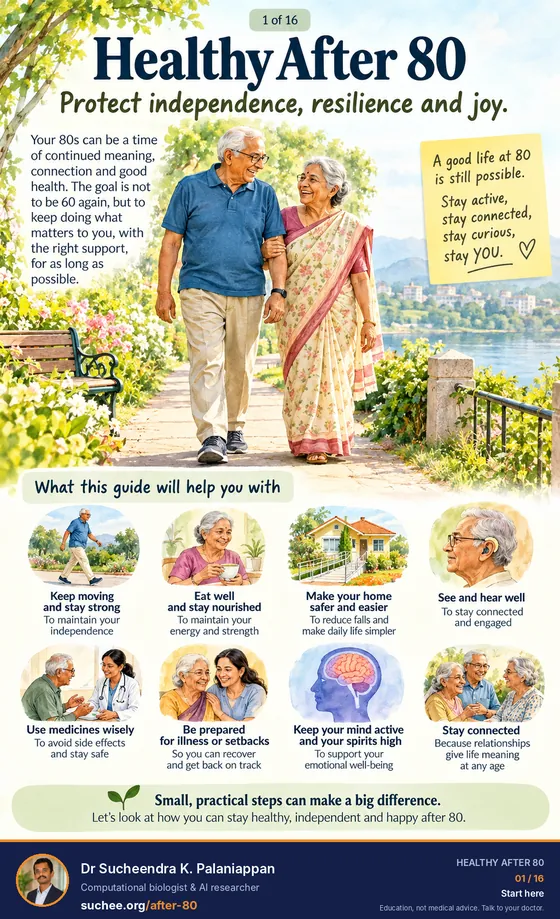
Most longevity news is early. These plain guides cover what is already proven, stage by stage, with Indian sources first.

Sources

Scientist working at the intersection of computation, biology and medicine. Longevity, Interpreted. exists to understand the evidence, not sell an intervention.
All issues · Subscribe · Health by age · suchee.org · LinkedIn · Scholar