21–27 September 2026
What moved in longevity science this week, what it changes for what you take, move, eat and measure, and what is being sold far ahead of its evidence. Global signal, India lens.
THE SHORT VERSION
Nothing this week is a reason to start a new treatment, and one item confirms what already works. Resistance training remains the most consistent story in this newsletter's record. Judge it by what you can lift, walk and climb, not by a muscle-mass number, since two different tools can disagree on mass anyway. Two very large studies measured how well a blood test detects cancer signals, not whether finding one earlier helps you live longer. Keep the screening your age and risk already qualify you for, and treat this one as unproven rather than an upgrade. One joint statement is worth raising with your doctor if hormone therapy was ruled out on heart-risk grounds.
MOVE
Resistance training keeps working. The number most people track for it doesn't.
Three studies this week agree on how to judge it: by strength and function, not by a muscle-mass reading.
- Resistance exercise consistently improved strength and functional performance in older adults, while mass gains were smaller and more variable (People, tested on a stand-in)1.
- A self-selected lacto-ovo vegetarian diet was non-inferior to an omnivorous one for protein intake and appendicular muscle mass (Not a study, People, tested on a stand-in)2,3.
- An anthropometric skeletal muscle index equation failed to identify DXA-defined low muscle mass at existing thresholds in 501 Chinese adults (People, watched)4. No Indian validation of these thresholds appears in the available reporting.
Not shown: that raising a muscle-mass reading improves strength, falls or independence.
Harms: neither the review nor the diet trial reports adverse events (People, tested on a stand-in)1,3.
IndiaA large share of the population eats lacto-ovo vegetarian by default, and sarcopenia advice built on omnivorous cohorts assumed a diet many Indian patients will not adopt (People, tested on a stand-in)3.
DOES THIS CHANGE WHAT I SHOULD DO?
Maybe. Nothing here argues against training. It is the most consistent finding in this record, and nothing about it is in question. What changes is which number tells you it's working: strength, gait and stair-climbing move more reliably than muscle mass, and two different tools can disagree on mass anyway. Both arms in the diet trial trained, so it compares diets against each other, not diet against training. After a recent fall, or with a cardiac condition, have a training plan cleared by a physician.
TAKE
A joint obstetrics and cardiology statement links hormone therapy started early to long-term heart benefit
Two proteomic studies arrived alongside it, tying the menopause transition to brain aging markers.
- The statement covers women with cardiovascular risk factors or established ischaemic heart disease. In them, systemic therapy begun early after symptom onset is associated with long-term cardiovascular benefit (Not a study)5.
- Hormone-linked molecular changes correlated with poorer later-life cognitive outcomes (People, watched)6.
- Inflammatory, synaptic, metabolic and Alzheimer's-related pathway changes tracked hormone status more closely than chronological age (People, watched)7.
Not shown: that hormone therapy prevents dementia or cardiovascular events, or that either molecular signature is a treatment target.
Harms: no harms figures accompany the benefit claim, and it does not remove the need for individual cardiovascular and cancer risk assessment (Not a study)5.
DOES THIS CHANGE WHAT I SHOULD DO?
Maybe. If you have menopausal symptoms and were told cardiovascular risk rules hormone therapy out, raise this statement with your doctor. Bring your own cardiovascular and cancer history to that conversation. An association in early starters is not a randomised cardiovascular outcome, and nothing here supports taking hormone therapy to protect the brain.
MEASURE
Two large studies of one multi-cancer blood test reported how well it detects, not whether it helps
Both were published with a commentary saying the question that matters is still open.
- PATHFINDER 2 tested the blood test in an intended-use population of adults aged 50 and older (People, tested on a stand-in)8.
- NHS-Galleri reported secondary performance analyses nested inside a randomised trial of participants without suspicion of cancer, added to usual care (People, tested on a stand-in)9.
- The accompanying commentary concludes that demonstrating population-level benefit remains the unresolved challenge (Not a study)10.
Not shown: that finding a cancer signal earlier makes anyone live longer. Not priced in the published performance results: overdiagnosis, false positives and the imaging they trigger (People, tested on a stand-in)8,9.
Harms: no adverse-event or false-positive figures appear in the available reporting (People, tested on a stand-in)8,9.
DOES THIS CHANGE WHAT I SHOULD DO?
No. This test has not been shown to add anything to the screening you already qualify for. If a clinic offers it, ask what a positive result triggers, who reads the follow-up imaging, and who pays for it. The randomised trial's clinical-outcome result would change this answer.
WHAT DIDN'T MOVE
Aging clocks and alcohol.
Organ-specific proteomic clocks read alcohol as slowing aging in some organs and accelerating it in others. The author attributes the split to clock construction, alcohol phenotyping and confounding control, not biology (Not a study)11. A reading that depends on which clock a vendor licensed cannot direct a decision.
Shatavari for hot flushes.
A widely sold botanical got the right design, in 70 peri- and postmenopausal women over 56 days (People, tested on a stand-in)12. No effect size is reported and safety was assessed without figures.
NAD+ precursors.
Nicotinamide riboside restored ACC1-deficient adipose immune cells in mice (Animals)13, beside two reviews (Lab, Not a study)14,15. Still no human outcome data.
Senolytics.
A review argued senescence is too dynamic to target confidently (Lab)16, alongside a fisetin pilot registration and a company hair-loss statement (Not a study)17,18. No senolytic has a human functional outcome.
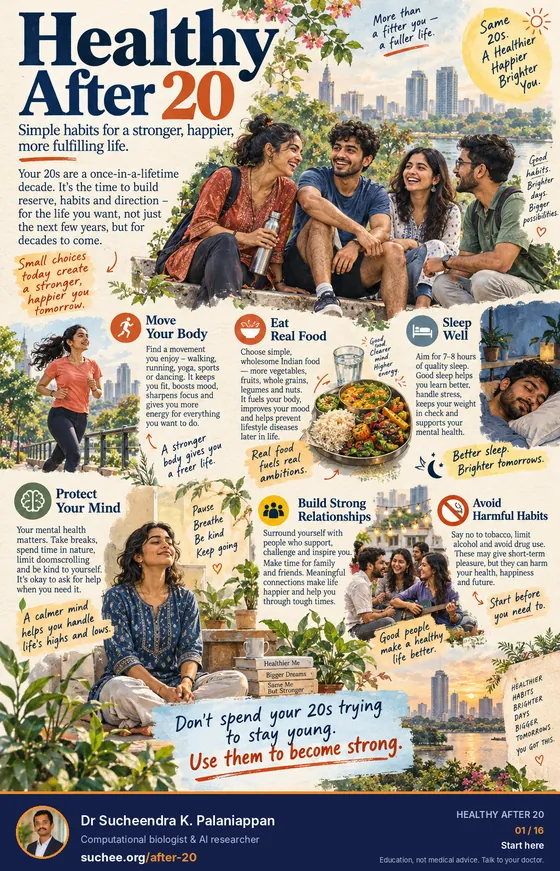
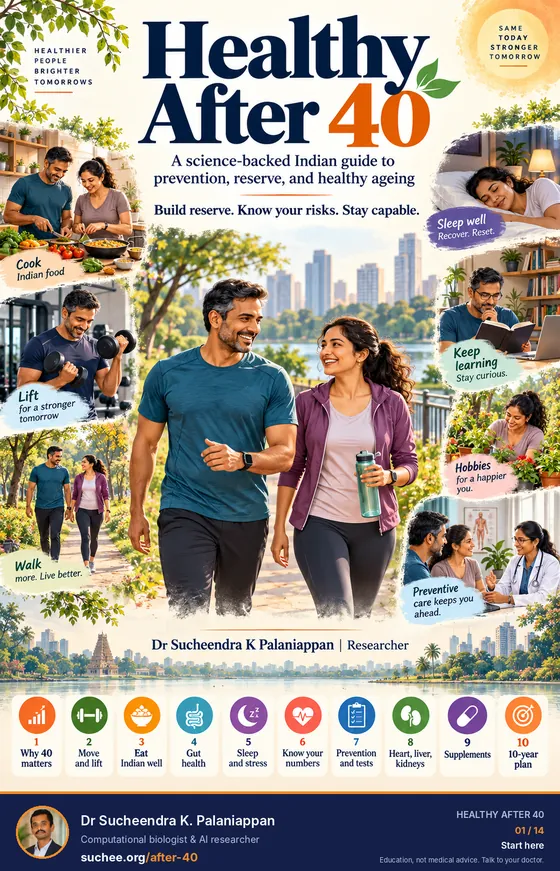
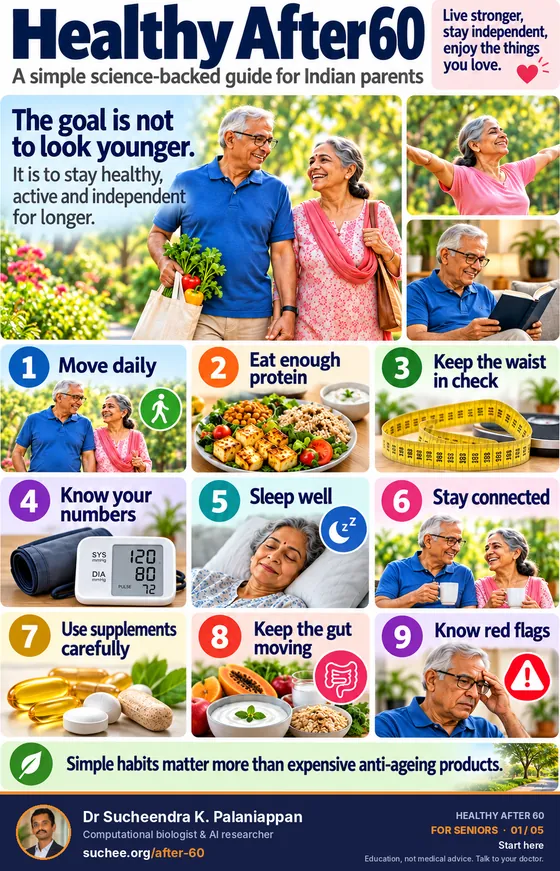
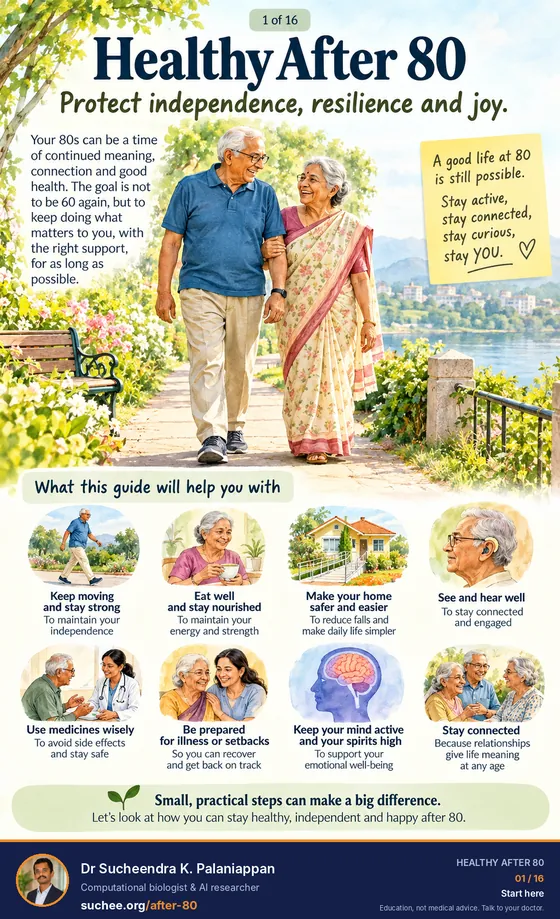
Most longevity news is early. These plain guides cover what is already proven, stage by stage, with Indian sources first.
Sources

Scientist working at the intersection of computation, biology and medicine. Longevity, Interpreted. exists to understand the evidence, not sell an intervention.
All issues · Subscribe · Health by age · suchee.org · LinkedIn · Scholar