14–20 September 2026
What moved in longevity science this week, what it changes for what you take, move, eat and measure, and what is being sold far ahead of its evidence. Global signal, India lens.
THE SHORT VERSION
Nothing this week changes what you should buy or take. Two items are worth a question to a clinician. The AI-designed drug that made blood look "biologically younger" is a company re-analysing its own markers, and the lifespan headline was about mice. Hold off buying a biological-age test: no clock in the record has been validated against a clinical outcome as an endpoint. An independent pooling of 51 studies also found about half the anti-ageing products tested moved no clock at all. If you or a parent has non-urgent surgery coming, ask the surgical team whether they run a prehabilitation programme. Which exercise type and dose ranked best for bone is in the paper, not in the available reporting. Any of this would mean more if someone showed that moving the number moves how long or how well people live.
MOVE
Prehabilitation before surgery is being tested on the outcome that matters
A multicentre randomised trial tested three weeks of individualised prehabilitation before elective surgery (People, tested on what matters)1. Patients were frail or pre-frail and aged 70 and over, with standard care as the comparator.
The endpoint is maintained independence and avoided long-term care dependency, not a biomarker (People, tested on what matters)1.
Effect size: in the paper, not in the available summary. It has to be read before anyone changes a pre-surgical pathway.
Exercise in frail patients carries fall and cardiac risk, and the adverse-event profile is not reported (People, tested on what matters)1.
DOES THIS CHANGE WHAT I SHOULD DO?
Maybe. Asking whether a surgical unit offers prehabilitation costs nothing, and the trial aims at independence rather than a surrogate. Until the effect size is read, that is a question to raise, not a service to buy privately.
Exercise for bone now has a dose-response ranking
A Bayesian network meta-analysis of randomised trials ranked exercise types and doses against bone mineral density and fracture risk in adults over 40 (People, tested on a stand-in)2.
- Dose and modality ranking is what a clinician needs, and almost nothing sold for longevity has it (People, tested on a stand-in)2.
- Bone mineral density is a surrogate. Fracture is the outcome.
- High-impact loading carries fracture risk in people who already have low bone density (People, tested on a stand-in)2.
DOES THIS CHANGE WHAT I SHOULD DO?
Maybe. Which modality and dose ranked highest is not stated in the available reporting, so this is a reason to read the paper, not to change protocol. If you have diagnosed osteoporosis, have the loading prescribed rather than self-selected.
MEASURE
Half the anti-ageing products tested moved no clock at all
A Yale-led reanalysis pooled 51 studies of anti-ageing interventions through one harmonised pipeline (People, tested on a stand-in)3.
About half the tested products moved no epigenetic clock (People, tested on a stand-in)3. A Nature analysis separately ranked clocks by responsiveness to human interventions (People, tested on a stand-in)4.
Supply grew anyway: sex-specific multi-organ clocks (People, watched)5,6, a retinal age gap with 2.66-year mean absolute error (People, watched)7, a brain-age product called Brain Years (Not a study)8.
- None of the clocks in this record has been validated against a clinical outcome as an endpoint. Methylation clocks tracked women's survival to 90 but not cognitive healthspan (People, watched)9.
- The blood draw is not the harm. What gets bought on the strength of the number is, and none of those purchases has outcome data.
INDIA. Clinic formats scaled this week. A physician-led longevity centre is opening in Whitefield, Bengaluru (Not a study)10, an operator has rebranded as The Longevity Centre with a celebrity ambassador (Not a study)11, and Temple has acquired the UK clinic Longevous (Not a study)12. None of these items reports clinical outcome data, and none states a price. Harms are the standard ones for unindicated testing: incidental findings and the investigations they trigger. No harms data exist for these specific services.
DOES THIS CHANGE WHAT I SHOULD DO?
No. A clock reading changes no management decision, and this week made the case against paying for one stronger, not weaker. Predicting death is a different claim from predicting good years, and these products are sold on the second.
TAKE
Senolytics gained mouse targets and lost ground in humans
Three preclinical studies refilled the pipeline in the week a pooled reanalysis cast doubt on some senolytic claims (People, tested on a stand-in)3.
- Blocking PD-L2 cut senescent-cell burden and improved metabolic and physical function in aged mice (Animals)13,14. Soluble PD-L2 rose with human age and fell after senolytic treatment, a biomarker observation, not an outcome.
- UA-30 reduced frailty and extended lifespan in aged mice (Animals)15. Genetic clearance of p16-positive cardiac cells improved remodelling in mice at n=6 per group (Animals)16.
- No new human senolytic trial result appeared.
- None of the mouse studies reports adverse-event data.
DOES THIS CHANGE WHAT I SHOULD DO?
No. Nothing you can buy as a senolytic changed. If you already take one, nothing changed: the pooled reanalysis found many tested products moved no clock, which is a biomarker result, and no human senolytic outcome result has been reported.
WHAT STILL HOLDS
Standing positions, restated here because this week did not move them. The highest-stage evidence in this issue is a randomised prehabilitation trial, not a drug (People, tested on what matters)1. Its effect size is not in the available reporting.
- No epigenetic clock has been validated against a clinical outcome as an endpoint (People, tested on a stand-in, People, watched)3,9. More clocks arrived this week (People, watched, Not a study)5–8, two of those reports possibly describing one study, and none changed that.
- No new human senolytic trial result appeared this week (People, tested on a stand-in)3. Every new target this week was in mice (Animals)13,15,16.
- No randomised trial has tested metformin for aging endpoints in people without diabetes, and the observational signal is confounded by indication (Not a study)17,18.
WHAT DIDN'T MOVE
- The AI-designed drug claim widened from one clock to six proteomic clocks, in a company-reported, unpublished post-hoc biomarker analysis with no peer review reported (People, tested on a stand-in)19, then recirculated through several outlets (People, tested on a stand-in, Not a study)20–22. Repetition is not replication, and no adverse-event data accompany the claim.
- Semaglutide extended lifespan in female mice and slowed aging markers (Animals)23,24. One sex, and maximum lifespan is unreported. Nobody should start or stop a GLP-1 because of it.
- Metformin drew two journalism pieces and no new data (Not a study)17,18.
- A T-cell "longevity vaccine" programme was announced with no efficacy data (Not a study)25. Stage not assignable.
- Trials were registered for calcium alpha-ketoglutarate (Not a study)26, young-donor faecal transplant with a fermented diet (Not a study)27, and diet, exercise and metformin in frail obese veterans (Not a study)28. The supplements are on sale already; the trials that might justify them have not reported.
ONE FOOD, INTERPRETED. — Turmeric
What the evidence shows. As a culinary spice, turmeric is safe and its use goes back centuries; nothing here changes that. As a disease-treating supplement, the case is thinner. Cell and animal work is extensive, but no single human study is in view here, so stage not assignable, and the human trials that exist are small, short and confounded by poor oral bioavailability.
What is oversold. The jump from mechanism to disease claims. A culinary dose is not a supplement dose, and a supplement dose is not a tested drug.
INDIA. Culinary use is ancient and uncontroversial. No turmeric product, seller or trial appears in the record.
DOES THIS CHANGE WHAT I SHOULD DO?
No. Keep cooking with it. That part was never in question. Concentrated extracts are where harms would matter, and the human trials are too small and short to characterise them.
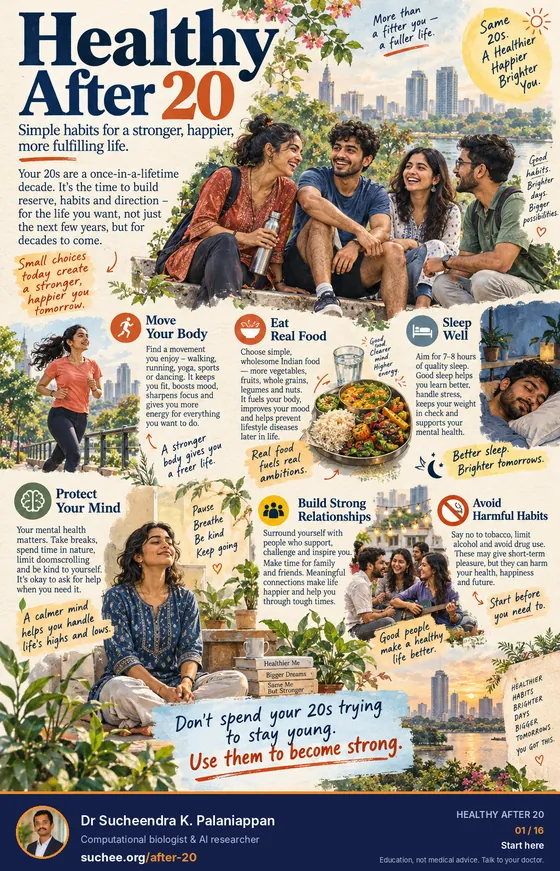
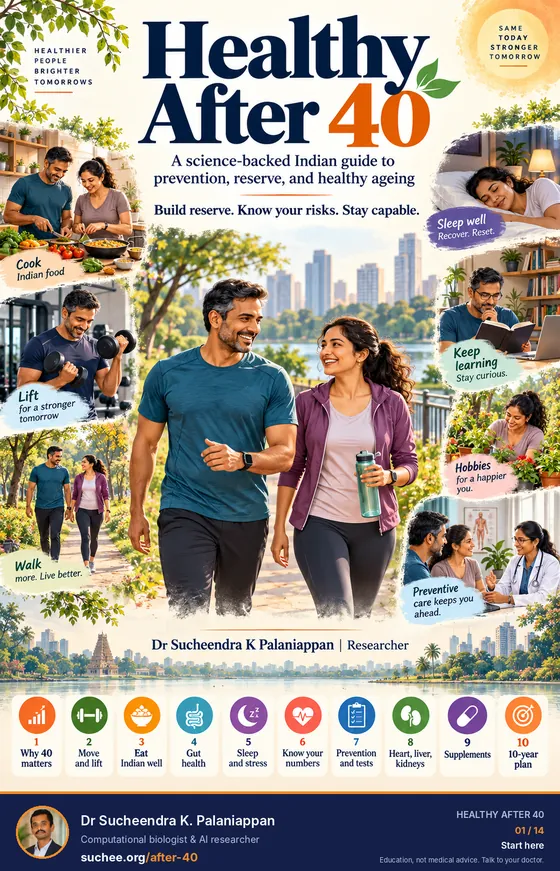
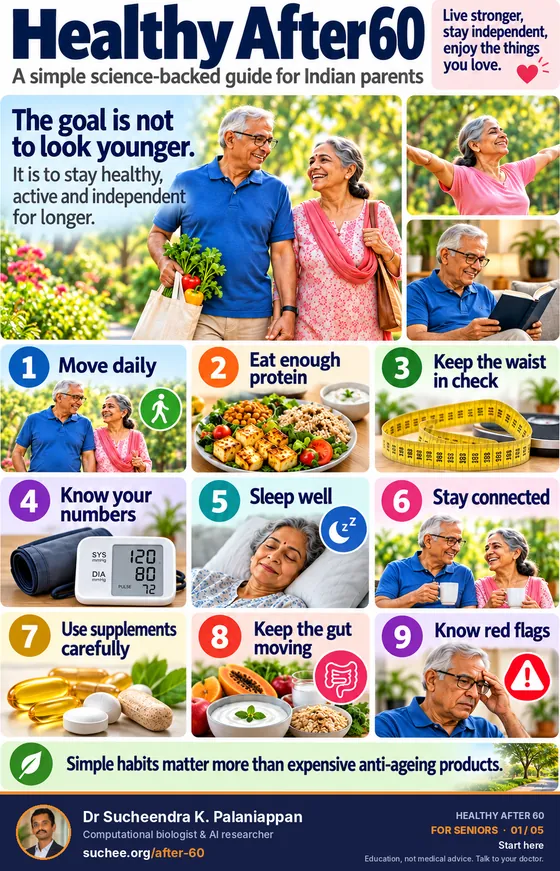
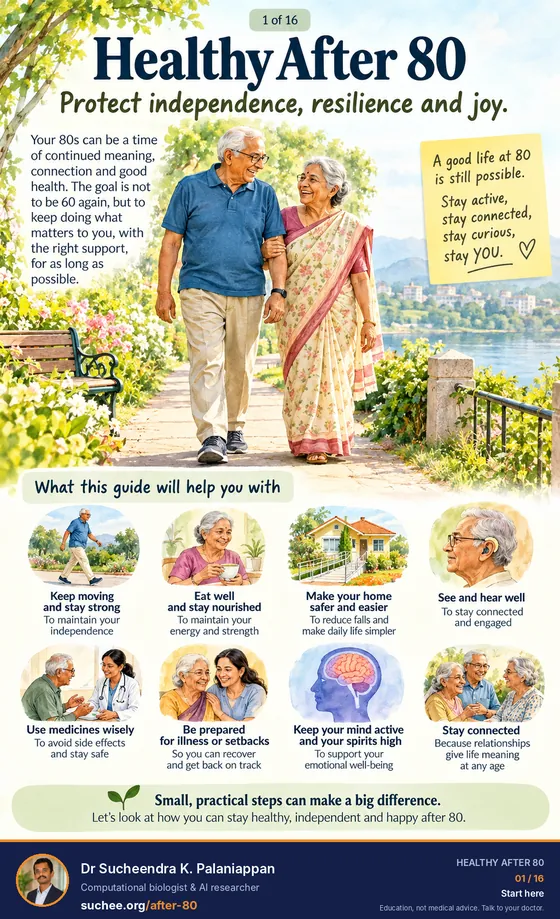
Most longevity news is early. These plain guides cover what is already proven, stage by stage, with Indian sources first.
Sources

Scientist working at the intersection of computation, biology and medicine. Longevity, Interpreted. exists to understand the evidence, not sell an intervention.
All issues · Subscribe · Health by age · suchee.org · LinkedIn · Scholar