31 August – 6 September 2026
What moved in longevity science this week, what it changes for what you take, move, eat and measure, and what is being sold far ahead of its evidence. Global signal, India lens.
THE SHORT VERSION
Nothing this week changes what you should do. You have probably seen that Ozempic-type drugs "extended lifespan". That happened in mice, and dosing began when the mice were already old. Nobody has run the equivalent human trial, and it would take years. If you already take one of these drugs, ask your doctor how your strength and physical function are being checked. Two trials of muscle-protection adjuncts are registered, and neither has reported results. Biological age tests predict mortality in cohorts. None of this week's clocks was tested as a treatment target, so a reading buys a prediction and no plan.
TAKE
Semaglutide extended lifespan in mice that were already old
Two mouse studies gave GLP-1 drugs a lifespan result. The human evidence stayed observational.
- Semaglutide started at 20 months of age extended lifespan in female mice and slowed aging hallmarks (Animals)1.
- A second study extended median lifespan in mice through GLP-1 receptor agonism (Animals)2. Maximum lifespan is unreported.
- Three other mouse interventions begun in middle or old age also extended lifespan (Animals)3–5. Lifelong dosing may not be required, in rodents.
- The human side stayed observational. A records-based cohort linked GLP-1 initiation around a transient ischaemic attack to lower later stroke and death (People, watched)6. No absolute risks are given.
Not shown: no human trial has tested these drugs against an aging endpoint, and none of the mouse studies reported harms.
Harms in people: bone density tracked the degree of weight loss over 12 months in 70 people with type 1 diabetes (People, watched)7, a population that is not the typical weight-loss user. A review treats sarcopenia during incretin therapy as a real risk (Not a study)8; a perspective disputes it (Not a study)9.
A review states bariatric surgery remains superior to high-dose semaglutide and tirzepatide (Not a study)10. Those drugs give roughly 15-22% weight reduction at one year.
DOES THIS CHANGE WHAT I SHOULD DO?
No. A mouse lifespan result is not a reason to seek a prescription (Animals)1,2. If you already take one of these drugs for an approved indication, nothing here changes that decision. Dose, duration and safety for an aging purpose in older adults are untested.
Muscle-protection products entered trials before the muscle harm was measured
Three clinical bets were placed in one week against muscle loss on GLP-1 drugs.
Registered, no results: enobosarm alongside GLP-1 therapy, with physical function among the endpoints (People, tested on a stand-in)11.
Registered, no results: a placebo-controlled ubiquinol trial for fatigue and strength, aimed at Wegovy and Mounjaro users (People, tested on a stand-in)12.
Reported, weakly: a 12-week coaching programme improved body composition, without randomisation (People, tested on a stand-in)13.
The disagreement: a perspective argues lean mass loss need not mean worse muscle quality, strength or function (Not a study)9. A review treats sarcopenia during incretin therapy as a real risk (Not a study)8.
- Measured strength and function outcomes are unreported in all four of those studies (People, tested on a stand-in, Not a study)9,11–13.
- In obese mice matched for weight loss, tirzepatide preserved blood stem cell function while calorie restriction caused cytopenias (Animals)14.
Harms: neither registered adjunct has reported safety results in GLP-1 users.
DOES THIS CHANGE WHAT I SHOULD DO?
No. Nothing here supports adding a second product to a prescription, and sellers reach you faster than trials report. The question worth asking your doctor is how your strength and physical function are being measured, because none of this week's work measured them.
An mTOR inhibitor enters a human aging trial that measures markers
A randomised trial of low-dose everolimus was registered against the hallmarks of aging.
The design: 24 weeks of dosing in insulin-resistant or prediabetic adults aged 55 to 80, with a younger untreated comparison group (People, tested on a stand-in)15.
Endpoints are physiological and molecular hallmarks, not disease or death (People, tested on a stand-in)15.
Harms: immunosuppression and metabolic effects in this drug class are real and dose-dependent (People, tested on a stand-in)15.
DOES THIS CHANGE WHAT I SHOULD DO?
Not yet. Even a positive result would show markers moving over 24 weeks, not longer or healthier life (People, tested on a stand-in)15. If you already take a drug in this class, infection risk and glucose control are worth reviewing with a physician (People, tested on a stand-in)15.
MEASURE
Three new biological age tests, and a paper attacking how all of them are built
New age measures arrived from urine, chest X-rays and immune cells, alongside an objection to the method behind them.
The measures: urine peptides (People, watched)16, chest radiographs (People, watched)17 and immune cell profiling (People, watched)18. Each predicts mortality or surgical risk in retrospective data.
The objection: the machine-learning regressions used to build such clocks carry systematic prediction bias (Lab)19. That bias can distort or reverse the associations the clocks are sold on.
- Neither side cites the other. This is an open argument about method, not a failed replication.
- One number also averages over real differences. Tissue aging ran organ-specific across 40 tissues (People, watched)20, and immune aging differed between men and women (People, watched)21.
Harms: none of these studies reports harms from testing (People, watched)16–18. The risk is acting on a number that was never tested as a treatment target.
IndiaA clock built on 4,240 adults in the Phenome India-CSIR cohort targets cardiometabolic risk, because existing models were built mostly on Western populations (People, watched)22.
DOES THIS CHANGE WHAT I SHOULD DO?
No. A ranking across a cohort is not an instruction for one person. If a reading would not change a decision you and your physician could otherwise make, it buys worry. Indian buyers carry a second problem: the models were built mostly on Western populations (People, watched)22.
WHAT STILL HOLDS
Standing positions, restated. The only section here not reporting this week's evidence.
No human trial tests any geroprotector against an aging endpoint.
Five mouse lifespan results arrived this week (Animals)1–5, and the human counterpart exists for none of them. The gap has not closed.
A clock predicts, it does not direct.
Ranking mortality risk in a cohort is not evidence that moving the number moves the outcome. None of this week's clocks was tested as a treatment target (People, watched)16–18.
Observational human data stayed observational.
The strongest human evidence tying GLP-1 drugs to lower stroke and death is a records-based cohort (People, watched)6. Cohorts rank risk; they do not establish cause.
WHAT DIDN'T MOVE
NAD+ precursors and senolytics.
A review concluded the evidence is insufficient to support NAD+ supplementation for delaying aging (Not a study)23. A senescence roadmap listed what the field still lacks (Not a study)24, and a fisetin sepsis trial was registered (People, tested on a stand-in)25. No human results appeared this week for senolytics, metformin, rapamycin, NAD+, taurine or spermidine.
Biological age diagnostics forecast.
A syndicated projection put the market at $5.58 billion by 2030 (Not a study)26,27, with no clinical data on any panel.
Tea and cardiovascular risk.
A review concluded causal inference remains uncertain (Not a study)28. Trials used surrogate outcomes, and Mendelian randomisation has not consistently supported an effect.
Vitamin D3 versus D2.
One news report described D3 outperforming D2 on muscle and cardiovascular markers (People, tested on a stand-in)29. No methods are given, so stage is not assignable, and markers are not outcomes.
Vegetarian and vegan diets.
A Dutch study reported inadequate protein and micronutrient intake in long-term vegetarians and vegans (People, watched)30. It measured 20 vegetarians and 6 vegans with 3-day food records at one time point. That cannot guide anyone, including the Indian vegetarians it will be quoted at.
Stem cell and exosome products.
US manufacturing of MuseCells, exosomes and secretome products was agreed (Not a study)31, with no clinical data attached. If a clinic offers you these, supply exists and evidence of benefit does not.
INDIA, dialysis.
Hepatitis B, pneumococcal and influenza vaccination gaps, plus a substantial tuberculosis burden, were found at dialysis initiation in a North Indian tertiary centre cohort (Not a study)32. Cheap to fix, and worth raising at initiation.
_Population-level interpretation, not individual medical advice. Nothing here recommends starting or stopping a prescription._
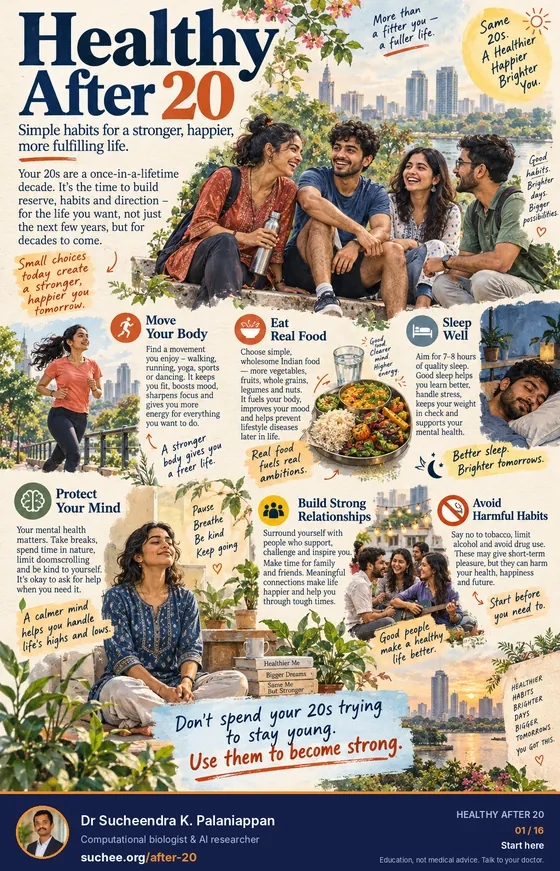
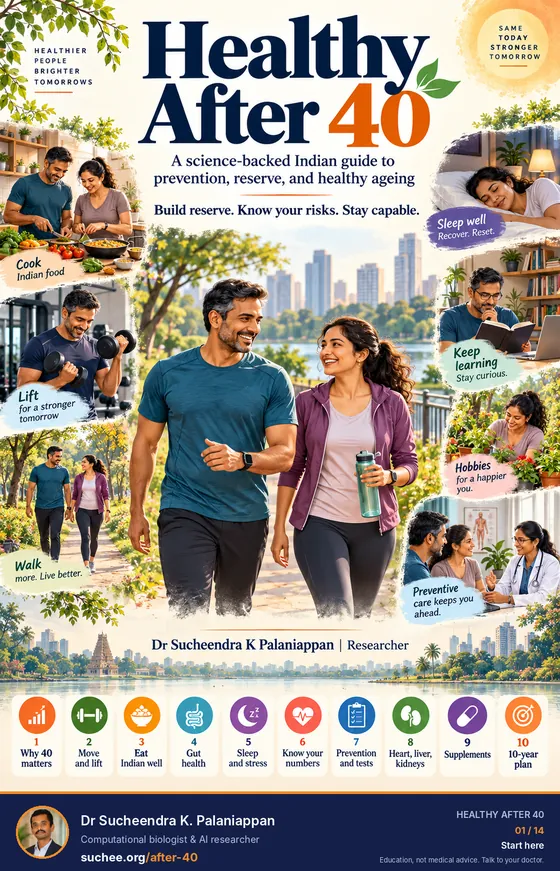
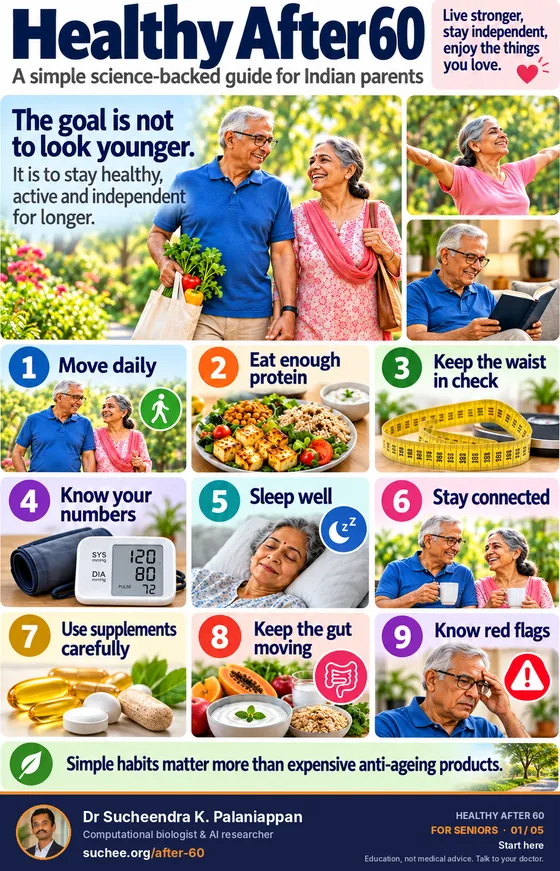
Most longevity news is early. These plain guides cover what is already proven, stage by stage, with Indian sources first.


Sources

Scientist working at the intersection of computation, biology and medicine. Longevity, Interpreted. exists to understand the evidence, not sell an intervention.
All issues · Subscribe · Health by age · suchee.org · LinkedIn · Scholar